Fragnet Schedule in Construction
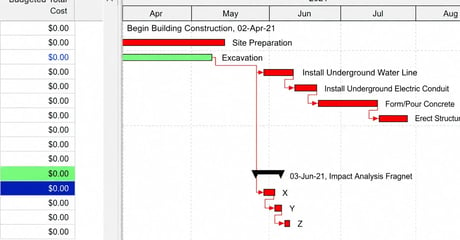
A fragnet schedule is a small network of related tasks, built with its own durations and logical relationships, that gets inserted into a larger project...
Blog

A time impact analysis adds a modeled delay event to an accepted CPM schedule and measures how far the projected project completion date moves. That movement becomes the basis for a time extension request.
Most guidance stops at the mechanics, which are the easy part. Time impact analysis submissions fail far more often because of the schedule underneath the modeled event than because of the model itself.
That distinction is where this article spends its time.
Time impact analysis (TIA) is a forward-looking method for quantifying the effect of a delay event on the project completion date. AACE International's Recommended Practice 52R-06 defines it as a prospective technique that inserts a modeled event into an unimpacted schedule to determine the potential impact on the longest path.
Four terms carry the method:
The output is a number of days measured against the contract date, and it travels with the change order. That number supports a change order request, a time extension, or an internal project management decision about whether to mitigate a potential delay or absorb it. Where the fragnet lands off the longest path, the honest answer is zero days.
The process runs in five steps.
RP 52R-06 tells analysts which schedule to use. It says nothing about whether that schedule is sound enough to carry an analysis. This is the gap where most time extension requests quietly die.
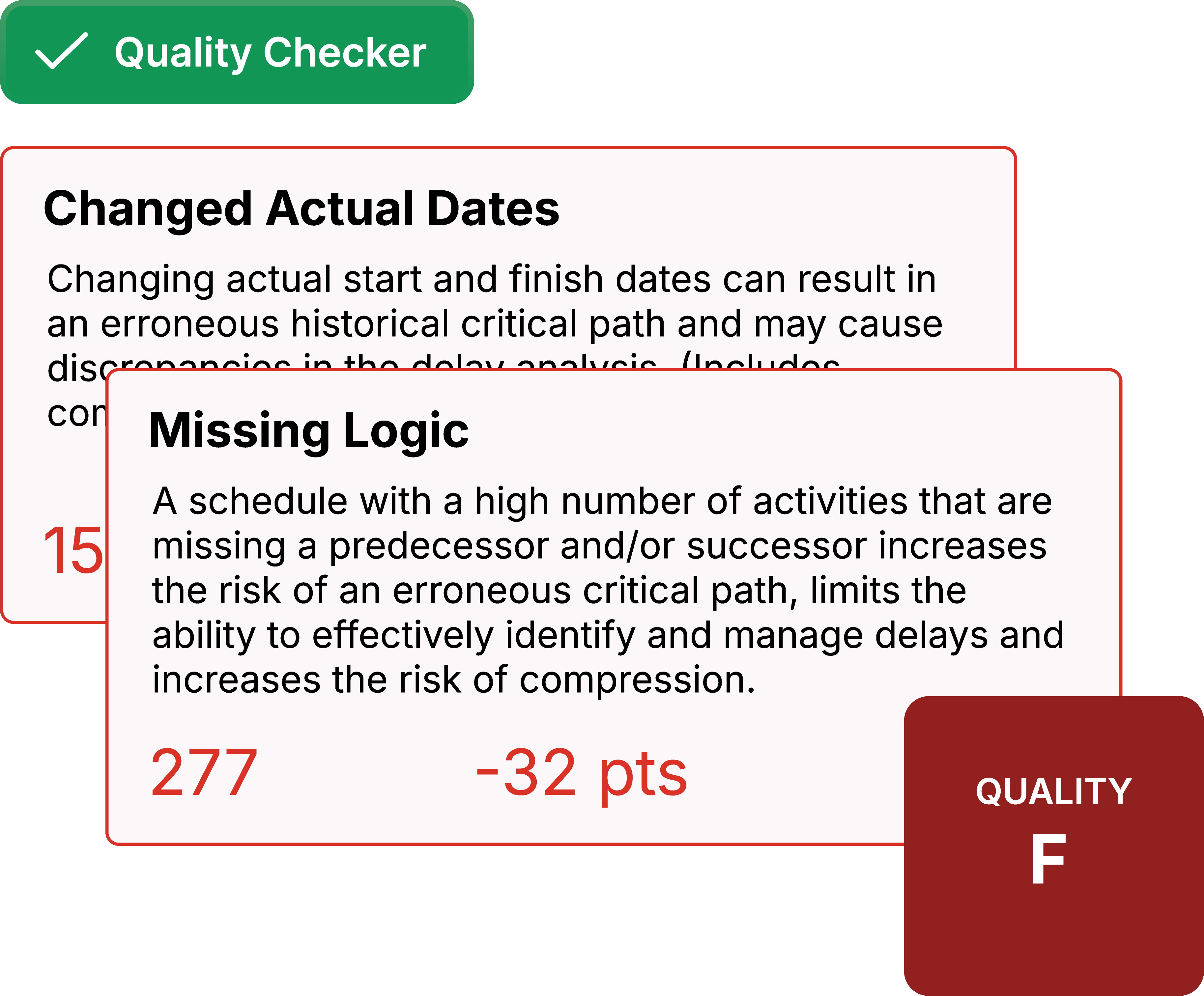
A fragnet only moves the project completion date if the surrounding logic carries the impact to the critical path. Four defects break that chain:
|
Schedule defect |
What it does to the time impact analysis |
|
Open ends |
The fragnet has no successor to push. The delay lands and stops. |
|
Hard constraints |
A Must Finish On date absorbs the impact, reporting zero movement or converting it to negative float. |
|
Negative float |
The baseline schedule already shows a project completion the contractor's plan cannot achieve, so the delta measures nothing. |
|
Missing or excessive logic |
The longest path shifts every schedule update, so no reviewer accepts that one event drove the change. |
None of this is exotic. It is the ordinary condition of most schedules in the construction industry. GAO's Schedule Assessment Guide built ten best practices around these traits, and a schedule that fails them cannot credibly measure anything.
The practical consequence: run quality checks on the unimpacted update before modeling the delay, not after the owner rejects the change order. SmartPM grades every schedule uploaded against 35+ quality metrics, including the DCMA 14-point check, and flags open ends, constraints, and negative float automatically. A D-grade schedule turns a time impact analysis into arithmetic performed on a broken model.
See how SmartPM grades schedule quality before you build a claim. Book a demo.
RP 52R-06 covers prospective TIA, performed while work is ongoing. Retrospective work belongs to RP 29R-03, Forensic Schedule Analysis. A prospective TIA forecasts what an event will do so the parties can settle a time extension before the work is complete. A retrospective analysis reconstructs what occurred using as-built data.
Project managers run into trouble when they file a TIA months after the fact and present it as a forecast. Reviewers and claims practitioners notice. Once actual progress exists for the affected activities, the modeled estimate has to answer to the record, and any gap between the two becomes the other party's argument.
A time impact analysis loses validity as the gap between the delay event and its approval grows. RP 52R-06 states this directly: the longer that period runs, the less useful and valid the prospective TIA becomes, until at some point a retrospective forensic analysis is the more appropriate tool. The Society of Construction Law's Delay and Disruption Protocol puts the same idea in its core principles: do not wait and see on the impact of delay events.
Read together, those two sources describe a decay curve. Immediately after an event, the work plan is frozen and the model reflects the contractor's actual position. Ninety days later, crews have been redeployed, work has been performed out of sequence, and the impact has been absorbed into actual data rather than estimated. Two identical submissions filed at different times are not equally persuasive.
Timing is a project controls discipline problem more than a methodology problem. The teams that file in-period are the teams whose schedule update cadence makes in-period analysis possible.
A TIA quantifies the schedule effect of an event. Entitlement is a separate question, and three parts of it sit outside the method entirely.
RP 52R-06 is direct here: requiring an analysis of concurrent delays as a precondition adds forensic complexity to a process meant to be quick. Concurrent delays get untangled later, under a retrospective method that reads the as built schedule rather than a forecast.
Whether an event was owner caused or contractor caused, and whether the result counts among excusable delays or rises to compensable delay, follows from the contract and construction law. A time extension can be granted with no money attached to it.
RP 52R-06 separates time from cost deliberately, reasoning that quantifying the days first makes the liquidated damages discussion cleaner.
Naming those limits tends to strengthen a submission. Overclaiming invites a line-by-line audit.
|
Method |
What it answers |
When it applies |
Main limitation |
|
Time impact analysis |
What will this event do to project completion? |
During project execution, before the delay fully unfolds |
Models an estimate; sidesteps concurrency |
|
Window analysis |
What caused delay in each period? |
Retrospectively, when reliable schedule updates exist |
Time-consuming; needs complete update data |
|
As-planned vs. as-built |
How did the plan differ from what happened? |
Simple projects, few delay activities |
Shows variance without proving causation |
|
Collapsed as-built |
What would have finished but for these delays? |
Litigation, after completion |
Heavy analyst judgment; frequently challenged |
A deeper breakdown of each approach is available in this guide to CPM schedule delay analysis methods.

Cost per analysis governs how often project management teams run one. Brandon Howell, Vice President of Scheduling at Layton Construction, oversees 170 active projects in SmartPM. A windows analysis that traditionally took his team an estimated 40 hours of dedicated effort spread over two weeks now runs in two hours, a 98% reduction.
That shift is what makes in-period analysis realistic. When quantifying delays takes an afternoon rather than a fortnight, teams evaluate every change order as it surfaces instead of batching them into an end-of-project reckoning. Each event gets a time extension request while the record still supports one.
The same speed changes what a team can say when challenged. On one of those projects, a consultant calculated that Layton had failed to start 85% of the activities it committed to since the previous schedule update, and Layton's own analysis agreed. Filtering the critical path in SmartPM let Howell show that only two of those activities were on it, and that owner delays accounted for the misses. The statement was accurate and the conclusion drawn from it was wrong.
Automated construction delay analysis software does not replace the analyst's judgment about which events matter. It removes the manual work that keeps most teams from doing the analysis while it still counts.
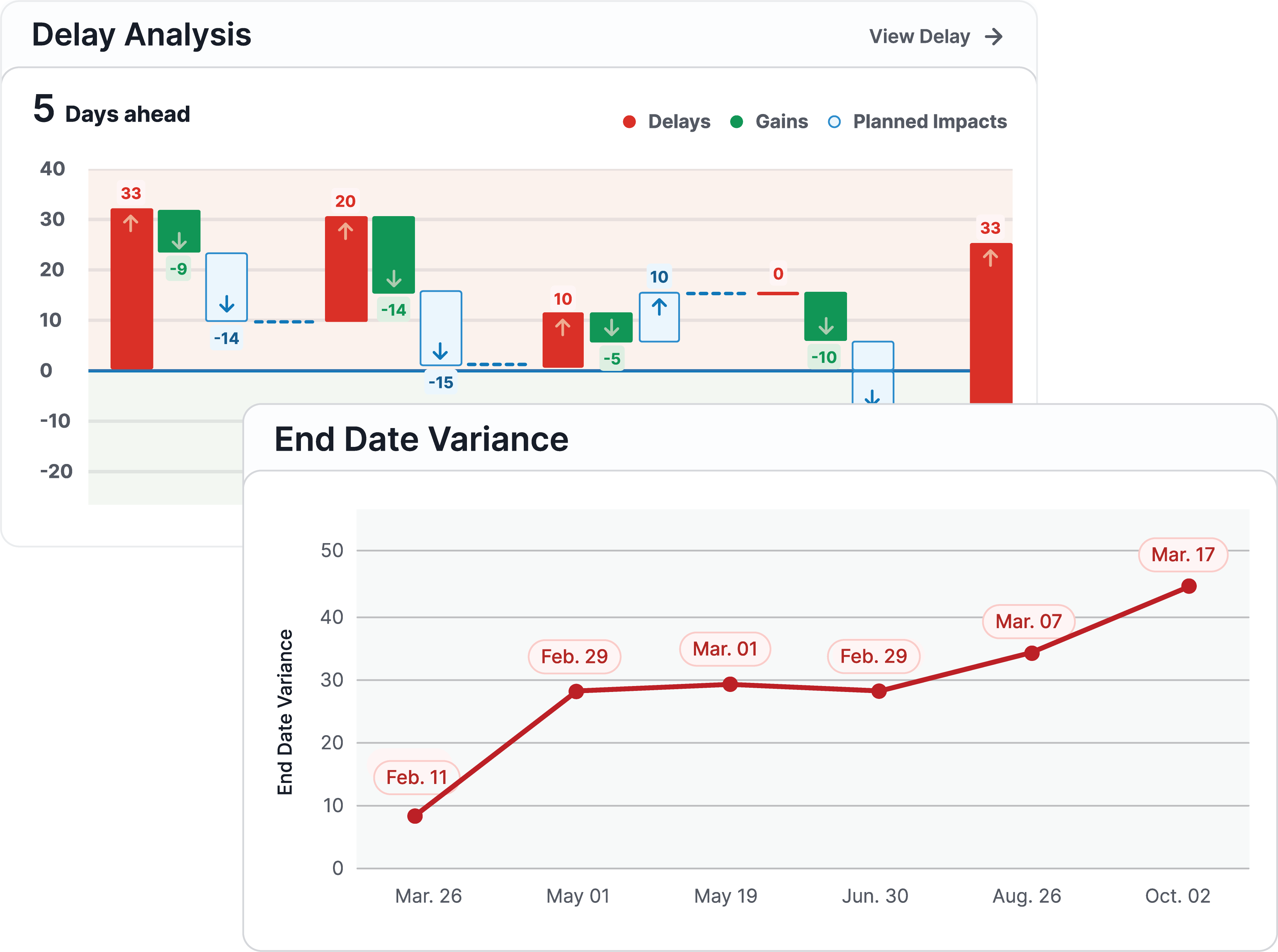
Quantify delay impacts in hours instead of weeks. Request a demo.
SmartPM analyzes every schedule update against 35+ quality metrics and tracks delay impacts as they happen. See it on your projects. Book a demo.