
Construction Delay Analysis for Portfolio-Level Schedule Control
When supported by reliable schedule data, delay analysis enables organizations to understand responsibility early, protect margin, and maintain predictable project outcomes.
Blog
A guide to the methods construction teams use to prove, dispute, and resolve schedule delay claims.

When a construction project finishes late, the real dispute rarely starts with the delay itself. It starts with whose version of the data gets believed.
CPM schedule delay analysis is the discipline that cuts through competing narratives by tracing exactly how, when, and why construction delays affected the critical path. Getting this right protects margins, resolves claims faster, and in some cases, keeps disputes out of court entirely.
This guide covers the main types of CPM schedule delay analysis, how each method works, when to use it, and what separates a defensible analysis from one that falls apart at the negotiating table.
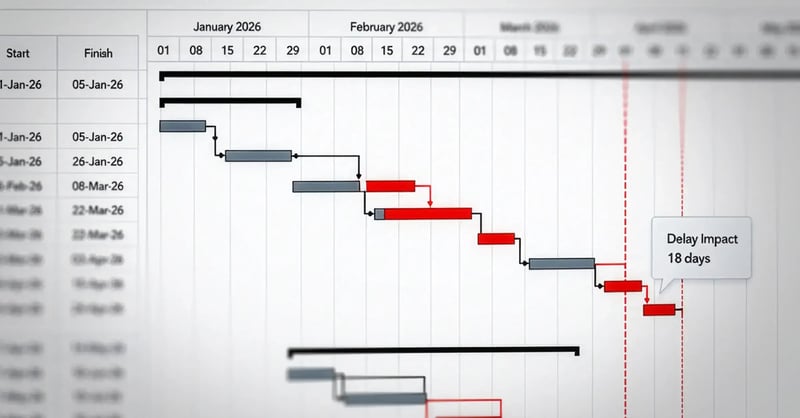
CPM schedule delay analysis is the structured process of examining schedule data to identify which delay events caused a project to miss its planned completion date, and by how much. The foundation is the critical path method (CPM): a scheduling approach that maps every activity in a project, links them through logical dependencies, and identifies the sequence of work that determines the earliest possible finish date.
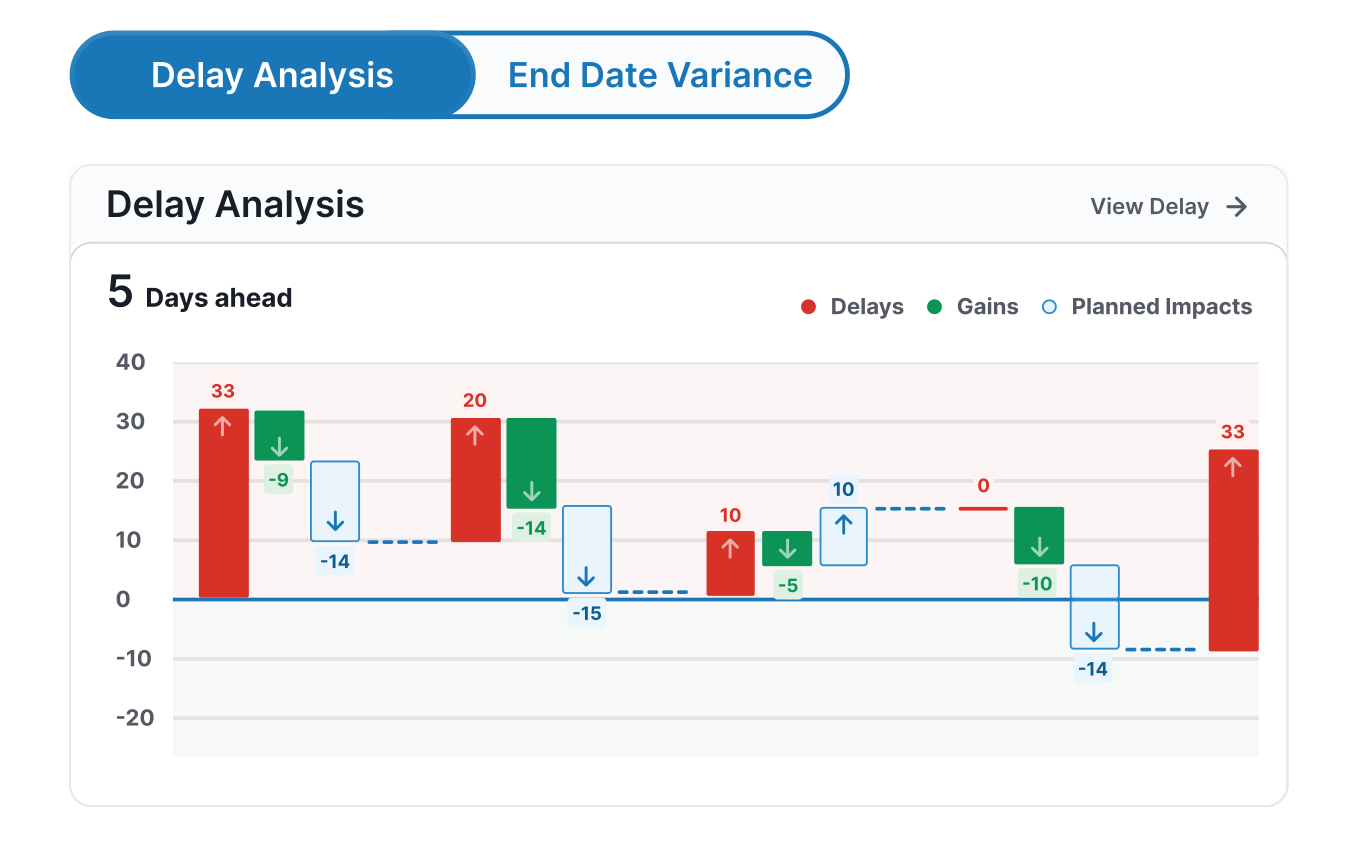
Not all construction delays matter equally. Delays to non-critical activities absorb available float without affecting the end date. Only delays that affect the critical path at the time they occur extend project completion. Ideally, CPM schedule delay analysis focuses on those critical path impacts, quantifying them update by update, and attributing them to specific events or parties.
The same logic drives a what-if scenario, which inserts or removes a single delay event from the CPM network to isolate how much that one event actually moved the finish date.
This discipline sits at the intersection of construction scheduling, project controls, and contract law. AACE International's Recommended Practice 29R-03 serves as the primary industry framework, defining nine method implementation protocols (MIPs) for forensic schedule analysis and the factors analysts must consider when selecting among them.
Here is something most articles on this topic skip entirely: the method you choose matters far less than the quality of the schedule data behind it.
Any forensic schedule delay analysis depends on schedule files that are logically sound, consistently maintained, and free from the errors that quietly corrupt a CPM network over time. Missing predecessor relationships, excessive lags, activities with no successors, hard constraints that override calculated logic, out-of-sequence progress: these issues do not just reduce schedule quality scores. They produce a distorted critical path, which means the delay analysis built on that data is unreliable regardless of how rigorous the methodology.
This is the garbage-in-garbage-out problem that practitioners encounter constantly, and it is why analyzing construction schedule delays starts with checking data integrity before applying any analytical method.
The DCMA 14-point check is the most widely recognized baseline for this evaluation. It flags fourteen categories of schedule deficiency, including missing logic, negative float, and high-duration activities, that signal a schedule may not be reliable for decision-making. However, it’s binary pass-fail evaluation leaves little room for error. That’s why SmartPM's CPM engine runs a custom analysis using over 35 quality metrics on every schedule upload, going beyond the DCMA check to catch patterns that actually correlate with project delay, based on observed data from thousands of real construction projects.
A low schedule quality grade does not mean delay analysis is impossible. It means the results carry higher uncertainty, and any findings will face harder scrutiny.
Among those flags, negative float deserves a closer look before any method is selected, since a constraint changed to clear it can erase the evidence a windows analysis depends on.
The as-planned vs. as-built method compares the original baseline schedule against the documented as-built schedule to identify where the project deviated from plan. It is one of the oldest and simplest approaches to analyzing construction schedule delays.
How it works: Analysts map planned start and finish dates against actual dates for each activity, calculate the variance, and trace those variances to their causes using project records and contemporaneous documentation.
When it applies: This method works best when contemporaneous schedule updates are unavailable or incomplete, and when the project records are detailed enough to reconstruct what actually happened.
Key limitation: As-planned vs. as-built analysis is inherently static. It tells you what changed but says little about the sequence in which schedule delays occurred or how delays on one activity affected the rest of the network. It also assumes the original planned logic remained valid throughout construction, which is rarely the case on construction projects where sequencing and critical paths evolve over time. The theoretical assumptions underlying this approach make it one of the more easily challenged methods in disputes involving complex projects.
Time Impact Analysis (TIA) is primarily a prospective method that inserts a "fragnet," a small network of activities representing a delay event, into the most recent accepted schedule update and recalculates the critical path.
How it works: The analyst takes the schedule as it existed at the time of the delay event, adds the fragnet representing the delay, and recalculates the schedule to measure how much the end date shifts.
When it applies: TIA is the standard method for evaluating change order requests and time extension claims in real time, while the project is still active. Most construction contracts that require schedule updates also contemplate TIA as the mechanism for demonstrating delays. When performed contemporaneously with schedule updates, TIA produces some of the most defensible delay analysis available.
Key limitation: TIA can overstate or understate the impact of a delay event if the underlying schedule does not accurately reflect actual project conditions at the time of insertion. A schedule with inflated logic or unrealistic durations will produce TIA results that are difficult to defend. A more defensible retrospective approach typically relies on contemporaneous updates – often using window-based methods – rather than relying solely on a reconstructed TIA.
The tie-in relationships draw the same scrutiny, since a fragnet schedule connected to an open end or propped up by a new constraint produces movement the underlying logic cannot account for.
Running quality checks on that update before the fragnet goes in is what separates a time impact analysis that survives review from arithmetic performed on a broken model.
Also called the "but-for" method, collapsed as-built analysis works in reverse. It starts with the as-built schedule and removes the delay events attributed to one party (based on the analyst’s assumptions regarding causation) to determine what the project completion date would have been "but for" those delays.
How it works: The analyst reconstructs the as-built schedule, identifies the delay events to be tested, removes them from the schedule, and recalculates. The difference between the actual completion date and the "but-for" completion date represents the time impact of those specific delays.
When it applies: This method is often used retrospectively, after a project is complete, particularly in construction claims and litigation contexts where a contractor needs to demonstrate the impact of owner-caused delays.
Key limitation: The collapsed as-built method requires a high level of analyst judgment in determining which activities to remove and how to model them. Because the analysis is conducted after the fact without contemporaneous schedule updates, results can vary significantly depending on how the "but-for" scenario is constructed. Law firms and arbitrators frequently challenge the assumptions behind this method.
Windows analysis, sometimes called the time-slice or periodic method, divides the project duration into defined windows or time periods and analyzes delay events within each window using the schedule data available at that time.
How it works: The analyst selects analysis windows, typically aligned with schedule update periods, and applies a consistent evaluation methodology within each window. Each window produces an independent finding about delay responsibility during that period. The results are then combined to develop a comprehensive picture of total project delay.
When it applies: Windows analysis is well-suited to complex projects with multiple delay events, concurrent delays, and long project durations. It is the preferred method when contemporaneous schedule updates are available and reliable, since each window is evaluated using the schedule data that existed during that period rather than theoretical reconstructions.
Key limitation: Windows analysis is more time-consuming than simpler methods. It requires complete, consistent schedule update data for each analysis period. Gaps in the update record create gaps in the analysis. That said, when the schedule data is clean and consistent, windows analysis produces the most comprehensive approach to understanding cumulative delay across a project's full timeline.
One important refinement of windows analysis is the use of a “half-step” or “progress-only” evaluation, formally described in AACE RP 29R-03 under MIP 3.4 (Contemporaneous Split).
In real projects, schedule updates rarely reflect pure progress. They often include changes to logic, durations, calendars, or sequencing – some intentional, some corrective, and some questionable.
A half-step analysis separates these two forces:
By isolating progress-only impacts, the analyst can measure how much delay occurred in a “sterile” environment – before accounting for resequencing, acceleration, or logic manipulation.
This matters because many disputes are not about whether the schedule moved, but rather why it moved. Without this separation, analysts risk comparing two schedules that are not equivalent, making it difficult to distinguish real delay from schedule changes that mask or shift responsibility.

The timing of a delay analysis matters as much as the method itself.
|
Prospective Analysis |
Retrospective Analysis |
|
|
When it occurs |
During active construction, in real time |
After substantial completion or project closeout |
|
Primary methods |
Time Impact Analysis (TIA) |
As-planned schedule vs. as-built, collapsed as-built, windows analysis |
|
Goal |
Quantify current delay impact, document time extension entitlement, adjust the schedule |
Reconstruct delay history, attribute responsibility, support or defend a claim |
|
Key limitation |
Requires consistently maintained, high-quality schedule updates |
Quality of analysis depends entirely on completeness of the historical schedule record |
|
What it produces |
Contemporaneous schedule updates that strengthen any future retrospective analysis |
A structured account of how and why construction delays accumulated over the project |
In practice, the two approaches often work together. A contractor may perform TIA prospectively during construction and then combine those findings with retrospective windows analysis after completion to address cumulative delay claims.
The most defensible delay analyses draw on both contemporaneous schedule updates and a structured retrospective methodology. Construction schedule delays documented as they occur are far easier to attribute than those assembled later from incomplete records.
A defensible delay analysis is not just technically correct. It has to hold up when the other side's experts review it.
Several factors determine whether a forensic schedule analysis survives scrutiny.
This comes first. If the schedule files underlying the analysis have quality problems, those problems will be exposed. Analysts on the opposing side are looking for exactly this. Clean, consistently maintained schedule data is the foundation everything else rests on.
The stronger the link between the delay analysis and documented events during construction, the harder the analysis is to challenge. Project records, meeting minutes, RFI logs, change orders, and daily reports all strengthen the evidentiary basis.
Applying the same methodology uniformly across all events and all parties involved avoids the appearance of selective analysis. Inconsistency is one of the fastest ways to undermine an otherwise credible finding. Fundamentally, a delay must affect the critical path at the time it occurs to be considered a project delay. Analyses that fail to demonstrate this linkage – regardless of method – are unlikely to hold up under scrutiny.
The analysis should be reproducible. If the other side ran the same data through the same methodology, they should arrive at comparable results. Analyses that cannot be independently verified rarely survive arbitration or litigation.
The Columbia Ventures case illustrates why this matters. When a GC brought a delay claim against the developer at the end of a late-finishing urban multifamily project, Columbia Ventures used SmartPM to study the schedule update history, track critical path impacts, and document what actually occurred. Josh Thigpen, Senior Development Manager and Partner at Columbia Ventures, brought visual data to the negotiating table showing all pertinent workflows and critical path movements. The GC could not counter the findings because the analysis was built on their own schedule files. As Thigpen noted, the data "removed emotion in order to let the facts and data dictate negotiation." The parties avoided litigation entirely.
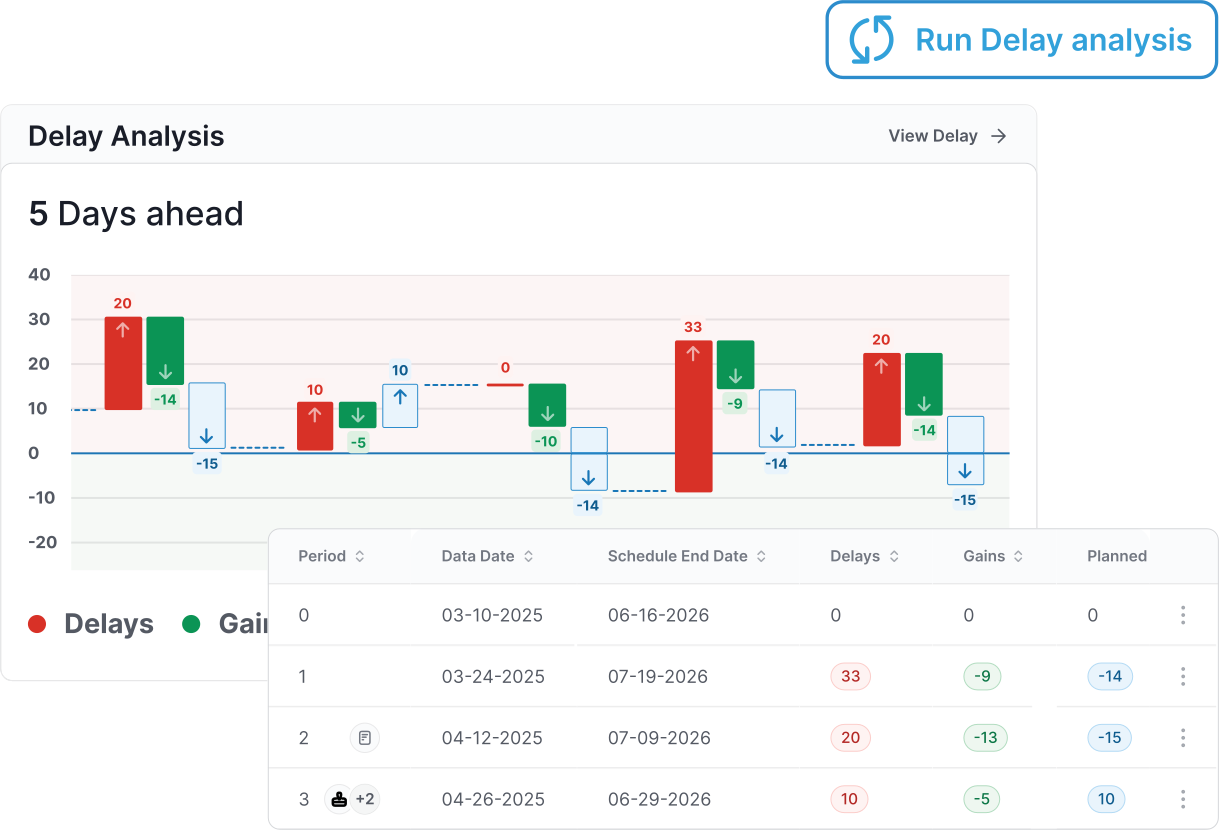
See how SmartPM builds the audit trail that supports defensible delay analysis. Book a demo.
Garver an engineering, planning, and environmental services firm, supports state DOT programs across the South and Midwest with scheduling and project controls. The team frequently acts as the owner's representative on highway and infrastructure projects, reviewing contractor schedules and diagnosing risks throughout construction.
Before SmartPM, reviewing contractor schedule updates was a manual, time-consuming process that often produced disagreements rather than resolution. As Chris Taylor, a Garver scheduling professional, described it: the team would spend weeks comparing updates and still find themselves arguing about the math with contractors who took the findings personally.
The dynamic shifted when Garver standardized on SmartPM for their schedule reviews. Every update was evaluated against the same criteria, and the results were presented in a format all parties could see and understand. When a TIA was needed, the team could run the analysis in the platform, check the critical path and concurrency, and reach agreement on time and cost steps in a fraction of the time. A TIA process that previously took approximately a month was resolved in roughly 15 minutes after both sides reviewed the data together.
Across a 10-year, 32-project Arkansas DOT program, the outcome was clear: approximately 90% of projects finished on time or early, and accurate claims and planning contributed to over $55M in documented results for the program.
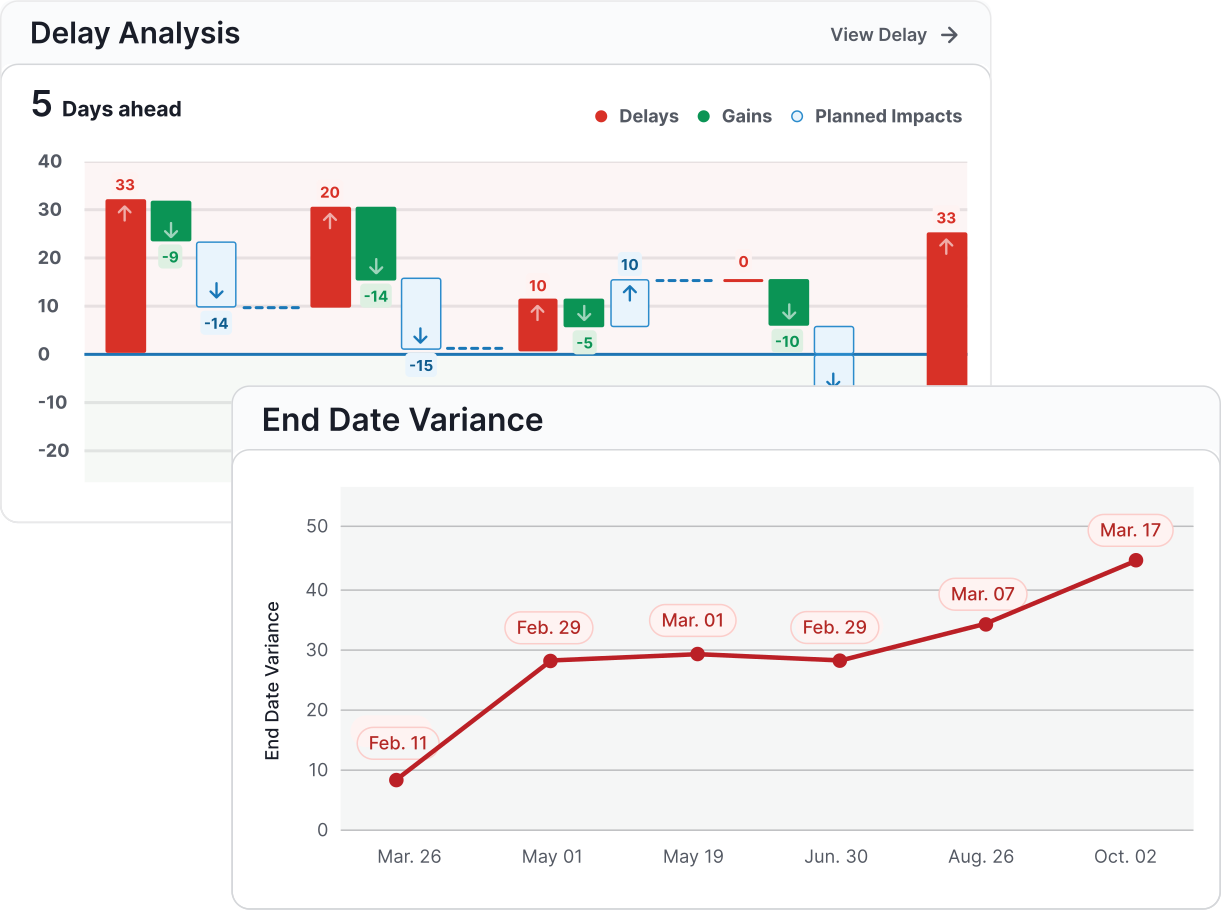
Forensic schedule analysis has traditionally been reactive. A project falls behind, finishes late, and both sides retain experts to reconstruct what happened. The process is expensive, slow, and often produces competing analyses that neither side fully accepts.
The more durable approach treats CPM schedule delay analysis not as a post-project exercise but as an ongoing discipline during construction. Every schedule update is an opportunity to identify delay events, document their impact on the critical path, and build the contemporaneous record that makes any future analysis cleaner and more defensible.
This is the philosophy behind how construction delay analysis software built on a true CPM engine works in practice. Rather than exporting raw schedule files into a separate tool when a claim arises, construction teams maintain continuous analytical visibility across every update period. Delay accumulation is tracked from the first update. Schedule quality is scored at every submission. When a dispute does occur, the evidentiary foundation is already built.
For mid-market general contractors who have not historically maintained this kind of analytical discipline, the starting point is often simpler than expected: enforce consistent schedule quality standards, maintain regular update cadences, and treat each update as a document with evidentiary value, not just an internal planning tool.
For owners managing multiple contractors or programs, schedule performance visibility for owners and developers provides the same analytical lens on the contractor side of the relationship, enabling informed oversight without requiring deep scheduling expertise.