

SmartPM’s End of the Year Review 2024
Enjoy this look back on the trends, features, and milestones that helped the industry achieve smarter project management in 2024.

Blog

Aconstruction milestone schedule is a high-level view of a project's most important dates: the handful of moments that prove real progress. It strips a dense CPM network down to the key events an owner, a project manager, and the field all care about, from permits to substantial completion.
Done well, it keeps everyone on the same page and flags trouble early. Done as a wish list of dates with nothing behind them, it becomes one of the most misleading project documents on the job. The difference comes down to the schedule underneath.
This guide covers what a milestone schedule is, how it relates to Gantt charts and the critical path method, real construction milestone examples, and how to keep milestone dates defensible once the construction project starts.
A construction milestone schedule is a summary of the project milestones that mark major progress points across the project life cycle, each tied to an exact point in time rather than a span of work. Unlike project tasks, which represent the daily activities crews perform, a milestone is a significant event with zero duration: a due date, not a chunk of work.
The Project Management Institute defines a milestone as the planned completion of a significant event, not the completion of every task. That distinction matters on a construction project, where thousands of activities roll up into a small set of significant checkpoints.
A milestone schedule sits above the level where project tasks break into smaller activities, giving stakeholders involved a shared reference without drowning them in detail. It complements the detailed scheduling methodologies the team uses to build the plan rather than replacing them.
These project management milestones give owners, the project team, and trade partners a common language for project progress. On complex projects, a project plan can hold hundreds of lines, and the milestone schedule answers the question everyone actually asks: are the key project deliverables still on track? Sound project management depends on that shared view of the key milestones.
A milestone schedule shows the destinations; Gantt charts and the CPM project schedule show the road that gets you there. On Gantt charts, work appears as horizontal bars across a project timeline, and each milestone appears as a diamond, or milestone icon, with zero duration. Milestone charts are the simplest expression of that view: strip away the bars, keep the diamonds, and you have a clean summary of key dates for reporting.
Here is the part most guides skip. A milestone date is an output of the critical path method logic beneath it, not a number a project manager types in by hope. The critical path is the longest chain of dependent critical tasks that determines the project's shortest possible duration. Every meaningful milestone should sit on or near that path.
Linking milestones to their true predecessors and successors is what makes the date mean something. A milestone with no logic behind it will not move when the work slips, so it quietly misleads everyone reading the plan.
Scheduling tools, project management software like Primavera P6 and Microsoft Project, build the project schedule and its Gantt charts. SmartPM does not replace them. It is a construction schedule analytics platform that sits on top of those tools and analyzes whether the logic driving your milestone dates is sound in the first place.
The clearest way to understand a milestone schedule is to see common project milestones examples across the phases of a real build. The table below shows milestone examples from the initiation phase through project completion.
|
Project phase |
Milestone example |
Why it matters |
|
Initiation |
Project kick off meeting held; Notice to Proceed issued |
Sets the official start and the contract clock |
|
Preconstruction |
Permits secured; client approval of design |
Removes a common source of early delay |
|
Foundations |
Site prep complete; foundation complete |
First proof the plan matches the field |
|
Structure |
Building enclosed (dry-in) |
Weather-sensitive trades can begin |
|
Systems |
MEP rough-in complete |
Gates inspections and finishes |
|
Closeout |
Final inspections passed; substantial completion |
Triggers occupancy and beneficial use |
|
Handover |
Final completion; owner handover |
Marks project completion and closes the contract |
These milestone examples apply to most vertical construction, though the exact set shifts by sector and delivery method. Milestone charts built from this set help teams determine major scheduling periods for billing and reporting, since payment applications and owner reviews often align to these key dates.
Not every milestone carries the same weight, so grouping them by type keeps priorities clear. Contract milestones are written into the agreement and often carry liquidated damages, which makes their end dates legally significant.
Interim milestones are internal targets the project team uses to stay ahead of the final deadline. Owner and regulatory milestones, such as inspections and payment milestones, round out the set. Knowing which of these dates trigger money or penalties tells a project manager where to focus first.
To create a milestone schedule that holds up, start from the project charter and project scope, map the major project phases, then work down to the logic rather than the other way around. Those dates are only as reliable as the CPM schedule feeding them, so the sequence below protects both.
A project milestone template can speed up the first draft, but a template is a starting point, not a substitute for sound logic. The federal GAO Schedule Assessment Guide lays out ten best practices for building reliable schedules and verifying the integrity of received ones, and a defensible milestone schedule reflects those same principles.
The best milestone charts mirror the live CPM project schedule instead of living in a separate spreadsheet. When milestone charts are maintained by hand, they drift from the real project plan the moment the schedule updates. A milestone chart helps only when its dates come from the same logic the field is working to, so any project management tools you use should keep the two connected.
See how SmartPM grades the schedule behind your milestone dates. Book a demo.
To manage project milestones during construction, track completed milestones and slippage against the baseline at every update, not just at month end. The baseline is the approved original plan. Each progress update is a new snapshot, and the value comes from comparing the two: if one milestone slips, does the next milestone still hold, and is the final deadline at risk?
This is where automated analysis changes the cadence. Manual milestone tracking is slow, so many teams update monthly, by which point the window to react has closed. Analyzing every update lets a project manager see movement across the project timeline while there is still time to protect the project budget, the project plan, and the project schedule.
SmartPM's automated schedule reporting produces this comparison in minutes, turning project tracking from a lagging report into an early warning system that flags a dependency blocking team members downstream.

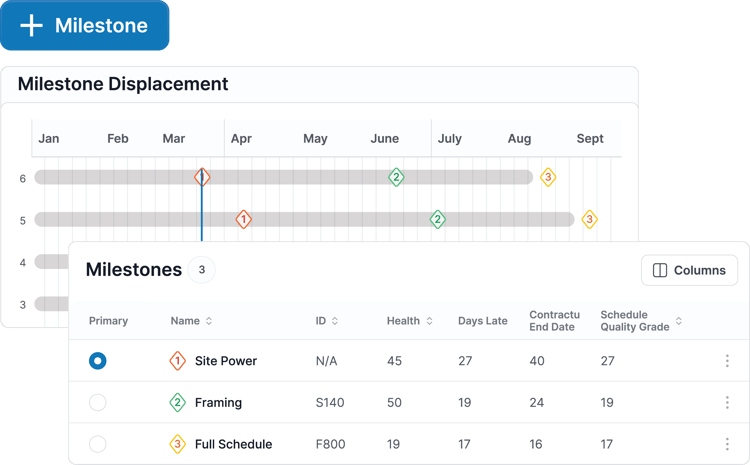
When a milestone slips, defending the date requires showing exactly which critical path activities caused the movement and when. A moved milestone does not prove a claim by itself; the evidence behind it does.
SmartPM performs critical path delay analysis that quantifies delay period by period against the baseline, so the record is built in real time rather than reconstructed under pressure. For teams facing disputes, the AACE International recommended practices for forensic schedule analysis define the methods that hold up in review, and consistent update-by-update analysis is what makes that standard achievable.
Satterfield & Pontikes Construction, an ENR Top 400 firm and SmartPM customer, credits the platform with helping the team develop higher-quality baseline schedules and mitigate end-date slippage to deliver on time. Better baseline quality is exactly what makes a milestone date defensible when questions arise.
SmartPM is the analytics layer that tells you whether your milestone dates can be trusted and warns you early when they cannot. Its proprietary CPM engine runs more than 35 schedule quality metrics, including the DCMA 14-point check, against every schedule update, so weak logic that would distort milestone dates surfaces before it misleads the team.
From there, teams monitor project milestones across an entire portfolio, watch delay accumulate against the baseline, and track projects without building reports by hand. That is project management grounded in analyzed data, not assumption.
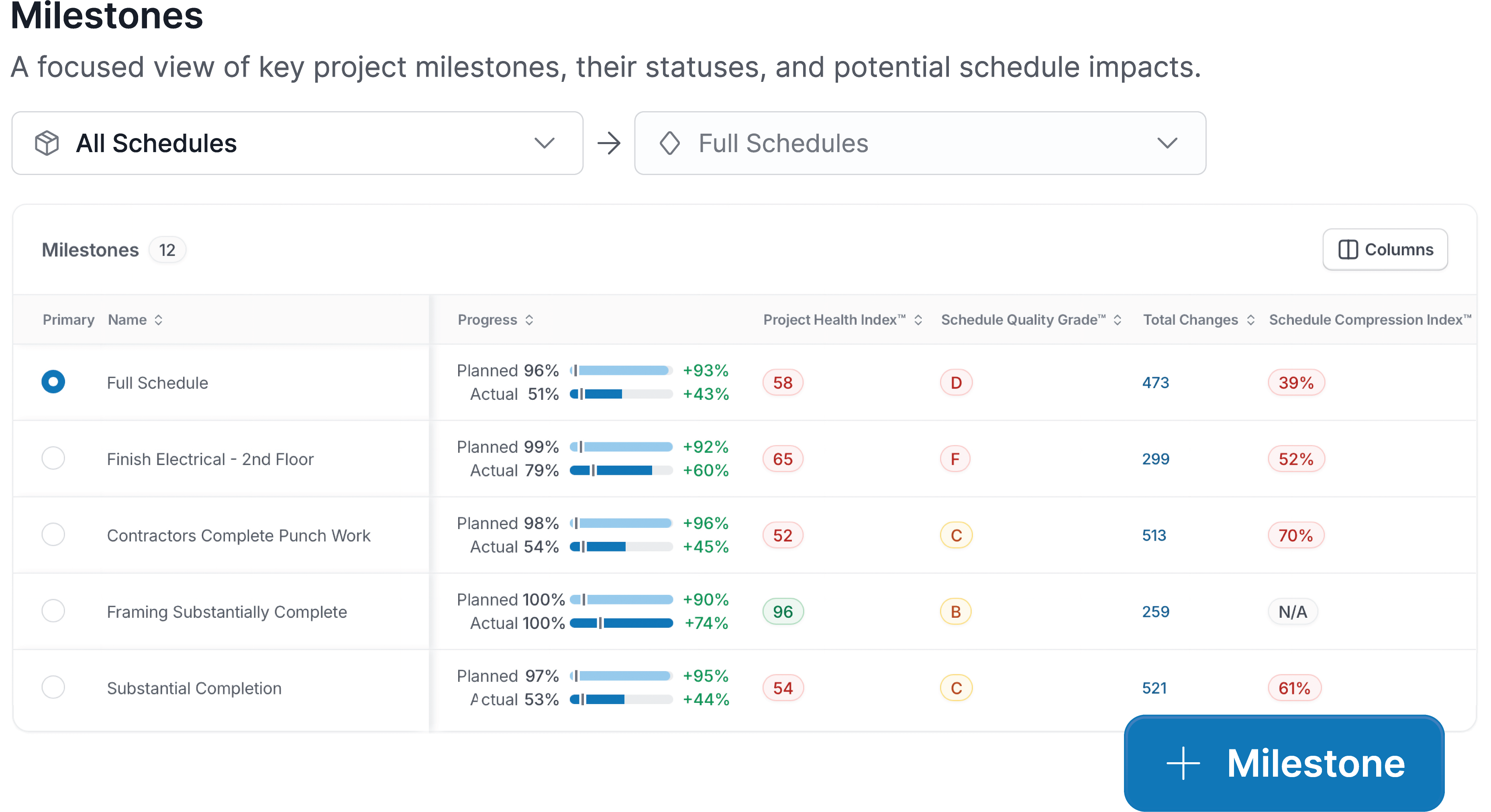
For a project controls team, reliable project milestones mean decisions backed by evidence. For an owner, it means the transparency of independent project management oversight: trust, but verify what a contractor's schedule reports.
Put your milestone dates on a foundation you can defend. Request a SmartPM demo.
A milestone schedule is only as reliable as the schedule behind it. See how SmartPM analyzes yours: Book a demo.