
What Is a Construction Schedule Risk Analysis?
Schedule risk analysis is how project controls teams stop guessing and start knowing where their CPM schedule is most likely to break down.

Blog

A baseline schedule is the approved version of the project schedule, frozen before work starts. An updated schedule is that same project schedule after actual progress, revised remaining durations, and a new data date have been applied. The difference between the two project schedule files is what most teams report as variance.
That definition is where most articles stop. The useful part starts there, because the comparison holds only if both files describe the same job.
Per SmartPM's 2025 State of Construction Scheduling Report, 76% of construction projects finish later than their original baseline. Knowing how much of that slip came from the work and how much came from quiet changes to the project plan is where project controls teams keep control or lose it.
A baseline schedule is the approved project schedule that becomes the fixed reference point for measuring project performance. Once key stakeholders accept it, the project baseline schedule stops changing. Every later forecast, delay calculation, and time extension request is measured against that project schedule baseline.
The schedule baseline sits alongside the cost baseline and the scope baseline in the performance measurement baseline. Project managers measure time against the schedule, spend against the cost baseline, and work against the scope. The schedule baseline gets tested first, because dates surface problems before costs do.
Federal contracts make this explicit: contractors submit a project baseline schedule for acceptance before progress payments begin, then monthly updates against it, per the Unified Facilities Guide Specifications for network analysis schedules.
Creating a project baseline follows the standard CPM scheduling sequence. Identify tasks through a work breakdown structure and WBS dictionary that ties each project element to the scope statement. Set activity durations, assign resources, and tie logic so dependent tasks reflect how crews build the job. Add schedule milestones and contractual end dates. Check the critical path, then submit the initial project schedule for approval.
Duration estimating leans on analogous estimating: planned durations come from historical data on similar projects. That works when the reference jobs resemble the current project scope, crew sizes, and resource constraints. It fails when they do not, and inflated durations are usually the first thing compressed once the job slips.
An updated schedule is the current project schedule after the team records what happened and recalculates what remains. Each cycle applies actual start and finish dates to completed tasks, revises remaining durations on work in progress, advances the data date, and recalculates the forecast completion date.
The updated schedule is a live model of the actual project. Comparing planned versus actual progress shows where the work stands today and where it lands if performance holds. The project baseline answers what everyone agreed to.
|
Baseline schedule |
Updated schedule |
|
|
Purpose |
Records the approved plan |
Reports actual progress and forecast |
|
Created |
Before construction starts |
Every update cycle |
|
Contains |
Planned dates, logic, durations |
Actual dates, remaining durations, new data date |
|
Approved by |
Owner or contracting officer |
Reviewed each cycle, rarely re-approved |
|
Changes |
Only through a formal re-baseline |
Continuously |
|
Used in a claim |
Proves what was promised |
Proves what occurred |
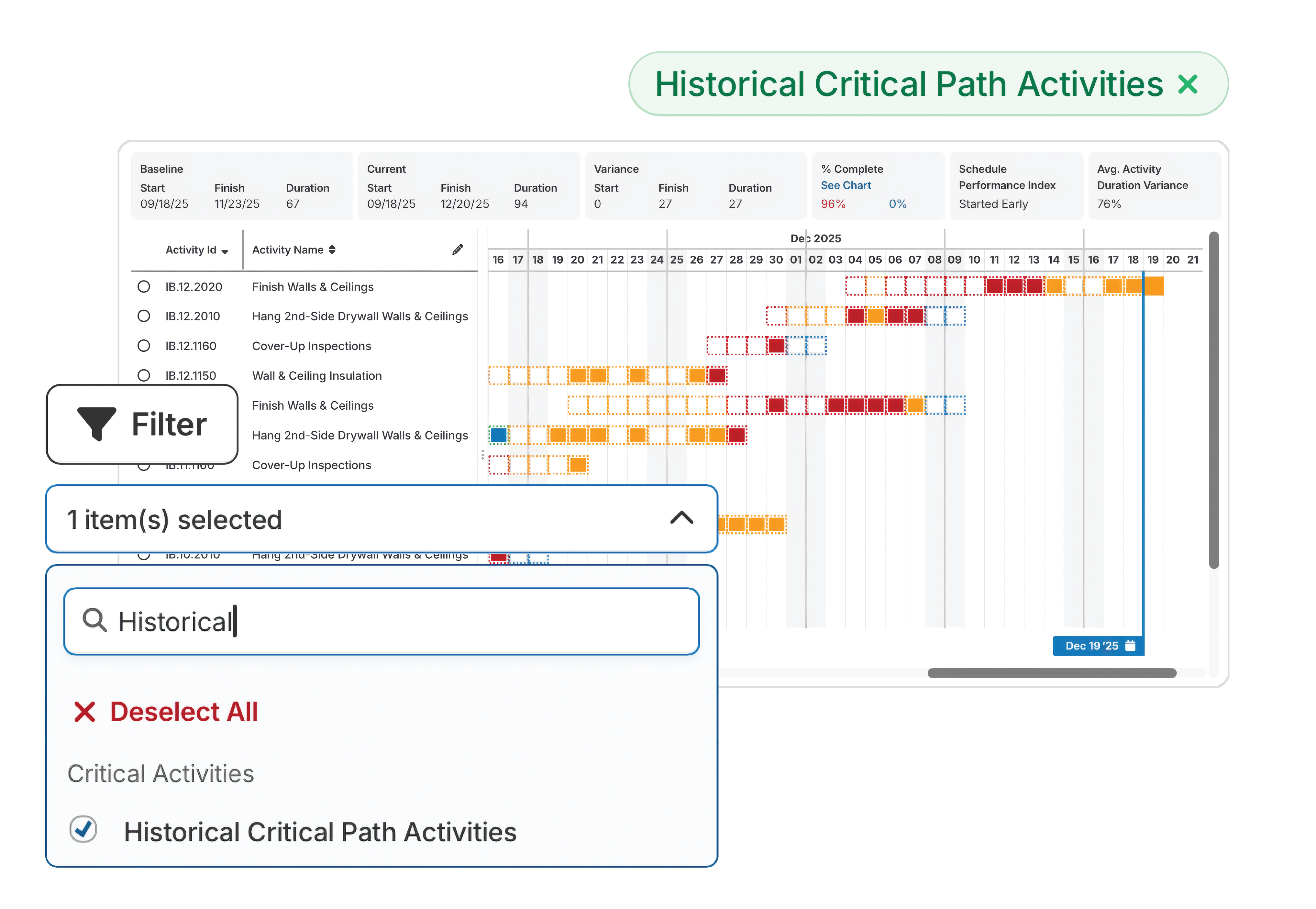
The variance between a baseline schedule and an updated schedule answers two separate questions, and most teams only measure one. Schedule variance measures that gap in days; a Schedule Performance Index below 1.0 expresses it as a ratio.
The first question is how much the work slipped. Crews started late, production ran below plan, an inspection took three weeks.
The second question is how much the plan changed. Tasks were added, logic was re-tied, remaining durations were shortened to hold the contract date, constraints were added to force finish dates the logic no longer supports.
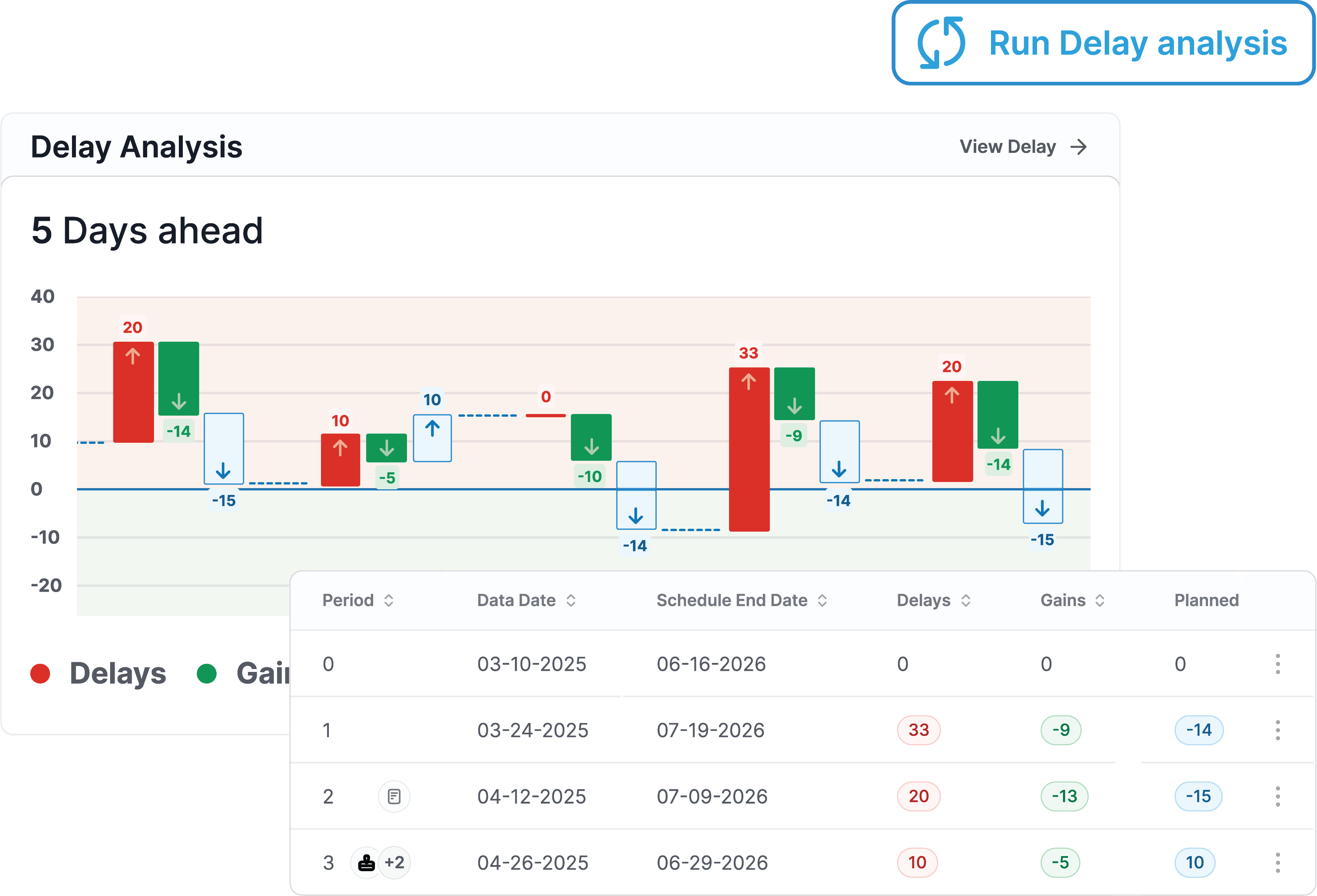
Both change the same variance number. Only the first is about the field. A team reporting a 14-day slip without separating the two hands leadership a figure that blends what happened to the work with what happened to the project schedule baseline. Project managers make recovery adjustments off that figure.
When asked how a project baseline most commonly stops being a valid comparison point in forensic analysis, and around which update cycle that typically happens, Mike Pink, the CEO of SmartPM says:
It drifts whenever the plan gets edited rather than executed. SmartPM's 2025 report found that only 12% of baseline schedules meet quality standards at the outset, and fewer than 5% hold that quality through closeout. The project plan degrades as the job runs.
Five mechanisms account for most of it:
Satterfield & Pontikes Construction hit this before adopting SmartPM. Their Director of Scheduling, Seth Jeffrey, put it plainly: "We had no visibility into our activity start and finish distribution as compared to the baseline plan." Determining which changes caused it was harder.
Schedule quality analysis scores each update against the same metrics as the project schedule baseline, so a falling grade flags a plan being edited rather than executed.
.jpg?width=1200&height=800&name=SmartPM%20Dashboard%20(1).jpg)
Monthly is the contractual standard on most construction projects; weekly or biweekly protects the budget. Detection lag is the real cost: a problem found on a monthly cycle has had 30 days to compound before project managers can act.
Re-baseline when the original baseline no longer describes the work in a recoverable way: major scope additions, heavy resequencing, or negative float so deep the plan cannot reach a believable date.
A re-baseline resets the reference point, and accumulated delay against the original baseline goes with it. AACE International's recommended practice on forensic schedule analysis treats the schedule baseline and every update as the evidentiary record behind a delay claim.
Keep the original baseline intact and create a new one alongside it, so the project holds both records: what was promised at award, and what the team manages to now.
When asked what question he asks first when a team considers re-baselining, and what answer signals that they should not do it, Mike Pink, the CEO of SmartPm, says:
See how SmartPM separates work slippage from plan changes on your projects. Book a demo.
Five project management habits keep the comparison honest through the execution phase:
SmartPM is a schedule analytics platform, not a scheduling tool. It sits on top of Primavera P6, Microsoft Project, and Phoenix, reading files they already create.
Import the schedule baseline, then each update; a Gantt chart overlays the two. SmartPM's proprietary CPM engine recalculates the network, grades every file against 35+ schedule quality metrics including the DCMA 14-point check, and attributes delay by cycle against the performance measurement baseline. Teams see which portion of the variance came from performance and which came from plan changes, without building the comparison by hand.
The same team later reported that "the platform has helped us develop higher-quality baseline schedules."
A project baseline stays useful only while it stays fixed and updates stay comparable. Teams tracking those separately catch problems while fixes are cheap. Teams reporting one blended variance find out at closeout.
Request a demo to see how SmartPM grades your baseline and every update against it. Book a demo.