

The Top 5 Breakdowns in Construction Schedule Management
Schedule management involves navigating a complex landscape of risks that can significantly impact project budgets and timelines.

Blog
Schedule risk analysis is how project controls teams stop guessing and start knowing where their CPM schedule is most likely to break down.

Construction schedule risk analysis is the process of identifying, evaluating, and responding to threats that could push a project past its planned completion date. On any active construction project, the schedule is never static. Scope changes, subcontractor performance issues, procurement delays, weather, and design gaps all create schedule risk, often before anyone on the project team recognizes what is happening.
The problem is that most teams only look for risk after they already feel it. By then, the float is gone, the critical path has shifted, and the options for recovery are expensive.
Construction schedule risk analysis, done correctly, is what prevents that sequence from playing out.
Schedule risk analysis measures the gap between what the project plan says will happen and what is realistically likely to happen, given current conditions and the structure of the CPM schedule.
At the schedule level, this means evaluating which activities carry the most potential to affect the project completion date. That includes activities on the critical path, where zero float means any delay translates directly to a late finish. It also includes near-critical activities, which carry small float buffers that can erode quickly under normal project pressure.
Beyond individual activities, schedule risk analysis looks at the health of the schedule as a system: how logic paths are connected, whether float values are realistic, whether the critical path is stable across updates, and whether compression is building up in ways that suggest the team is absorbing delay rather than reporting it.
This is distinct from a general project risk register, which catalogs broad risk categories. Schedule risk analysis is specifically focused on the CPM schedule as a data source, asking: what does the schedule itself tell us about where this project is vulnerable?
Inside a project risk management plan, schedule risk analysis is the component that ties that register to hard CPM data, so float erosion and critical path shifts get scored alongside every other risk.
Schedule risk that goes undetected does not stay small. A two-week float erosion trend that nobody flags in month two can quietly become a six-week delay by month five, at which point recovery requires significant acceleration cost, if it is possible at all.
Erosion that continues past zero produces a finish date the logic can no longer support, which is a different problem from a shrinking buffer and calls for a different response.
The financial exposure is real. Liquidated damages clauses are standard in commercial construction contracts. Cost overruns from delay-driven acceleration, extended general conditions, and subcontractor claims compound quickly. Every day a project runs past its contractual completion date carries direct cost consequences.
Beyond the immediate project, there are relationship and reputational stakes. Owners who feel they received inaccurate schedule reporting are not easy to bring back. General contractors who consistently miss completion dates lose their standing with both clients and bonding companies.
Because those stakes cut across cost, schedule, and reputation, evaluating embedded schedule risk belongs inside the wider review a project team runs before and during the job, not off to the side as a separate exercise.
Reactive analysis, reviewing what went wrong after the project finishes, cannot change those outcomes. It only explains them. Construction schedule risk analysis, conducted throughout the project lifecycle, creates the window for informed decisions while there is still time to act.
A what-if scenario analysis is what fills that window, letting the team test a recovery move against the current schedule before any resources are committed to it.
Responsibility for schedule risk analysis does not belong to one person. It is distributed across roles, and the breakdown matters.
The scheduler is responsible for building and maintaining a CPM schedule that is analytically sound. If the schedule has missing logic, inflated float, or hard constraints masking the real critical path, any risk analysis performed on it will be unreliable. Schedule quality is the prerequisite, and the scheduler owns it.
The project controls manager is responsible for interpreting schedule data across updates, identifying risk patterns, and surfacing findings to decision-makers in time to act. This role connects raw schedule outputs to project management decisions.
The project manager or project executive is responsible for acting on risk information, directing recovery efforts, and communicating schedule status accurately to owners and stakeholders.
At large ENR Top 100 firms, these are distinct roles with dedicated headcount. At a mid-market GC managing multiple projects with limited resources, one person may carry all three. The risk is that when roles collapse, the monitoring function gets deprioritized in favor of active project management. Weekly schedule review falls to monthly, and monthly review consistently catches problems too late to fix cheaply.
At the portfolio level, someone with authority across projects, typically a VP of Operations or Director of Operations, needs visibility into risk patterns that are systemic rather than project-specific. Recurring delay drivers, chronic schedule quality issues, and compression trends that repeat across jobs are signals that require executive-level response, not just site-level adjustment.
Mike Pink, the CEO of SmartPM, says:
“When schedule risk analysis breaks down, it’s rarely because the risk wasn’t there — it’s because nobody owned the process of surfacing it. The scheduler may be updating, the project manager may be focused on execution, and leadership assumes everything is fine. That gap is where risk lives. If no one is accountable for interpreting the schedule and pushing uncomfortable insights to decision-makers, the project shifts from proactive management to reactive recovery — and by then, the options are limited and expensive.”

Here is the part most articles on this topic skip entirely: schedule risk analysis is only as reliable as the schedule it runs on.
Running a schedule quality checker against the baseline before any risk analysis begins is the fastest way to confirm whether the data can actually support the conclusions being drawn from it.
A CPM schedule with poor logic, excessive constraints, or inflated float does not accurately represent the project. When risk analysis is performed on that schedule, the outputs are wrong. Float values that suggest a comfortable buffer may actually be masking a fractured critical path. Activities that appear non-critical may be driving real delivery risk that the schedule cannot surface because the logic is incomplete.
According to SmartPM's 2025 State of Construction Scheduling Report, only 12% of baseline schedules meet best-practice quality standards. Fewer than 5% maintain that level of quality through project closeout. That means the overwhelming majority of construction schedule risk analysis in the industry is being run on data that cannot support reliable conclusions.
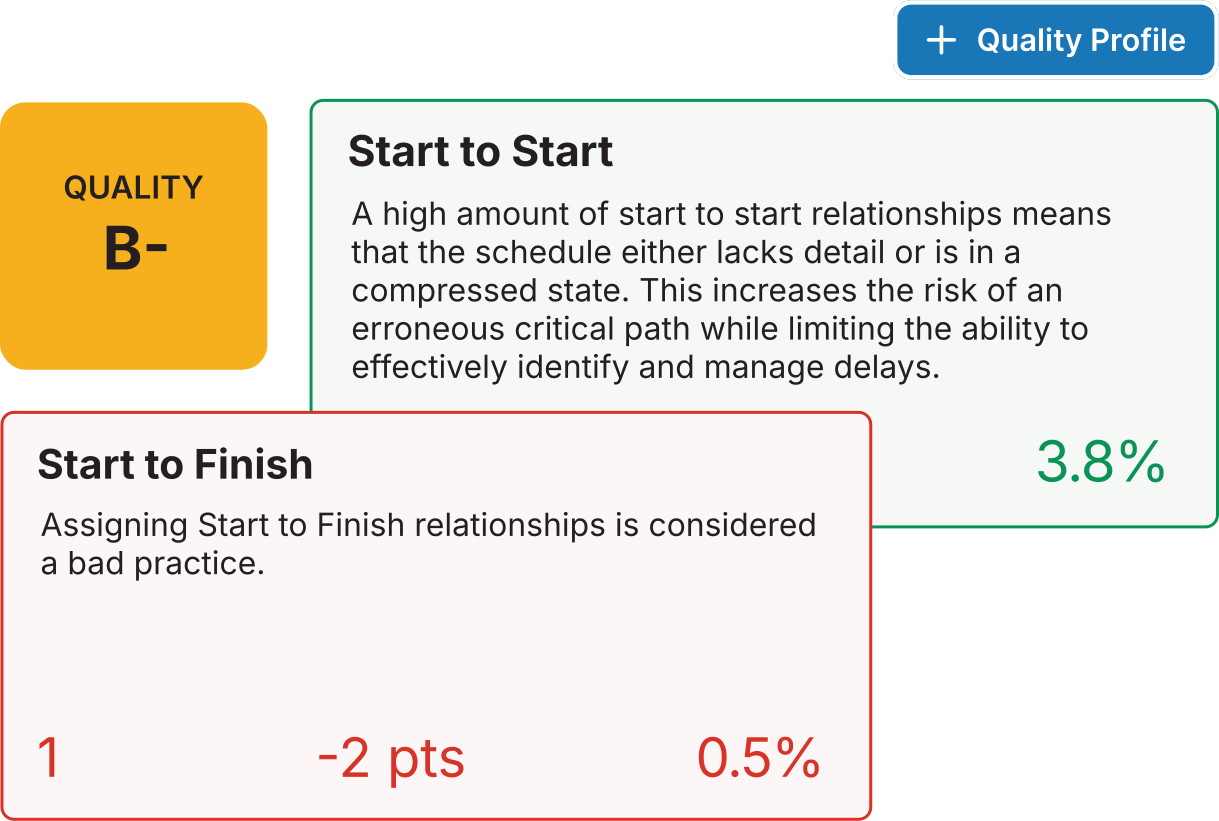
The DCMA 14-point assessment is the baseline industry framework for evaluating CPM schedule quality. It checks for missing logic, improper constraints, excessive float, negative float, out-of-sequence progress, and other structural issues that undermine schedule reliability. Passing those checks is not the ceiling for schedule quality; it is the floor.
SmartPM's schedule quality analysis approach goes beyond the DCMA framework with 35+ metrics drawn from thousands of real construction projects, grounded in forensic delay analysis practice rather than theoretical compliance.
Risk analysis built on a poorly constructed schedule is not analysis. It is noise that looks like analysis.
The most useful early warning signals in schedule risk management are not found in a risk register. They are embedded in the CPM schedule data itself, and they appear in every update cycle for anyone who knows where to look.
Float erosion trends are more informative than point-in-time float values. A single update showing a critical path activity with 12 days of float looks fine. Three consecutive updates showing that same activity trending from 18 days to 12 days to 6 days with minimal to no progress made is a risk signal that demands attention.
Schedule compression ratio measures how much acceleration the project has absorbed. When the schedule shows activities compressing without explanation or baseline change, the project team is typically absorbing delay rather than reporting it. That pattern tends to resolve badly.
Near-critical path density reflects how many activities sit within a tight float window. The higher the percentage of remaining schedule activities with fewer than 10 days of float, the more volatile the critical path becomes. A schedule where 40% of remaining activities are near-critical has very limited margin for any disruption.
Critical Path Length Index (CPLI) measures the efficiency required to finish on time. Values below 1.0 signal that the project needs to perform better than its current rate just to meet the planned completion date.
Out-of-sequence progress and logic path gaps between updates are indicators of schedule manipulation or data entry errors that distort the picture of where the project actually stands.
These metrics function as leading indicators of project risk. They tell you where the project is heading before the delay is large enough to see in a Gantt chart.
Both qualitative and quantitative approaches to schedule risk analysis have a place in construction project management. Understanding what each method does well, and where it falls short, matters for choosing the right approach for a given project.
|
Qualitative |
Quantitative |
|
|
Method |
Expert judgment, schedule review workshops, visual critical path review, structured risk registers |
Mathematical modeling, Monte Carlo simulation, probability distributions on task durations |
|
Output |
Ranked risk register, identified risks with likelihood and impact ratings |
Range of possible completion dates, statistical likelihood of hitting a certain date, standard deviation around mean finish |
|
Best suited for |
Most commercial GC work, projects where speed and accessibility matter |
Federal programs, large infrastructure projects, high-value contracts with significant schedule risk exposure |
|
Limitation |
Subjective, difficult to defend in a dispute |
Computationally intensive, requires high-quality schedule data to produce defensible outputs |
|
Software required |
No specialized tools needed |
Monte Carlo simulation tools |
The GAO Schedule Assessment Guide explicitly recommends quantitative risk assessment for complex federal programs. For most commercial GC work, qualitative analysis supported by rigorous schedule quality monitoring delivers more practical value.
The critical point is that neither approach produces defensible outputs on a poorly constructed schedule. Monte Carlo simulation fed with unrealistic durations and broken logic paths generates statistically precise answers to the wrong question. Qualitative risk assessment built on a schedule with phantom float misses the risks hiding in plain sight.
Schedule risk analysis should not be a milestone event. It should be a continuous discipline embedded in the project controls process.
|
When |
What to Do |
|
At project baseline |
Establish the risk profile before construction begins. Identify near-critical activities, document constraint dependencies, assess logic integrity, and set the benchmark against which all future updates will be measured. |
|
At every schedule update |
Compare current performance against the baseline risk profile. Track float erosion, compression accumulation, and critical path shifts systematically, not selectively when something already feels wrong. |
|
When scope or sequence changes significantly |
Reassess the risk profile. A major change order that adds activities to the critical path changes the entire risk picture. |
The practical barrier to continuous risk monitoring is time. When schedule review is done manually, monthly analysis is often the limit of what a project team can sustain. By the time a monthly review catches a developing delay, the window for low-cost intervention has typically already closed.
Automated schedule analytics change what is operationally possible. Weekly risk monitoring becomes realistic when the analysis runs automatically rather than requiring a scheduler to spend hours rebuilding a report.
See how SmartPM makes weekly schedule risk monitoring operationally practical. Book a demo.
Effective schedule risk analysis follows a structured approach, regardless of the tools used to support it.
Run the CPM schedule through a quality assessment using a framework such as the DCMA 14-point check as a baseline, supplemented by additional metrics covering critical path management and progress updating best practices, such as constraint density, logic ratios, and float distribution. A schedule that fails quality checks will produce unreliable risk outputs. Fix the schedule first.
Identify near-critical activities, map the float distribution across the schedule, document hard constraints and their dependencies, and note the critical path length. This is the starting point against which all future updates will be compared.
Categorize potential schedule impacts: owner-driven scope changes, subcontractor performance risk, long-lead procurement items, permit dependencies, design completion gaps, and weather exposure for schedule-sensitive work. Subject matter experts from the field team are an important source here. Risk identification without field input tends to miss the most realistic threats to project timelines.
For each identified risk, evaluate the likelihood of occurrence and the potential float impact if it materializes. Document response strategies for high-probability, high-impact items. A comprehensive risk register at this stage creates the factual record needed if risks materialize and documentation becomes important.
Running what-if models against those high-impact scenarios on a copy of the schedule shows whether the proposed response strategies actually protect the end date or just shift the risk elsewhere.
Risk without a responsible party is just a list. Each identified risk needs an owner and a defined response. AACE International's recommended practices provide structured frameworks for risk response planning in construction programs.
Compare each schedule update against the baseline risk profile. Track the leading indicators described above. When float erodes or compression builds, assess whether an identified risk is materializing or a new risk has emerged.
Project executives and owners need risk information in business terms, not scheduling metrics. A project controls team that can convert float erosion data into projected completion date exposure and cost implications is providing the decision-making support that changes project outcomes.
The Columbia Ventures case illustrates what happens when schedule risk analysis informs a real-world dispute rather than just a planning document.
Columbia Ventures, a commercial real estate developer, received a delay claim from a GC near the end of a multifamily project. The claim covered nearly the entire project duration but came with limited backup documentation. Without an objective data record, both sides were working from competing narratives.
With SmartPM's schedule analytics providing a traceable record of schedule performance across every update, Columbia Ventures was able to assess the GC's claim against actual documented schedule data. In their words: "SmartPM was instrumental in removing emotion in order to let the facts and data dictate negotiation."
That outcome was possible because schedule risk had been tracked throughout the project lifecycle as a continuous discipline, not reconstructed after the fact. The data already existed. It did not need to be assembled under pressure.
This is the real-world value of construction project controls done right: not just catching delays early, but creating the documented record that supports defensible, fact-based resolution when disputes arise.
Evaluating project management tools for schedule risk analysis requires looking past dashboard aesthetics to what the platform actually does with schedule data.
The most important question: does the platform run a true CPM engine, or does it visualize data that another tool calculated? A visualization layer displays what the schedule already contains. A CPM engine performs mathematical operations against the schedule data, which is what produces analytically defensible risk outputs.
Beyond that, look for:
Teams that pick a risk platform aligned to the scheduling tools already in use avoid the trap of maintaining two competing versions of the schedule.
SmartPM was built by a forensic delay analyst with 20+ years of experience. That origin matters because the platform's analytical framework reflects how schedule risk actually behaves on real construction projects, not how it is modeled in academic risk management literature.
The workflow follows the process described above. Upload the baseline schedule, then upload progress updates as the project moves forward. SmartPM's proprietary CPM engine runs mathematical operations against each update, producing a schedule quality grade across 35+ metrics, a schedule health score, a delay analysis breaking down what moved the end date and why, and predictive completion dates based on observed performance trends.
The schedule quality assessment goes beyond the DCMA framework to include SmartPM's own metrics developed from thousands of project analyses. Teams see not just whether the schedule passes a compliance checklist, but how schedule quality is trending across updates and where specific risk is concentrating.
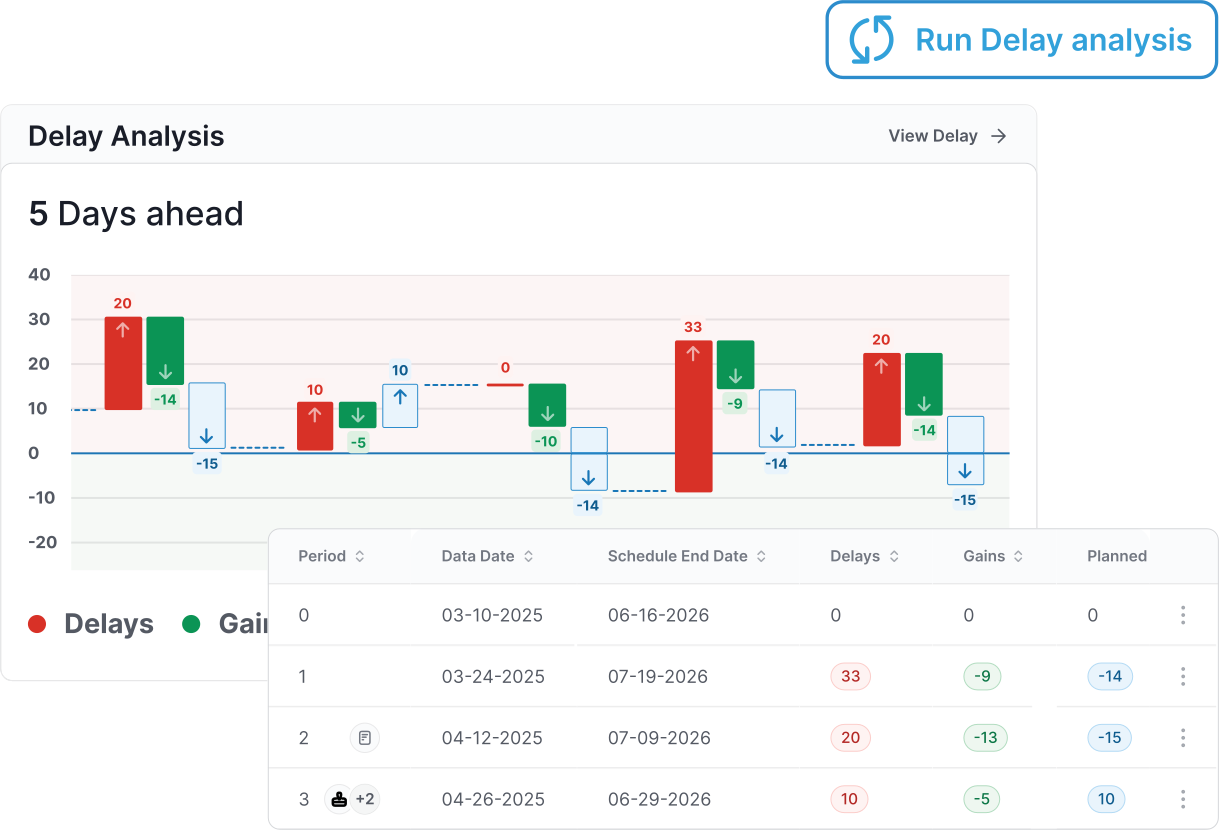
The delay analysis automatically identifies which activities drove end-date movement in each update cycle. Rather than a project manager spending hours comparing schedule versions, the platform surfaces what changed, quantifies the impact, and flags whether the shift came from field performance, plan changes, or both.
For project executives managing a portfolio, the dashboard provides cross-project visibility into schedule health, compression trends, and risk exposure without requiring a manual roll-up process. That is what allows a VP of Operations to move from managing by exception to managing proactively.
Reaching that level of oversight depends on a consistent way to monitor portfolio-wide schedule risk, so every project is measured against the same thresholds rather than each scheduler's judgment.
More than half of the ENR Top 50 use SmartPM. For mid-market GCs building their first formal project controls function, SmartPM Essentials provides the same analytical foundation with a simplified entry point.
The platform's construction delay analysis capability is the same forensic methodology that Mike Pink built his career on, now automated and available on every project update.
Ready to see what your schedule is actually telling you? Book a demo.