

What Is a Construction Schedule Risk Analysis?
Schedule risk analysis is how project controls teams stop guessing and start knowing where their CPM schedule is most likely to break down.
Blog

A construction management risk assessment done poorly is worse than none at all. It creates the illusion of control while leaving the most damaging risks unaddressed.
A 2022 McKinsey analysis of more than 500 capital projects found that cost overruns averaged 79 percent above initial budgets and schedule delays averaged 52 percent beyond original timeframes. Those figures do not reflect a shortage of risk assessment activity. They reflect assessments that missed the right things.
Most construction risk management frameworks center on safety compliance and financial contingency. But the risks that generate claims, liquidated damages, and margin erosion are most often schedule-embedded: compression, logic gaps, missed critical path shifts, and deteriorating schedule quality that nobody catches until the project is in trouble.
A complete construction risk management plan accounts for all of it.
A construction management risk assessment is a structured process for identifying, evaluating, and responding to potential risks that could affect a project's cost, schedule, safety, or quality outcomes.
It is the foundation of any serious construction risk management plan and applies across the full project lifecycle, from preconstruction through closeout.
The term is sometimes used interchangeably with safety hazard assessments. They are not the same thing. A safety assessment identifies physical hazards and protects workers. A construction management risk assessment is broader: it addresses everything that could prevent successful project completion, including financial risks, contractual risks, environmental risks, and schedule risks.
Risk assessment in construction projects converts uncertainty into decisions.
Without it, project managers react to problems rather than anticipate them. With it, construction teams:
Standard construction risk management frameworks give safety risks and financial risks most of the attention. Both have well-established industry processes, regulatory requirements, and insurance products that drive compliance. Schedule risks get a line in the risk register but rarely the analytical depth they require.
Schedule deterioration is often the earliest observable signal that a project is moving toward a claim. A declining Schedule Performance Index, increasing compression ratios, logic gaps accumulating across updates: these are measurable.
They appear in the schedule data weeks or months before they surface as formal disputes. Construction risk management that excludes systematic schedule quality monitoring is operating with a significant blind spot.
A thorough risk assessment maps construction risks across five categories. Each requires a different analytical lens and different mitigation strategies.
|
Risk Category |
Common Sources |
Primary Consequence |
|
Safety Risks |
Falls, equipment failure, hazardous materials handling, electrical exposure |
Workplace accidents, project stoppages, regulatory penalties |
|
Financial Risks |
Material price volatility, subcontractor default, change order accumulation, cash flow disruption |
Cost overruns, margin erosion |
|
Design and Contractual Risks |
Incomplete scope, design errors discovered mid-construction, ambiguous contract language |
Contract disputes, legal exposure, rework costs |
|
Environmental Risks |
Subsurface conditions, site contamination, permitting delays, weather disruptions |
Costly remediation, regulatory fines, unrecoverable delays |
|
Schedule Risks |
Logic gaps, inadequate activity durations, compression on the critical path, unapproved change order impacts |
Delay claims, liquidated damages, margin erosion |
Schedule risks sit last in this list but rarely last in financial impact. When schedule deterioration goes unmonitored, it compounds every other category: financial exposure grows, contractual positions weaken, and what started as a manageable risk becomes a claim.
Risk assessment is not a one-time preconstruction activity. The construction risk management process requires assessment at defined intervals.

Effective risk identification requires input from the people closest to the work: project managers, field superintendents, the scheduling team, estimating, and key subcontractors. Risk assessments built in a conference room without field input consistently underestimate execution risk.
Draw on historical data from previous similar construction projects:
Identify potential risks for the specific project using the five-category framework above. Document every identified risk in the risk register regardless of perceived probability.
For each identified risk, assess the probability of occurrence and impact if it materializes. A standard risk matrix plots these against each other to produce a priority score. The risk matrix is a triage tool that helps project teams prioritize risks and allocate response resources efficiently, not a final determination of risk severity.
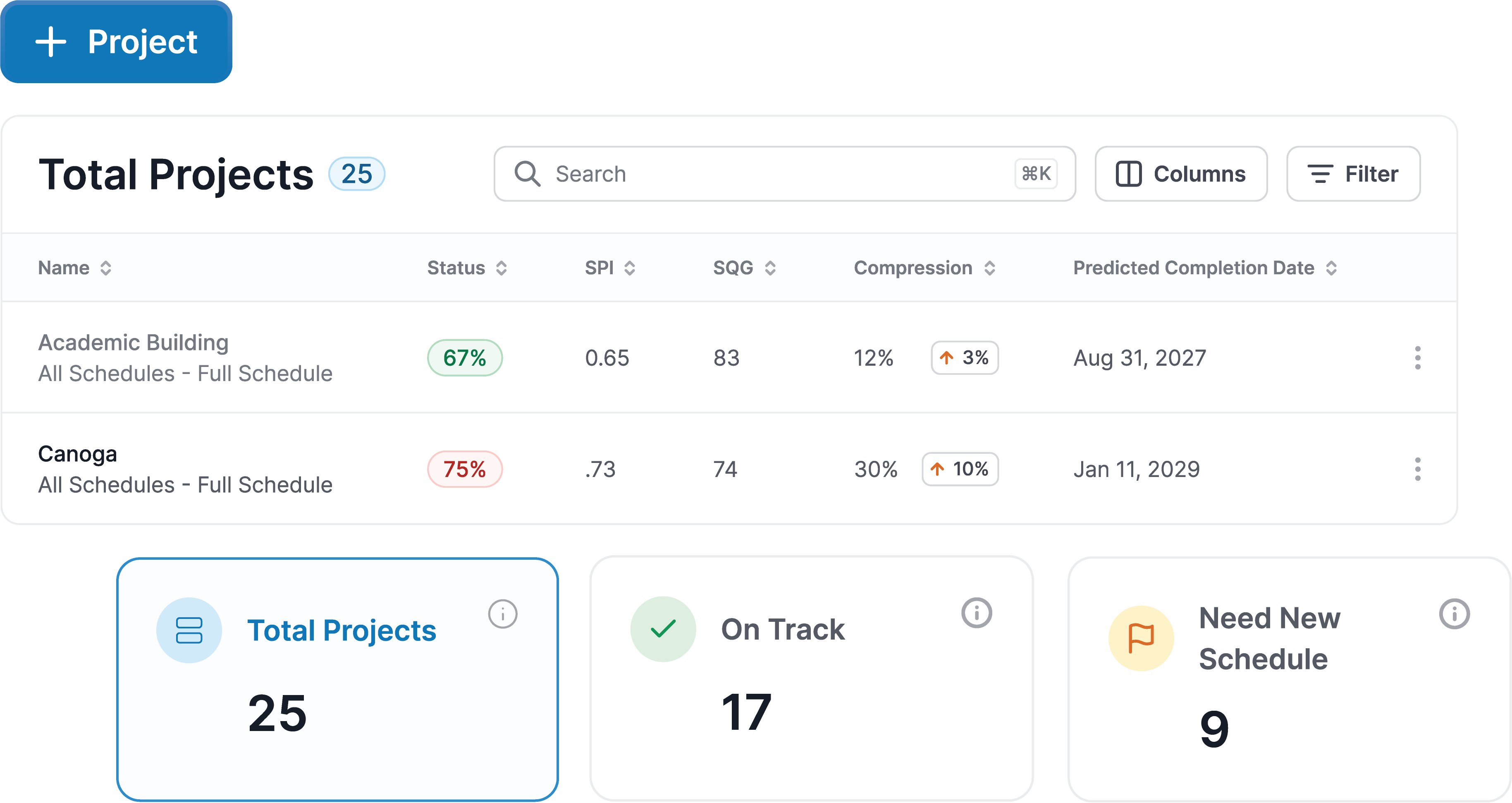
This is where most construction risk assessments stop short. Run a structured analysis of the project schedule to surface risks not yet visible in the risk register: logic gaps, activity durations that exceed benchmarks, hard constraints limiting float, and compression ratios indicating the schedule cannot absorb further delay without recovery.
The DCMA 14-point schedule assessment provides a baseline for this analysis. Platforms built on a full CPM engine run these metrics against every schedule update automatically, flagging deterioration in real time.
.png?width=3659&height=2832&name=Schedule%20Quality%20Cards%20(1).png)
Each risk register entry should include:
A risk register that is not updated as the project progresses is a historical artifact, not a management tool. Assign a specific team member to own it and define the update cadence at project kickoff.
Every significant risk needs a named risk owner responsible for monitoring and executing the response plan. Risk response strategies fall into four types: avoid, transfer, mitigate, or accept. Define the response before the risk materializes. Teams that wait until a risk event occurs to decide how to respond are managing consequences, not risk.
Establish key risk indicators for each major risk category and review them at every project team meeting. For schedule risks: SPI trend, float consumption rate, compression ratio, and schedule quality grade. For financial risks: cost-to-complete variance, change order volume, and cash flow against projections. When indicators move outside acceptable thresholds, the risk response plan activates.
See how SmartPM monitors schedule risk indicators across your entire portfolio. Book a Demo.
Consider what the schedule data was telling someone on an urban multifamily project long before the dispute began. The GC was submitting regular updates. The project appeared to be progressing. Nobody flagged a problem, not because the warning signs weren't there, but because nobody was reading them.
In the final third, delays surfaced and liquidated damages came into play. The GC submitted a claim covering nearly the entire project duration. Columbia Ventures turned to SmartPM to analyze the historical schedule record: past updates, quality trends, critical path shifts, and the changes log. The data told a clear story about which delays were legitimate and which were not.
The lesson for any GC is not that the owner had better data. It's that the data existed the whole time. A GC monitoring schedule quality at each update would have seen the same deterioration weeks or months earlier, with time to course-correct, document concurrently, or enter any negotiation from a position of preparation.
As Josh Thigpen, Senior Development Manager and Partner at Columbia Ventures, noted:
"SmartPM was instrumental in removing emotion in order to let the facts and data dictate negotiation."
That outcome applies equally to both sides of the table.
Construction firms that struggle with risk management tend to repeat the same errors.
A risk register completed at preconstruction and never revisited is a compliance artifact, not a management tool. New risks emerge as construction activities progress into new phases.
Schedule risks that are not measured are not managed. Teams that skip quality metrics at each update cycle miss the risk category most likely to generate financial exposure.
A risk without a named risk owner is unowned. Diffuse accountability produces diffuse responses.
They are not. Cost overruns and project delays compound each other. A risk management plan that addresses them in separate silos will underestimate the impact of both.
AACE International's Recommended Practice 62R-11 defines the standard for risk identification and qualitative analysis in construction and engineering projects: risk identification planning, risk categorization, probability and consequence assessment, and risk register documentation. For project controls professionals, this is the authoritative reference for a defensible construction risk management process.
The Defense Contract Management Agency's 14-point check is the most widely referenced standard for evaluating CPM schedule quality. It covers logic, leads, lags, hard constraints, float, and duration.
A schedule that fails multiple DCMA criteria cannot serve as the foundation for credible risk management. Running this check at every update, not just at baseline, separates teams that catch problems early from teams that discover them in claims.
GCs with a formal approach to schedule risk management use platforms that run quality assessments against every schedule update automatically, surfacing deterioration before it becomes a delay.
SmartPM's proprietary CPM engine evaluates schedules across 40+ quality metrics at each upload, producing an objective, consistent signal that no manual review can replicate at scale.
SmartPM Controls is built for this use case: forensic-grade schedule analytics that support real-time risk monitoring, delay attribution, and defensible reporting across a project portfolio.

Ready to see what your schedule data is actually telling you? Book a demo and see SmartPM in action.