How to Conduct a Construction Management Risk Assessment (Step by Step)
A construction management risk assessment done poorly is worse than none at all. It creates the illusion of control while leaving the most damaging risks...

Blog

Every construction project carries risk. What is worth examining is how poorly most teams account for the risks that matter most: not the ones listed in a kickoff meeting and never revisited, but the slow, compounding risks that erode schedules and budgets week by week before anyone sounds the alarm.
A risk management plan in project management gives teams a structured process for identifying, assessing, and responding to risks before they become claims.
In construction, late-stage discovery of a critical path delay does not just affect the timeline; it triggers a chain reaction of cost overruns, contractor disputes, and liquidated damages exposure that no contingency fund was sized to absorb. McKinsey's analysis of more than 500 large construction projects found that most megaprojects run significantly over budget and over schedule, a pattern driven not by force majeure but by insufficient risk management during execution.
This article covers what a complete construction risk management plan looks like, where most plans fall short, and what it takes to move from a static document to a live risk management process.
A risk management plan is the governing document that defines how a project team will identify, assess, respond to, and monitor risks throughout the project life cycle. It is different from a risk register.
A risk register is a list of identified risks with probability scores and response notes. The risk management plan is the process document that explains how that register gets built, maintained, and acted on.
A risk register can be completed in an afternoon and filed away. A risk management plan is a living framework.
Construction risk management differs from general project management in three fundamental ways:
Most construction risk management plans are written at project kickoff and treated as a deliverable rather than a process. Three failure patterns show up across projects of all sizes.
A complete construction risk management plan covers seven functional areas. Most plans address the first five. The last two are where the gap opens between teams that manage risk and teams that get surprised by it.
The risk management methodology applied across all seven areas determines whether the plan supports project objectives or simply satisfies a contract requirement.
Defines who identifies risks, how often, and what categories are in scope. Risk identification should not be a one-time exercise. It should happen at baseline, at each schedule update, and whenever a significant change event occurs, pulling from project managers, field superintendents, subcontractor leads, and project stakeholders, each of whom sees a different risk surface.
Construction risks fall across six primary categories:
Environmental and safety risks require separate treatment depending on project type and delivery method.
A consistent risk assessment matrix applied across the project team. Impact scoring should account for cost exposure and schedule exposure separately. A risk that scores moderate on cost but high on schedule should not be treated the same as one that is moderate on both.
Each high-priority risk needs a documented risk response: avoid, transfer, mitigate, or accept. Risk mitigation strategies should be specific, assigned to a named risk owner, and paired with defined risk mitigation actions so team members know exactly what steps to take to mitigate risks before they affect the schedule or budget. A risk response plan without ownership is not actionable.
Every identified risk in the register should have a named owner responsible for monitoring it, executing the response, and escalating when conditions change. Risk owners should be assigned to the people closest to each risk, not defaulted to the project manager across the board.
The component most construction risk management plans omit. Quantitative Schedule Risk Analysis (QSRA) evaluates how identified risks affect the critical path and probabilistic completion date. AACE International's recommended practices on integrated cost and schedule risk analysis provide a technical framework for this process. A risk breakdown structure helps organize risk management activities by category before running the analysis.
Project risk management tools that support Monte Carlo simulation are the standard for this work. The output is a range of dates with associated confidence levels, a realistic picture of delivery risk rather than a single optimistic end date.
Defines how often risk status is reviewed and what thresholds require escalation. Monitoring risks requires a cadence tied to schedule update cycles. If the schedule is updated monthly, the risk register review should happen monthly. The plan should define specific triggers: a change in critical path delay beyond a defined threshold, a risk probability increase above a set level, or a new risk category emerging post-baseline.
Risk management tools that integrate with the project schedule make this ongoing monitoring a byproduct of normal project controls work rather than a separate administrative burden.

Schedule risk is the most consequential and least analyzed category in most construction risk management plans. Most teams treat it as a narrative: "we think we are on track" or "we are running about two weeks behind." Neither is a risk assessment.
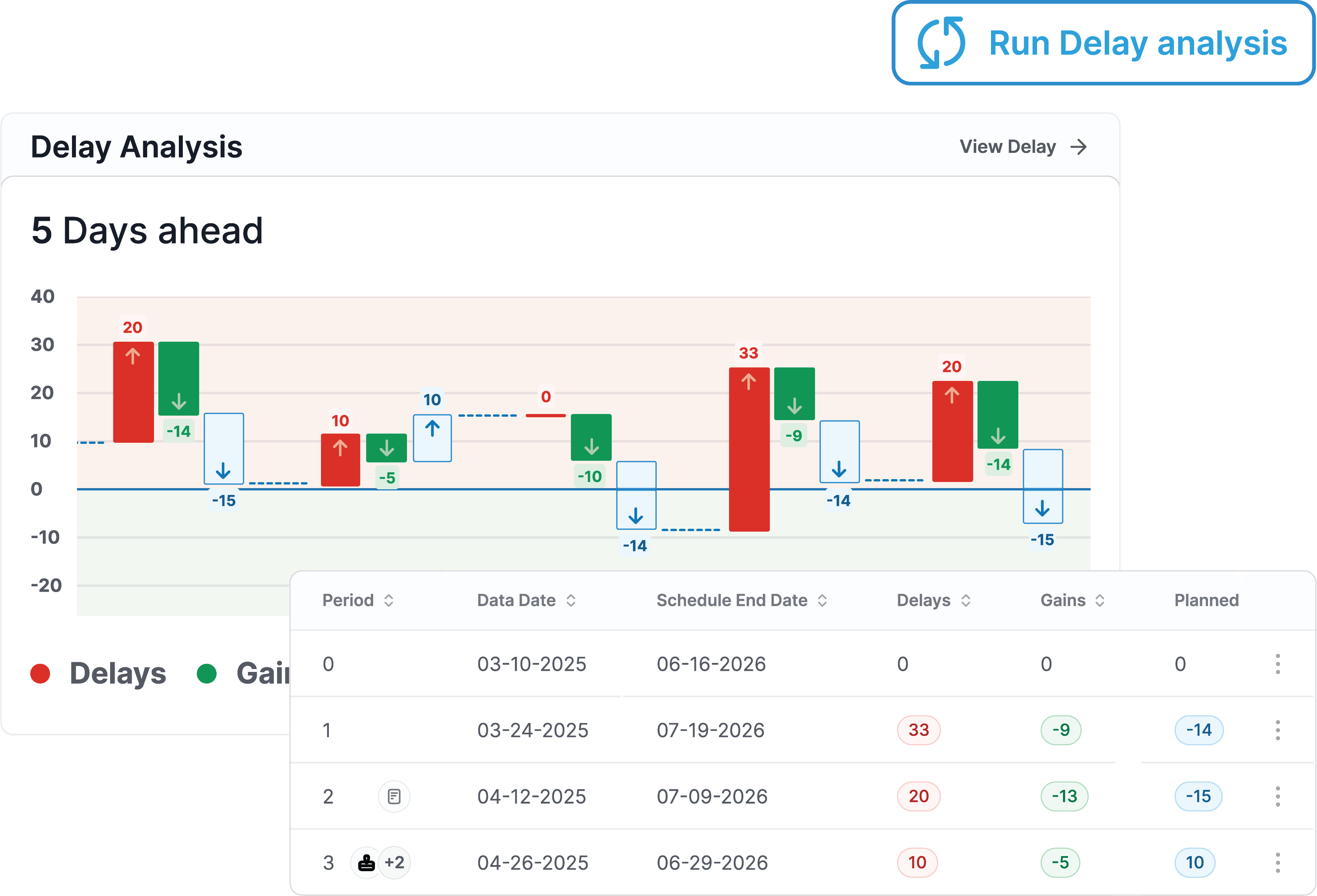
Schedule risk in construction is measurable. It appears in specific CPM indicators:
Tracked across update cycles, these data points surface potential threats and operational risks well before they become claims. Risks identified early through schedule data are manageable. Risks identified at project closeout become disputes.
The DCMA 14-point assessment, developed by the Defense Contract Management Agency in 2005, provides a widely adopted baseline for evaluating CPM schedule quality. It assesses missing logic, high float, negative float, hard constraints, and baseline execution index. A schedule that fails multiple DCMA criteria has structural integrity problems that distort any risk assessment built on it.
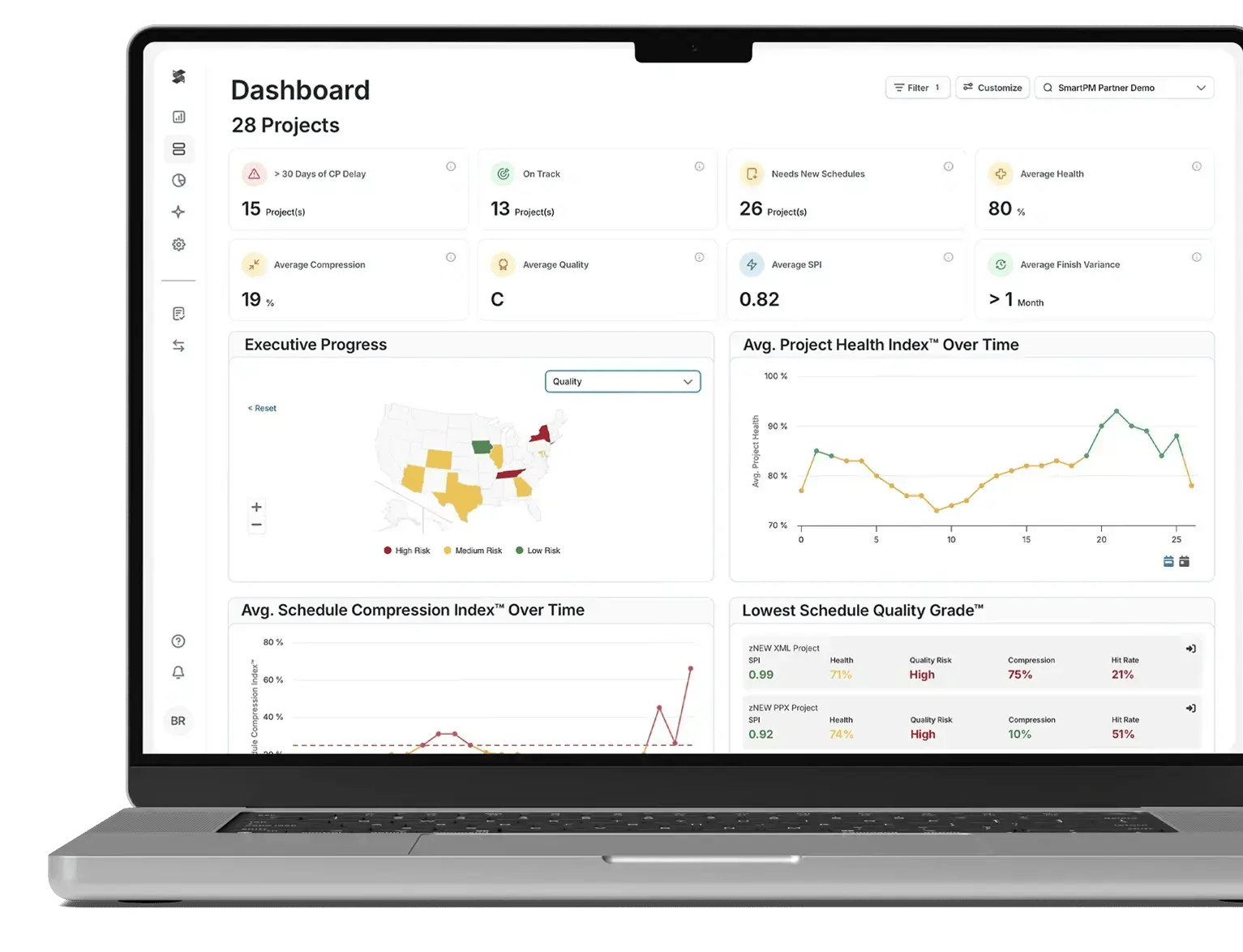
Passing the DCMA check is a floor. SmartPM's proprietary CPM engine evaluates schedules against more than 35 quality metrics, including the DCMA criteria alongside additional indicators developed from analyzing thousands of construction projects.
A schedule quality grade is produced for every update, giving project managers a consistent, objective measure of whether their schedule can be trusted as a risk management input. See how SmartPM's construction schedule analytics platform surfaces schedule quality issues before they become risk events.
Building a construction risk management plan is a systematic process. The steps below reflect how project teams with mature risk management practices approach it, not as a compliance exercise but as a live project controls function.
Across the construction industry, construction companies that treat risk management as part of the standard project management process rather than a standalone document tend to catch problems earlier and resolve them at lower cost.
Establish what the plan governs, what risk categories are in scope, and what success looks like. Align objectives with the project's contractual obligations and the owner's expectations for visibility.
Pull from the full project team: subcontractor leads, site superintendent, scheduling lead. A session that excludes field perspective will miss execution risks entirely.
Generic PM frameworks do not map cleanly to construction. Build categories that reflect the project type: schedule, design, procurement, subcontractor performance, environmental, safety, and contractual risks.
Assess the CPM schedule quality before any scoring begins. Known risks in a structurally defective schedule are not manageable. Fix the schedule integrity issues first.
Apply probability distributions to activity durations and risk events on the critical path. A Monte Carlo simulation produces a range of probable completion dates, giving the project team a data-backed basis for contingency planning.
Apply the risk assessment matrix and risk matrix to all identified risks using consistent criteria across risk owners, so that a "high impact" designation means the same thing regardless of who assigned it.
Document a risk response for each high-priority risk and name an owner. Risk prioritization determines who gets assigned first and where team members focus attention. A specific trigger, escalation path, and responsible party are the minimum.
Tie the risk review cadence to schedule updates so risk monitoring and schedule monitoring run as one process. Define what thresholds trigger escalation. Catching unexpected costs at the schedule-update stage is far cheaper than discovering them at project closeout.
A plan reviewed quarterly on a monthly-updated project is always looking backward. Update the risk register whenever a change event occurs and at every formal schedule revision. Ongoing process discipline at this stage is what enables successful completion without last-minute claims.
The template includes a risk register with pre-built construction risk categories, a probability/impact scoring matrix, a risk response log with owner assignment fields, a schedule risk section for QSRA inputs and outputs, and a monitoring log for tracking risk status changes across the project life cycle.
Download the free construction risk management plan template here.
Building the plan is the easier part. Maintaining it as a live document through full execution is where most teams lose discipline.
The most common failure mode is monitoring risks less frequently than the schedule is being updated. If schedule updates happen monthly and risk reviews happen quarterly, the team is assessing three-month-old data when making real-time decisions. By the time a risk materializes in the quarterly review, it has already affected the critical path.
Effective ongoing monitoring requires two things:
The Columbia Ventures case illustrates what this looks like in practice. When their GC assembled a delay claim at project closeout, Columbia Ventures had SmartPM's full record of schedule updates, delay trends, quality scores, and critical path changes across the project life cycle. That data allowed them to isolate which delays had legitimate claim support and enter negotiations from a fact-based position.
As Josh Thigpen, Senior Development Manager and Partner at Columbia Ventures, put it:
"SmartPM was instrumental in removing emotion in order to let the facts and data dictate negotiation."
For owners managing GC schedules across a portfolio, see how owners and developers use SmartPM to verify contractor schedule data independently.
For GCs managing multiple active projects, individual project risk management plans are necessary but not sufficient. The more meaningful question is whether leadership has visibility into risk patterns across the portfolio: which projects are showing critical path compression, and what does that mean for overall delivery exposure?
Portfolio-level risk management requires two conditions:
Without both, portfolio-level comparison is not possible.
SmartPM's portfolio dashboard gives operations leaders a single view of schedule health scores, delay accumulation, and quality metrics across all active projects. Teams can segment by region, sector, or scheduler to identify systemic patterns. Known risks that repeat across project types can inform a contingency plan at the company level rather than being rediscovered project by project.
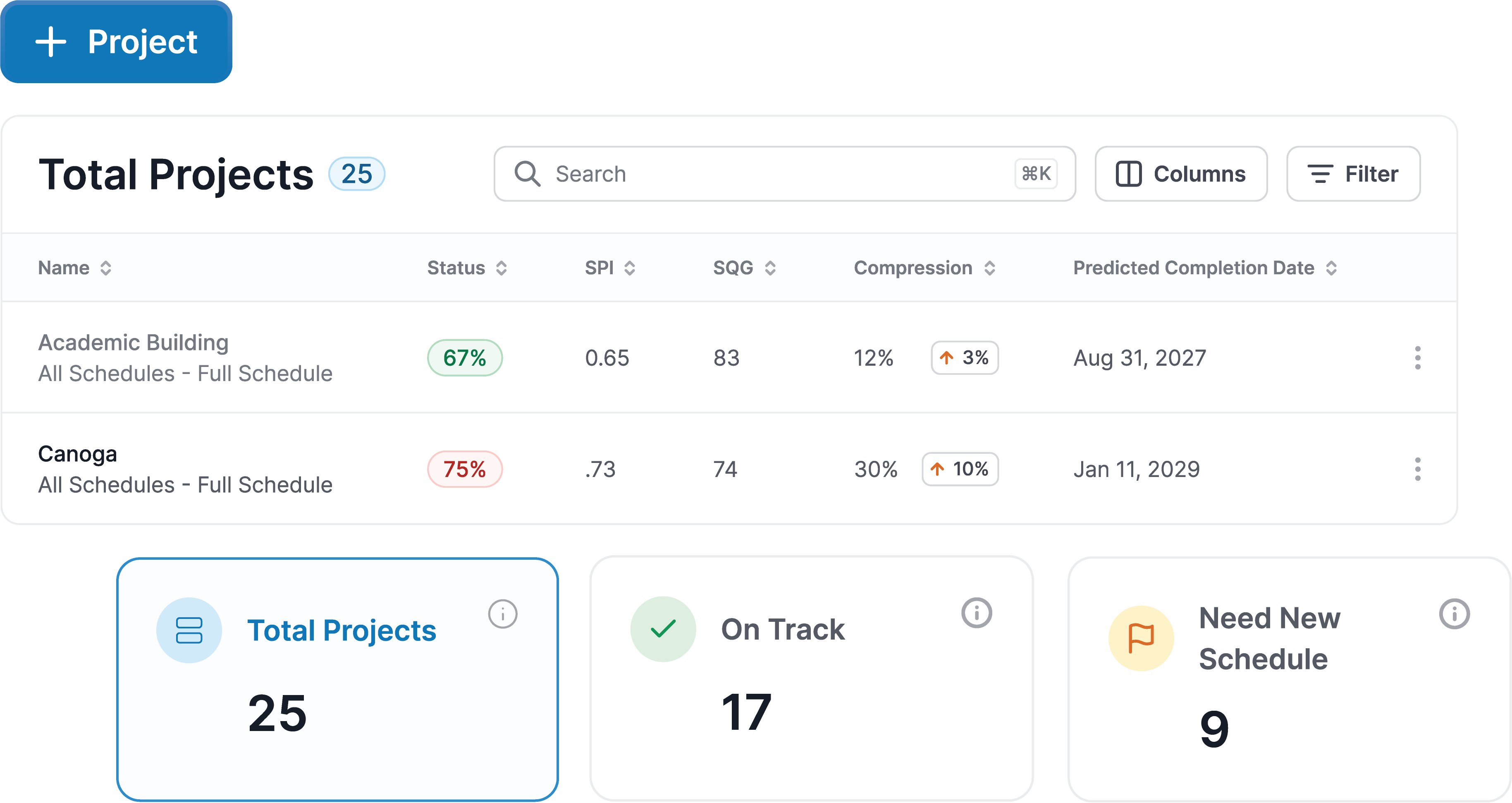
The Wood Partners case study shows what portfolio visibility makes possible. SmartPM's analysis surfaced over $1 million in potential excess costs tied to poor scheduling practices across two simultaneous multifamily builds. The GC subsequently hired a master scheduler and established benchmarks for future builds.
Book a demo to see SmartPM's portfolio-level schedule risk tools in action.