

Float in CPM Schedules: Total Float, Free Float, and Why It Matters
In essence, float can offer a buffer against unexpected changes, allowing activities to be postponed without impacting the overall end date.

Blog

Free float vs total float comes down to one question: does the delay affect the next task, or the whole project's finish date? Total float is the amount of time an activity can be delayed without pushing back the project completion date. Free float is the amount of time that same activity can be delayed without affecting the early start of its immediate successor.
Both come from the same critical path method calculations, but they answer different questions, and confusing the two is a common mistake with real consequences for project managers when a delay claim is on the table.
Total float is the total amount of slack available to an activity along its path through the network diagram before that path pushes past the project's finish date. It is calculated with a two-step pass:
Total float formula: Late Finish − Early Finish (or equivalently, Late Start − Early Start)
Activities with zero total float are critical activities driving the critical path duration; any delay to them delays the entire project. Total float belongs to the path, not the individual task. If framing and roofing sit on the same non-critical path, they draw from the same float pool, especially where multiple paths converge on a single successor.
A high total float value does not automatically mean an activity is low priority:
Free float measures something narrower than total float: the amount of time an activity can be delayed without delaying the early start of its immediate successor, regardless of what happens to the project end date.
Free float formula: Early Start of the successor activity − Early Finish of the current activity
To calculate free float, subtract the current activity's early finish from the early start of the very next activity in the network diagram.
An activity can carry weeks of total float and still have zero free float, because the immediate successor is scheduled to start the moment the current activity finishes, even though the overall path has plenty of schedule flexibility before it threatens the completion date.
|
Total Float |
Free Float |
|
|
What it measures |
Delay an activity can absorb without delaying the project's finish date |
Delay an activity can absorb without delaying its immediate successor |
|
Calculation basis |
Late Finish − Early Finish (path-level, from forward and backward pass) |
Early Start of successor − Early Finish of current activity |
|
Scope |
Shared across all activities on a non-critical path |
Specific to one activity and one successor relationship |
|
Zero value means |
Activity is on the critical path |
Any delay immediately pushes the next activity's start |
|
Best used for |
Portfolio-level view of schedule flexibility and critical path identification |
Trade sequencing, look-ahead planning, and logic gap detection |
Free float can never exceed total float for the same activity. When an activity has a single successor with no other predecessor converging on it, the two carry the same value.
When an activity has multiple successors, or a successor has more than one predecessor converging on it, some of that total float becomes interfering float: available to the current activity, but its use pushes a later activity's early start even though the project end date is unaffected.
Interfering float is the difference between total float and free float, and it explains why the same total float can produce very different outcomes downstream depending on how the network diagram is built.
Total float stops protecting a contractor the moment a delay claim is filed. Pointing to total float as proof a delay caused no harm is a project-level argument. Whether it holds depends on whether that total float was actually available, or already spoken for by another activity sharing the same path.
This is precisely where free float earns its keep in delay analysis work. An activity showing fifteen days of total float can still carry zero free float, meaning any slip at all pushes the next trade's start date even though the project's finish date is untouched.
Distinguishing the two is the difference between a claim that holds up under review and one that collapses the first time someone traces the float back through the network diagram to see who was actually using it.
At Columbia Ventures, a multifamily developer, this played out at the end of a project where the GC delivered late and liquidated damages came into play, without the delay notices the contract required ever being issued. Josh Thigpen, Senior Development Manager and Partner at Columbia Ventures, brought critical path data to the negotiating table instead of arguing from memory, saying the approach "removed emotion in order to let the facts and data dictate negotiation." The dispute was resolved without litigation.
Float ownership determines whether a delay that only consumes float, without pushing the finish date, still supports an extension of time. Where a contract is silent, the Society of Construction Law's Delay and Disruption Protocol treats float as project-owned, available to whichever party needs it first rather than automatically belonging to the contractor or the owner.
An owner-caused delay that consumes float without moving the finish date does not automatically settle a claim either way; it depends on what the contract says about ownership and whether the float was genuine flexibility or an artifact of missing logic.
Schedule quality is inseparable from entitlement here. Float built on incomplete logic produces values that do not reflect real flexibility, and a generous-looking total float number can evaporate once missing relationships are corrected. AACE International's forensic schedule analysis practice treats the integrity of the underlying float calculations, including how float ownership is determined, as a prerequisite for any delay methodology.
Most scheduling tools report a single float figure at the activity level, obscuring the distinction that matters most in a dispute. SmartPM's schedule analytics run on a proprietary CPM engine that calculates and reports total float and free float independently for every activity on every schedule update, giving project controls teams a portfolio-level view of flexibility that does not mask a handoff-level risk underneath it.
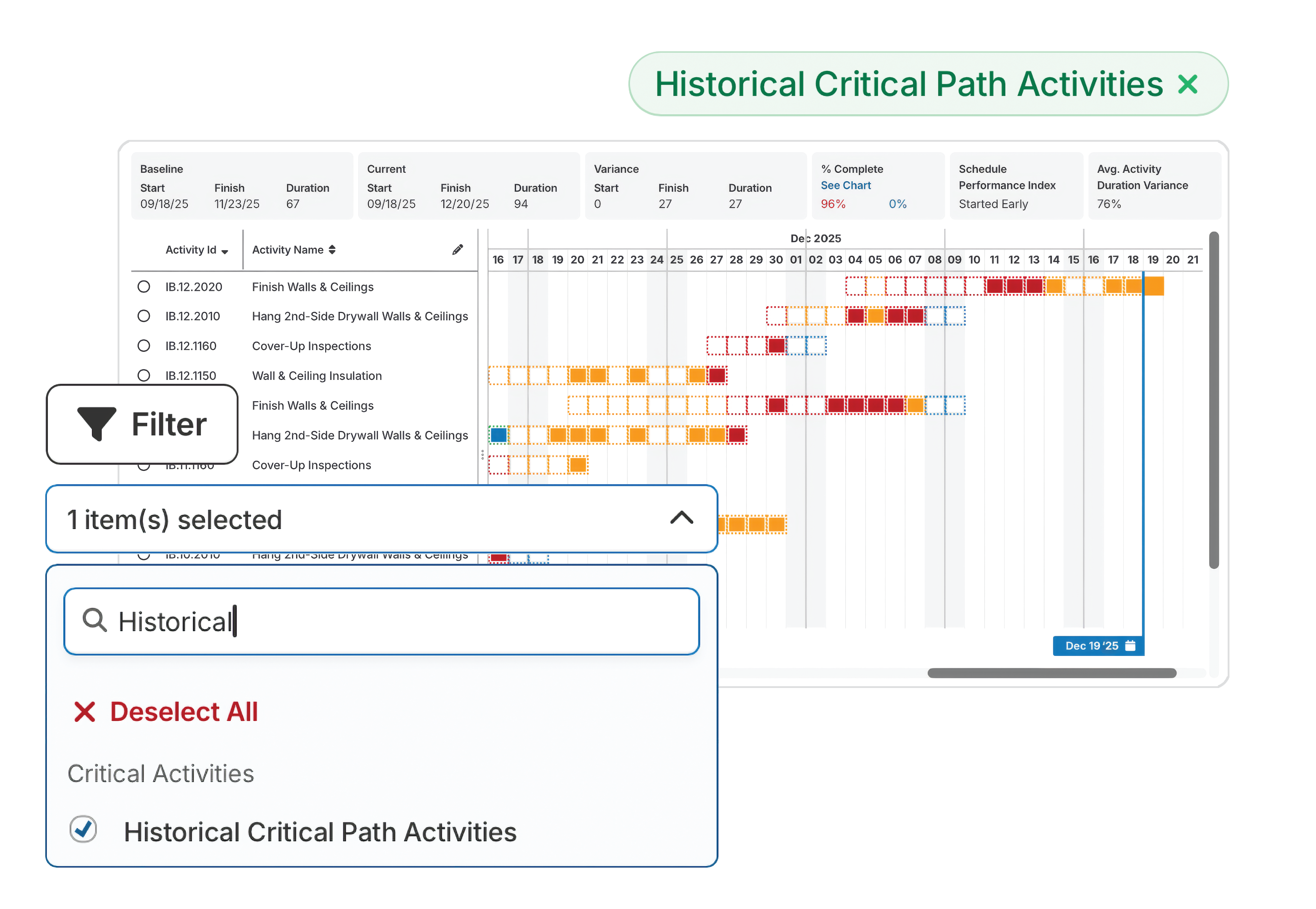
This is part of why understanding total float on its own is not enough for teams managing risk day to day. A project can show healthy total float across most of the schedule while individual trade handoffs carry zero free float, and that gap is where field conflicts and later disputes tend to originate.
Consider drywall installation with a total float of fifteen days. That looks like a comfortable cushion before it threatens the project's completion date. But the next task, painting, is scheduled to start the day drywall finishes, with no buffer between them. Drywall's free float is zero.
Now suppose the delay was a design change the owner issued late. The contractor did not lose entitlement to a time extension just because the finish date was held. Whether they have a claim depends on whether the float belonged to them and whether fifteen days of total float reflected genuine flexibility or missing logic.
This is the huge difference between a schedule number and a defensible position: one is a calculation, the other requires knowing what it represents. Time impact analysis is where this gets tested formally, since a modeled delay event has to show its actual effect on the critical path, not just cite a float value in isolation.
Understanding where a project stands before a dispute starts is far less costly than reconstructing it after the fact. See how SmartPM separates total float from free float on your own schedules. Book a demo.
Request a demo to see how SmartPM's schedule quality checks catch float distortion before it affects a project's delivery date or a claim.