
Construction Schedule Optimization: How to Improve Project Timelines
Most advice on construction schedule optimization starts in the wrong place. It treats a faster timeline as the product of clever tricks: run tasks in...
Blog

Root cause analysis (RCA) is a structured problem-solving approach used to identify the true origin of a problem rather than the surface-level symptom it produces. In construction, root cause analysis means tracing a cost overrun, a missed milestone, or a slipping completion date back to the specific decision, sequencing failure, or schedule breakdown that actually caused it.
The method grew out of manufacturing and quality management, where teams used root cause analysis (RCA) to investigate everything from customer complaints to recurring system issues to an organization's problems with defects and rework.
The principle is the same on a job site, but the data is richer. Every construction project produces the most detailed record of its own performance in one place: the CPM schedule. Most teams never analyze that record in time to act on it, and that gap is where effective root cause analysis in construction earns its value.
What makes root cause analysis important on a construction project is the cost of getting it wrong. A delay treated at the symptom level keeps coming back and leads to repeat slippage, and every day of delay carries a real price. The cost of a single day of delay scales with the size of the project. Extended general conditions, idle crews, and liquidated damages accrue every day a finish date slips, and on a large commercial build, that can run well into five figures per day.
When a project team reacts to the symptoms instead of the cause, it pays twice: once for the workaround and again when the same condition returns. A disciplined root cause analysis process breaks that loop, giving the team a clear understanding of what to fix, why it happened, and how to solve it. Used well, RCA is a leadership tool, not a paperwork exercise.
The most common failure in any root cause analysis is treating symptoms as if they were causes. A milestone slips, so crews get added. The end date moves, so the remaining work gets compressed. Those responses address the symptoms a crew can see without reaching the underlying issues driving the problem.
"The concrete sub was slow" is a symptom. The actual root cause might be a late design release that pushed rebar approval, delayed the pour, and left the sub no float to absorb a weather day.
To understand root causes, a scheduler has to dive deeper than the first answer and follow the chain of events back to the decision that set everything in motion. Stopping at the first symptom is how teams fail to identify the cause and end up trying to solve the wrong problem.

Root cause analysis is a set of problem-solving methods, not a single technique. Several methods came out of quality disciplines such as Lean Six Sigma and total quality management, where they were built to identify problems in repeatable processes.
A few carry over directly to construction:
Of course, these methods share a limitation. The 5 Whys and the fishbone diagram rely on team brainstorming, so they identify categories of potential causes without proving which one drove the outcome. In construction, that proof lives in the schedule itself, which works as an analysis tool these methods cannot replace.
|
Method |
Best use on a project |
Limitation |
|
5 Whys |
Quick analysis of a single delay event |
Can stop at a comfortable answer |
|
Fishbone (Ishikawa) diagram |
Mapping many possible causes across categories |
Generates causes, does not quantify them |
|
Causal factor analysis |
Reconstructing a sequence of events over a timeline |
Requires accurate, time-stamped records |
|
Schedule analytics |
Pinpointing the activity and logic that drove slippage |
Only as good as the schedule's quality |
A root cause analysis template or report captures the problem, the records reviewed, the causal factors, the root cause, and the corrective actions assigned. In construction, the schedule update history already works as a living root cause analysis template: each update is a dated record of what changed, which keeps the analysis traceable and defensible.
Performing root cause analysis in construction follows a repeatable RCA process. There is no rigid sequence, but these steps give a reliable path from problem to solution.
Define the problem narrowly. "The project is late" is too broad. "The structural milestone finished 19 days behind the baseline plan" gives the work a precise, measurable target.
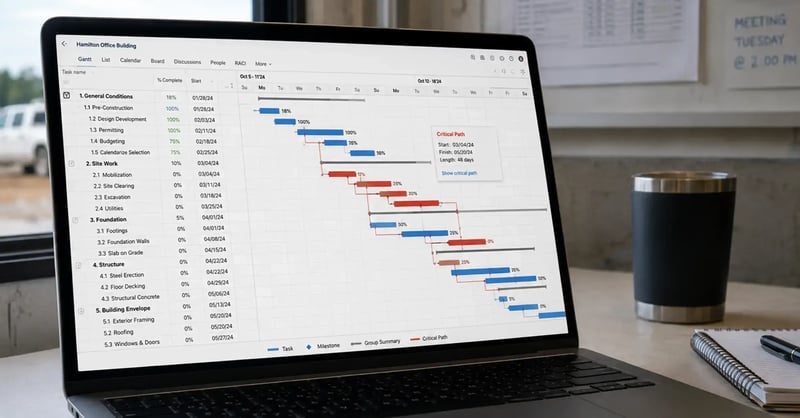
Collect data from the source with the most context: the CPM schedule and its updates. Good data collection means pulling the baseline, every progress update, and the logic and durations behind the affected activities. The quality of this data determines whether the process reaches a real conclusion or a guess.
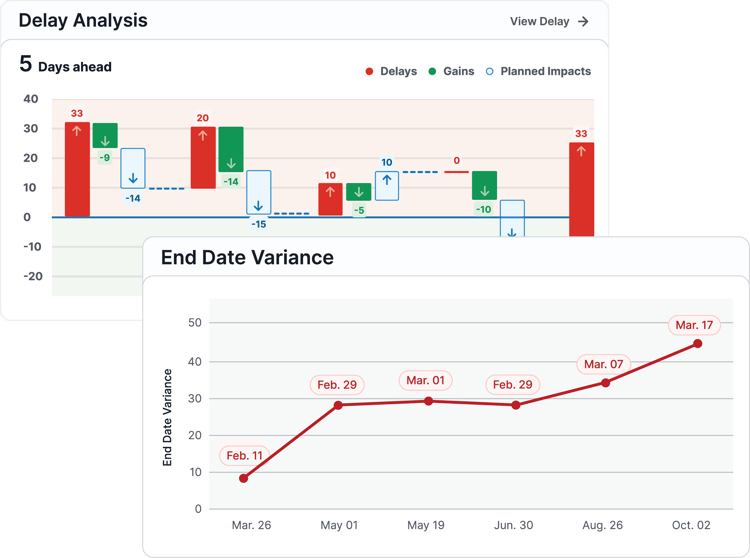
Identify the causal factors that contributed to the problem and sequence them on a timeline. Causal factors are the events and conditions that fed the delay without being the single root cause. Mapping them chronologically shows how the problem built up and helps the team identify which factors lead the chain.
Determine which factor actually drove the outcome. This is where construction delay analysis software does the heavy lifting. A proprietary CPM engine runs the math against the schedule rather than only visualizing it, isolating the update where the slippage originated and identifying the specific activity and logic tie responsible. The method narrows dozens of contributing factors down to the one root cause the solution must address.
Develop corrective actions and implement solutions that solve the cause, not the symptom. Assign an owner, the resources required, and a deadline, then implement the change on the next update. A corrective action with no owner and no plan is a wish, not a correction.
Verify the solution by checking the next schedule update, and monitor for future occurrences. Follow through matters: root cause analysis is a process that confirms the fix held over the course of the project, not a one-time event.
A short root cause analysis example makes the process concrete. A healthcare project shows the fit-out milestone slipping across three updates. Running the 5 Whys against the schedule: fit-out is late because rough-in slipped, inspections were rescheduled, permit revisions arrived late, and a design change was issued without a logic update. In this example, the root cause was not the trade in the field. It was an unmanaged change the baseline plan never absorbed.
In construction, most root causes hide in plain sight inside the schedule, showing up as quality problems long before they show up as delays. SmartPM's research in the 2025 State of Construction Scheduling Report found that only 12% of baseline schedules meet best-practice quality standards, and fewer than 5% hold that quality through closeout. A schedule built on weak logic produces unreliable analysis, which means the root cause of a delay is often a schedule management problem rather than a field problem.
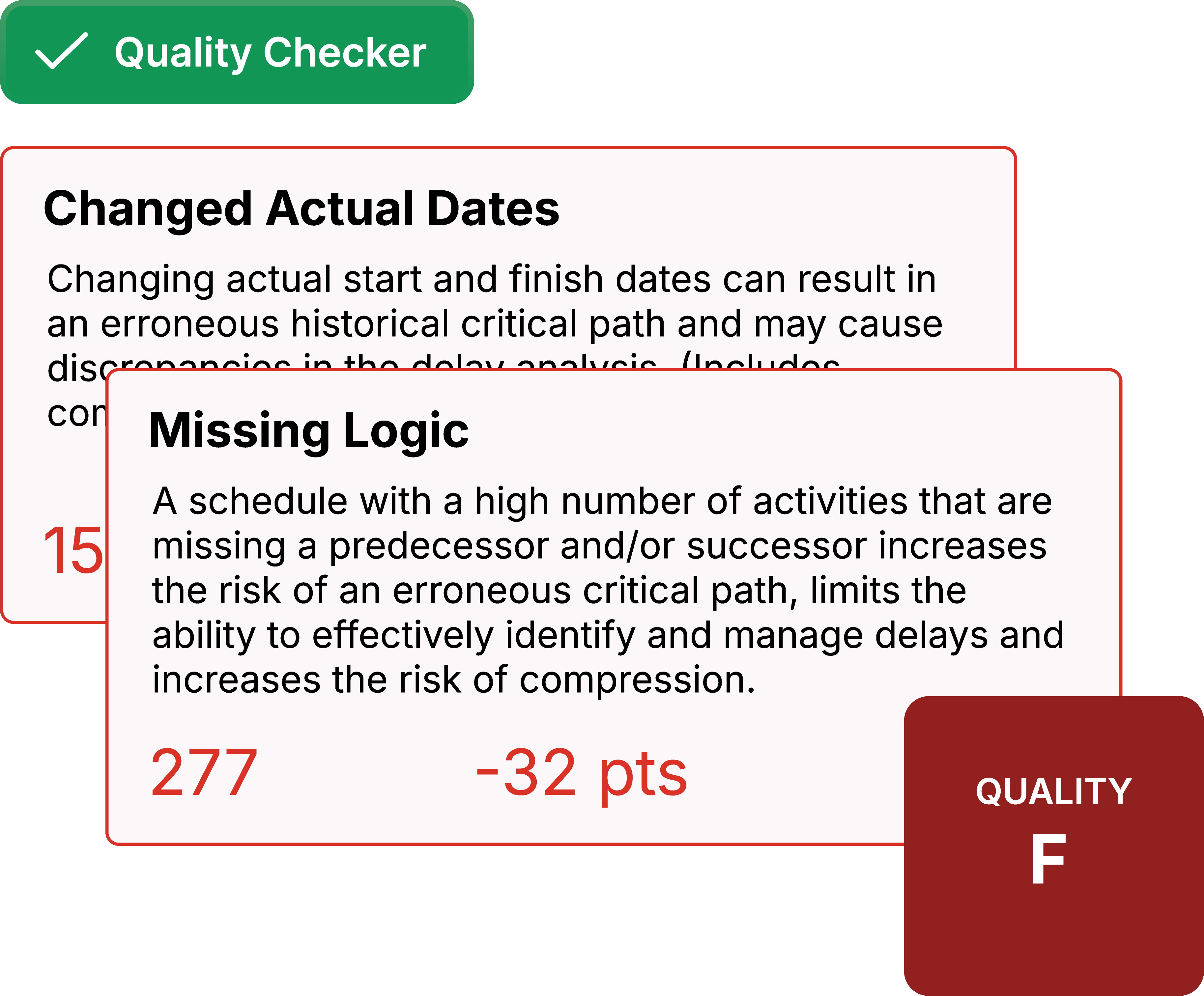
The recurring offenders are consistent: missing logic that hides dependencies, hard constraints that mask negative float, unrealistic durations, and compression that raises risk on the critical path. The DCMA 14-point assessment is the baseline framework for catching these issues, and the GAO Schedule Assessment Guide lays out ten best practices for reliable schedules that a credible analysis depends on. A platform that grades a schedule against 35+ quality metrics makes it easy to identify these problems automatically, which lets a team run construction schedule risk analysis on a schedule it can trust.
Forensic delay analysis is root cause analysis applied to a claim. When a delay becomes a dispute, the question is no longer only "what caused this" but "who is responsible and can we prove it."
Forensic delay analysis reconstructs how and why a schedule changed over time, using documented logic ties across updates to support a defensible conclusion and help resolve disputes. AACE International's Recommended Practice 29R-03 is the recognized industry framework for this work.
The same schedule data that supports a live root cause analysis becomes the evidence in a claim, so a team that tracks causation continuously is never forced to reconstruct it under pressure.
Columbia Ventures saw this directly: with a traceable record of schedule performance across every update, the team could assess a contractor's claim against documented data. In their words, "SmartPM was instrumental in removing emotion in order to let the facts and data dictate negotiation." That transparency supports owners and contractors alike, because both sides argue from the same record.
A few core principles separate effective root cause analysis from a brainstorming session that produces a tidy report and no change:
Schedulers who learn root cause analysis as a repeatable habit solve problems once and stop relitigating them.
The highest-value shift a construction organization can make is moving root cause analysis from an end-of-project autopsy to a continuous practice that runs through the project lifecycle. Reactive RCA explains why a project was lost. Continuous RCA catches the cause while there is still time to course-correct.
Wood Partners described the difference after standardizing on schedule analytics: "By using SmartPM, we are now driving the successful outcome of our projects effectively instead of waiting with our fingers crossed until the ball inevitably drops."
Getting there is partly cadence and partly team training. When RCA runs automatically on every update, a project can review root causes weekly instead of quarterly, and standardized root cause analysis training gives every scheduler the same method and process. That kind of training lets a mid-market contractor operate with the same management discipline as leading ENR Top 100 firms without a large project controls department.
The payoff is a culture that treats RCA as a habit, identifies causes earlier, and turns schedule data into shared understanding and clear, actionable insights.
See how your schedule reveals the root cause of a delay. Request a SmartPM demo.

Stop diagnosing delays after they cost you. See how SmartPM surfaces the root cause on every schedule update. Book a demo or contact the SmartPM team.