Baseline Schedule vs. Updated Schedule: What's the Difference?
A baseline schedule is the approved version of the project schedule, frozen before work starts. An updated schedule is that same project schedule after actual...
.webp?width=800&name=Construction-Progress-Tracking%20(1).webp)
Blog
Most teams track construction progress through field reports and site walks - but without schedule data, you're only seeing half the picture. Here's what actually keeps projects on track.

C
onstruction progress tracking sounds straightforward. Walk the site. Check the daily logs. Review the photos. Report back.
Most teams have been doing some version of this for decades.
The problem is that what you see in the field and what the schedule says are often two completely different stories. A project can look 70% complete on a site walk and be 30 days behind on its critical path.
Field activity gives you a snapshot. The schedule gives you a trajectory. Without both, you're managing with incomplete information, and incomplete information is exactly how projects end up delivering late, triggering disputes, and eroding margins that are never coming back.
Construction progress tracking is the process of comparing planned work against actual progress through disciplined schedule updates, field documentation, and performance analysis. The goal is to understand whether critical path movement, float erosion, or missed milestones are creating delay risk before those issues become impossible to recover.
This guide covers what construction progress tracking actually requires, the methods and metrics that matter, the mistakes that consistently derail efforts to track construction progress, and what a mature tracking process looks like in practice.
Construction progress tracking is the process of measuring actual work completed against the planned schedule to determine whether a project is ahead, behind, or on track. Field documentation, including site walks, daily reports, and photos, helps verify what happened on site, but it is not enough on its own. Schedule data shows what that field progress means by comparing actual performance to the baseline, critical path, milestones, and remaining work. Effective construction progress tracking connects jobsite reality to schedule risk so teams can act earlier.
Before getting into methods, it's worth being precise about stakes. Construction projects operate on compressed timelines, with interdependent trades, contractual completion obligations, and margins that don't survive extended delays.
The cost of discovering a problem late is always higher than the cost of catching it early.
McKinsey Global Institute research found that large construction projects typically take 20% longer to finish than scheduled and run significantly over budget. That pattern isn't random. It reflects what happens when teams lack real-time progress tracking and instead rely on monthly summaries that describe the past rather than flag what's coming.
Every day of delay on a commercial project carries a real cost: extended general conditions, subcontractor standby time, potential liquidated damages, and the compounding effect of compressed work windows later in the schedule.
Effective construction progress tracking is the mechanism that surfaces those risks early enough to act on them. Without it, project management becomes damage control.
For GCs, owners, and construction project controls teams, better progress tracking means fewer surprises, earlier recovery decisions, stronger documentation, and clearer portfolio visibility. It also helps leadership understand which projects are drifting, which schedules are deteriorating, and where intervention is needed before the monthly report confirms what the field already knew.
At its core, construction progress tracking is the process of comparing planned performance against actual performance over time so that deviations can be identified and acted on before they compound.
That definition has two parts most construction teams only partially execute.
The "planned performance" piece requires a baseline: a documented, approved schedule that captures what was supposed to happen and when. The "actual progress" piece requires consistent, disciplined schedule updates that capture what actually happened.
Without both, tracking is anecdotal.
Physical progress observation, including site walks, photo documentation, and daily reports, tells you what exists in the field at a given moment. That information is valuable for verification. But it doesn't tell you whether concrete poured on Tuesday was on time or three days late. It doesn't tell you whether the framing crew is ahead of schedule or quietly eroding the remaining float on the critical path.
Only the schedule tells you that.
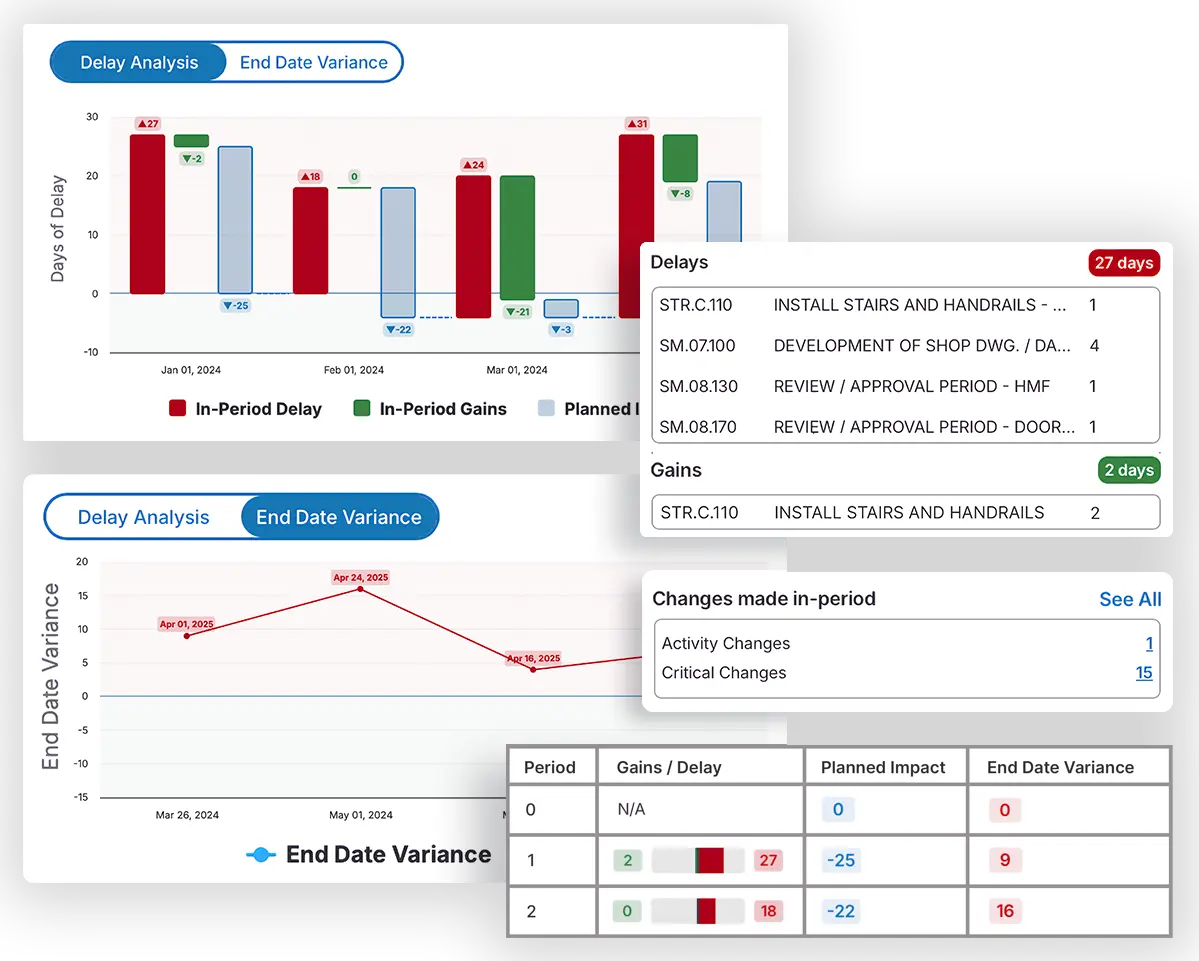
Tracked across successive updates, float erosion on the critical path is what separates a crew running a few days behind from a completion date that has already slipped out of reach.
Construction monitoring and construction progress tracking are related, but they are not the same discipline. Monitoring observes jobsite conditions and verifies what is happening in the field. Progress tracking compares those observations to the approved schedule, critical path, milestones, and remaining work to determine whether the project is truly on track.
|
Area |
Construction Monitoring |
Construction Progress Tracking |
|
Purpose |
Verify what is happening on the jobsite |
Explain what field progress means against the schedule |
|
Primary Evidence |
Photos, daily reports, site walks, field observations |
CPM schedule updates, baseline comparisons, milestones, float, critical path movement |
|
Main Question Answered |
What happened on site? |
Is the project ahead, behind, or on track? |
|
Best Use |
Documentation, verification, communication, issue visibility |
Delay risk detection, recovery planning, performance reporting, project controls |
|
Limitation |
Does not explain schedule impact by itself |
Depends on accurate schedule data and disciplined updates |
Monitoring verifies reality. Construction progress tracking interprets reality against the plan. The strongest teams use both, then connect that evidence to construction analytics that show whether schedule risk is increasing or decreasing over time.
The most common tracking approach in construction looks like this: a superintendent fills out a daily report, a scheduler runs a monthly update, a project manager assembles a summary for the owner, and leadership gets a PDF with a bar chart.
Everyone walks away feeling informed.
That process has a structural problem. By the time the monthly progress reports surface, the delays have already happened. The data is backward-looking. The schedule compression is already baked in. The recovery options are more expensive than they would have been two weeks earlier.
Traditional methods rooted in manual data collection and monthly reporting cycles simply weren't built for the speed at which modern construction projects accumulate risk. They document progress rather than manage it.
According to SmartPM's 2025 State of Construction Scheduling Report, 76% of construction projects finish behind their original baseline, and only 12% of baseline schedules meet quality standards at the outset. Fewer than 5% of projects maintain that level of schedule quality through closeout.
The implication is clear.
Most construction teams are tracking progress against a schedule that was never reliable to begin with. That's not a tracking problem. It's a foundation problem, and it requires fixing at the source.
CPM data validation at the baseline stage catches those structural problems before the first progress update is ever recorded, so the tracking framework starts from a defensible foundation.
Before a team can track progress with any confidence, the schedule itself needs to hold up. A poorly built schedule produces misleading progress data. And misleading progress data produces exactly the kind of false confidence that lets potential delays accumulate undetected.
Schedule quality isn't about aesthetics or color coding. It's about whether the CPM network is logically sound, whether activities are properly sequenced with realistic durations, and whether the critical path genuinely represents the work sequence.
The DCMA 14-Point Check, developed in 2005 by the Defense Contract Management Agency, has become a widely referenced framework for evaluating the technical quality of project schedules. Originally designed for Department of Defense contracts, it has since been adopted across the construction industry as a baseline for assessing schedule integrity.
The 14-point framework checks for common structural problems:
These aren't abstract quality concerns. They're the specific conditions that cause a schedule to misrepresent reality, and by extension, cause progress data to be untrustworthy.
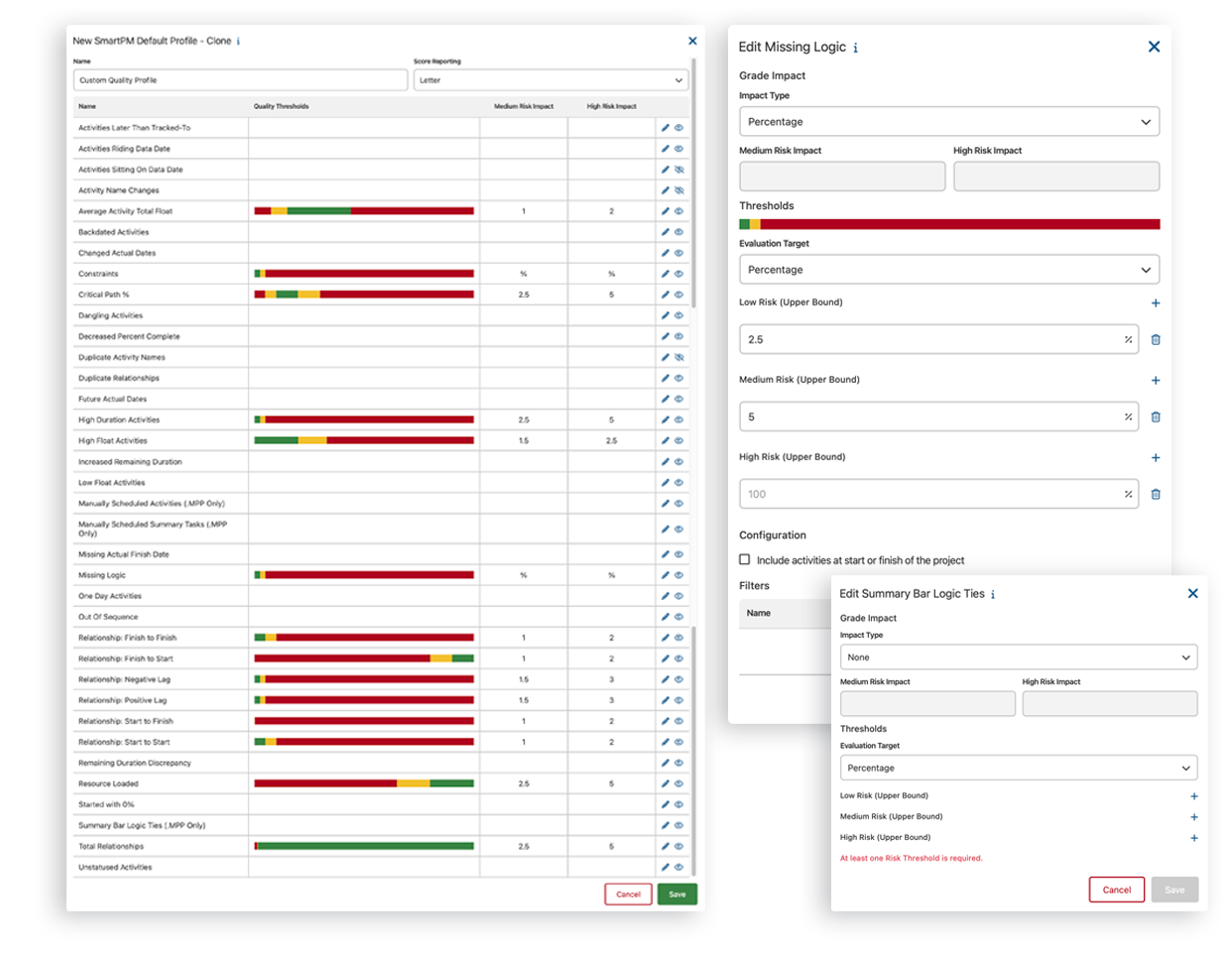
SmartPM's schedule quality framework evaluates 35+ metrics that reflect the realities of commercial construction: update integrity checks, contractor performance tracking, compression risk indicators, and logic density analysis.
The principle is straightforward. If the schedule doesn't hold up under scrutiny, the progress data drawn from it is unreliable, and the entire tracking effort is built on sand.
The practical implication: run a quality assessment on the baseline before comparing it to actual performance. If the schedule scores poorly, fix it first. Tracking progress against a bad schedule is worse than not tracking at all, because it creates false confidence.
If your team is still defining which schedule format best supports the project, start by understanding the types of construction schedules and how each one supports planning, coordination, and controls.
In my experience, the biggest mistake is tracking progress against a schedule that hasn’t been validated. If the logic is broken or the critical path isn’t real, the progress data gives teams false confidence. They think they’re measuring performance, but they’re actually measuring against a flawed baseline. Validate the schedule first — otherwise you’re using a broken measuring stick.


There's no single method that captures everything. Efficient progress tracking combines field-level observation with schedule-based analysis. Each method serves a distinct purpose, and understanding where each one falls short is just as important as knowing where it excels.
The strongest construction progress tracking systems combine CPM updates, field documentation, short-interval planning, and portfolio-level analytics rather than relying on one method alone.
|
Method |
Best Used For |
What It Misses |
|
CPM Schedule Updates |
Building the authoritative record of planned vs. actual performance; calculating delay; supporting or defending claims |
Requires disciplined, consistent input from qualified schedulers; quality of output depends entirely on quality of data entry |
|
Planned vs. Actual Percent Complete |
Planned vs. actual percent complete measures the gap between where the project should be and where it actually stands; identifying performance gaps early |
Does not explain why the gap exists or which trades or activities are driving variance |
|
Linking schedule performance to cost control; calculating SPI and CPI to measure efficiency against both plan and budget |
Requires a resource- or cost-loaded baseline to function; more complex to maintain accurately on fast-moving projects |
|
|
Daily Reports and Field Logs |
Capturing contemporaneous field activity; building the documentation record for dispute resolution; linking crew counts and conditions to specific dates |
Describes activity, not performance; knowing crews were on site does not tell you whether work was ahead or behind schedule |
|
Pull Planning / Short-Interval Scheduling |
Near-term coordination at the crew and trade level; constraint removal; task tracking in three-week look-ahead windows |
Not a substitute for CPM-based tracking; manages execution cadence within the overall timeline but does not replace it |
|
Giving operations leaders real-time visibility across multiple projects; identifying systemic scheduling problems; benchmarking performance by region or project type |
Depends on consistent data quality at the project level; portfolio insights are only as reliable as the underlying schedule updates |
Many teams upload photos and daily logs directly into construction management software, linking field documentation to specific activities and schedule updates. This creates a more complete, centralized project data record than paper logs or disconnected email threads.
Pull planning complements CPM scheduling well: the CPM schedule manages the overall project timeline, while pull planning manages the execution cadence within it.
This process works best when it is tied to disciplined construction project planning from the start, not introduced after the schedule is already under pressure.
Not all metrics are created equal. Lagging indicators, like whether a project delivered on time, tell you what happened. Leading indicators tell you what's likely to happen next, while there's still time to respond and make informed decisions.
The most useful construction progress tracking KPIs are leading indicators that reveal schedule risk before the completion date visibly moves.
The metrics below lean heavily toward leading indicators.
|
Metric |
What It Measures |
What to Watch For |
|
Schedule Performance Index (SPI) |
The ratio of work completed to work planned at any point in time |
Values below 1.0 are a flag; the earlier a declining SPI is identified, the more recovery options remain |
|
Milestone Tracking |
Performance and risk trends for key project phases by analyzing the activities and float path driving each milestone |
Milestones slipping, float shrinking, or increasing delay on the path to a milestone; changes beneath a milestone often signal risk before the overall completion date moves. |
|
Float Erosion |
The rate at which total float is shrinking on the critical path across successive updates |
Consistent erosion across updates signals a tightening critical path and shrinking tolerance for disruption; tracking trends update-to-update reveals project trajectory |
|
Schedule Compression |
Whether remaining work is being forced into a shorter window than originally planned |
Often appears before the end date visibly moves; detecting it early, before it becomes a change order or claim, is one of the clearest returns on disciplined tracking |
|
Baseline Execution Index (BEI) |
How many activities were completed by their baseline finish date |
Values below 0.95 indicate underperformance accumulating into slippage; track BEI from update to update rather than in isolation |
|
Delay Accumulation |
Cumulative delay building across schedule updates over time |
A project consistently losing days per update period without recovery will finish significantly late even when individual delays look manageable |
Float erosion on the critical path and compression risk are particularly important to monitor together. When float is eroding while remaining work is stacking, the project is approaching a point where timely interventions become the only cost-effective option.
Evaluating those risk signals as a system, rather than checking each metric in isolation, gives project teams a clearer picture of whether the schedule is trending toward a recoverable delay or a structural problem that requires immediate intervention.
“Early in a project, I’m watching float erosion and compression risk first. If float is disappearing while the remaining work is stacking, that’s a sign the schedule is tightening before the end date moves. SPI and BEI help confirm it, but float erosion tells you the margin for error is shrinking — and that’s where delays usually start to compound.” - Mike Pink, SmartPM CEO.
A schedule update is only as trustworthy as the discipline behind it.
Updates that are inconsistently timed, inaccurately reported, or manipulated to look better than reality undermine the entire tracking function. They also create a paper trail that will be scrutinized if a claim is ever filed.
Several errors consistently corrupt collected data in construction schedule updates.
If an activity was recorded at 60% complete in one update and drops to 45% in the next without a clear scope change, the previous update was misreported.
That degrades the reliability of everything downstream and raises questions about whether the entire progress reporting process is trustworthy.
Data date manipulation artificially extends the reporting period without moving the project forward.
When the data date isn't advanced consistently, float calculations become unreliable and the project's true position against the baseline is obscured.
Remaining duration creep is the quiet version of delay. When in-progress activities are given additional remaining duration without explanation, the schedule absorbs scope or delay without recording it honestly.
Over time, this produces an end date that drifts forward in ways the project team can't fully explain.
When an activity is in progress but hasn't been updated, it stacks against the data date and compresses the remaining network.
This is different from intentional schedule acceleration. It's an unintentional consequence of poor updating habits that creates the same pressure on resources.
Consistent update frequency (weekly or bi-weekly on active projects), disciplined data entry by qualified schedulers, and a review process that catches anomalies before they reach owners or project stakeholders.
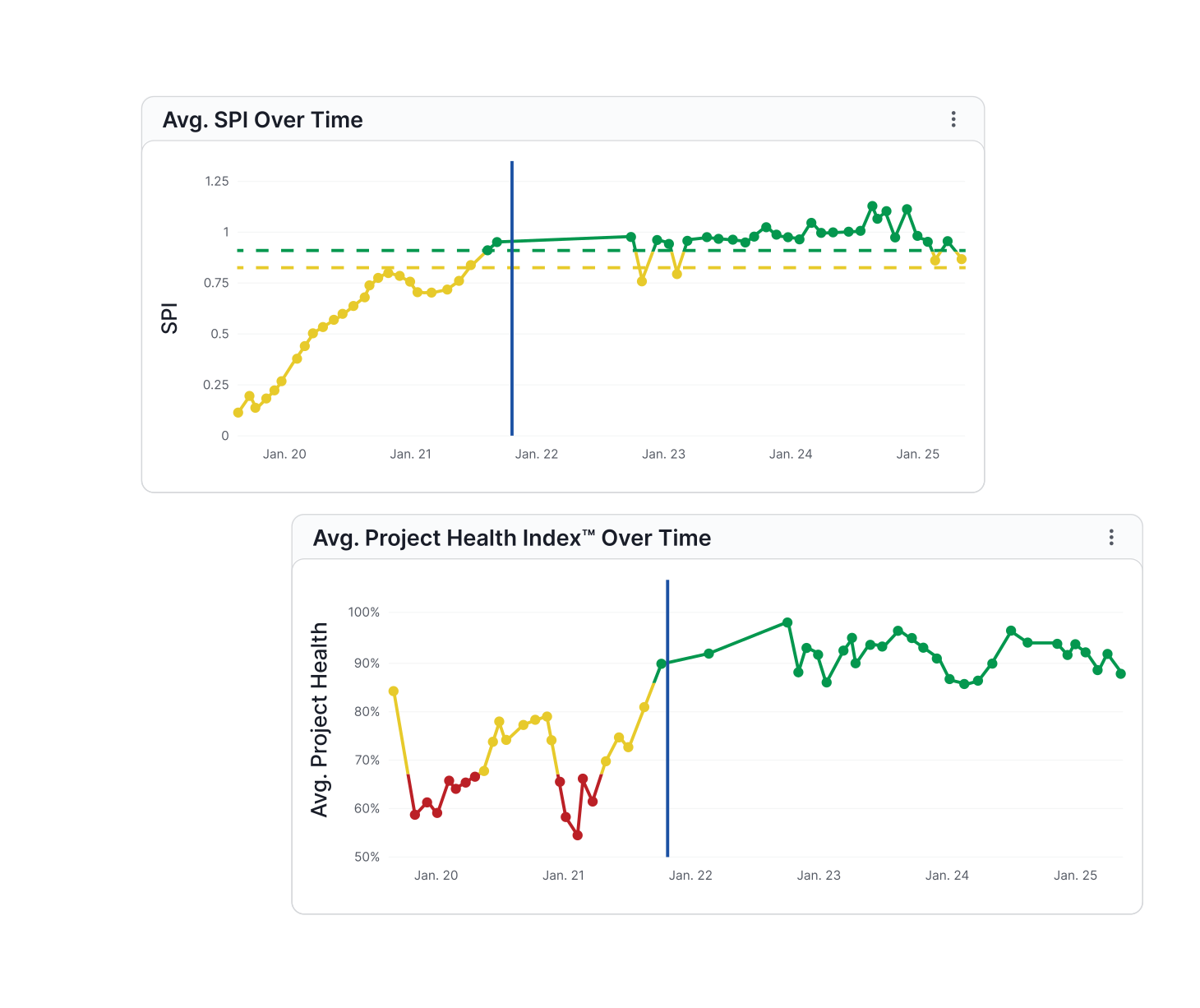
Modern tools have changed what's possible in real-time construction progress tracking.
Construction software that connects directly to CPM schedule files, automates quality checks, and surfaces performance metrics across the portfolio gives project teams capabilities that would have required a full project controls department to replicate manually a decade ago.
Real-time data availability matters because construction moves faster than monthly reporting cycles. When real-time progress tracking is in place, a scheduler uploading a weekly update can see within minutes whether the project's critical path has shifted, whether float has eroded, whether delay is accumulating, and whether key phase milestones are starting to drift. Instead of waiting for the overall completion date to move, teams can evaluate the paths driving major turnover points, trade handoffs, or phased deliveries and respond earlier. That's the game plan for proactive project management: catch the signal before it becomes a crisis.
Digital tools in this space generally fall into two categories. Construction management software such as Procore or Autodesk Construction Cloud centralizes project data, document management, RFIs, and field communication. Schedule analytics platforms like SmartPM sit on top of existing systems and analyze the CPM schedule files those tools produce. Both serve different purposes, and the most effective construction teams use both.
Real-time visibility into schedule performance is particularly valuable in multi-project environments. When visual data and schedule metrics are centralized rather than siloed by project, operations leaders can see where the risks are across the portfolio before team members escalate them through traditional reporting channels.
Microsoft Project, Primavera P6, and Phoenix Project Manager are the primary CPM scheduling tools used in commercial construction. None of them, on their own, provide the automated quality assessment, delay trend analysis, or portfolio-level dashboard capabilities that dedicated construction software in the analytics category delivers. The value of modern tools is in bridging that gap.
See how leading GCs use real-time construction progress data to stay ahead of their projects. Book a demo with SmartPM.
Project-level tracking answers the question: how is this project doing? Portfolio-level tracking answers the question: how is this company doing, and where are the risks nobody has surfaced yet?
These are different questions that require different capabilities. A spreadsheet summary assembled from project reports is not portfolio tracking. It's aggregated reporting, and it lags actual project status by at least a reporting cycle.
Satterfield & Pontikes Construction experienced this directly before implementing SmartPM.
Their Director of Scheduling, Seth Jeffrey, described the challenge: the company was using the DCMA-14 framework manually in Primavera, with everything built in Excel and siloed from the rest of the organization.
They had no real-time visibility into activity start and finish distribution against the baseline, couldn't see how multiple delays were compounding across the schedule, and didn't realize the magnitude of changes being made or their impacts on schedule quality.
"We had no visibility into our activity start and finish distribution as compared to the baseline plan," Jeffrey noted. "We also couldn't see how multiple delays impacted the schedule."
After implementing SmartPM, the team gained the ability to identify schedule changes and their impacts, have proactive conversations about workload and performance, and track quality trends across projects. The platform didn't replace their scheduling process. It made the collected data from that process actionable.
MCP Group, an award-winning general contractor based in Topeka, Kansas, had a similar experience at the project delivery level. Before implementing schedule analytics, their teams were consistently finishing projects two months late.
After building a disciplined tracking practice, the company reversed that pattern, completing projects ahead of schedule, saving up to $75,000 on individual jobs, and reporting a 50x ROI on their investment.
See how leading GCs track performance across their entire portfolio. Book a demo with SmartPM
Owners and developers have a specific need in construction progress tracking: the ability to independently verify what they're being told.
Most owners receive progress information through the GC's schedule updates and progress reports. Those reports are produced by the party with a contractual interest in presenting the project favorably. That's a structural reality of the relationship.
For owners, real-time visibility into actual progress, drawn from the same schedule file the GC is managing, provides an independent check that builds trust rather than creating adversarial dynamics.
Columbia Ventures, a commercial real estate developer, experienced the downstream consequence of this gap firsthand. A multifamily project in the final third of construction experienced budget overruns and delays that were never formally communicated through the required notices.
When liquidated damages came into play at closeout, the GC submitted a delay claim covering nearly the entire project duration. As Josh Thigpen, Senior Development Manager and Partner at Columbia Ventures, described it, SmartPM was instrumental in "removing emotion in order to let the facts and data dictate negotiation."
LCOR Incorporated put it simply:
"Facts and data. SmartPM arms us with facts and data that just leads to better outcomes for everybody."
This is the owner's version of progress tracking. Having access to objective schedule analytics, with centralized project data and real-time progress reporting, means conversations about where the project stands are grounded in shared reality rather than conflicting narratives. That tends to strengthen owner-GC relationships rather than strain them.
For government agencies and federally funded programs, schedule transparency carries additional compliance requirements. SmartPM is the construction schedule analytics platform with FedRAMP® High authorization, making it the defensible choice for federal construction programs where data security and audit-readiness are non-negotiable.
Learn more about how SmartPM serves owners and developers navigating schedule visibility challenges.
Mature construction progress tracking doesn't vary by project with inconsistent standards and ad hoc reporting formats. It's systematic, consistent, and it starts before ground breaks.
Here's the game plan for a well-run project week to week.
The baseline is submitted, graded for quality before it's approved, and locked. Schedule updates are uploaded on a consistent cadence. Each update is reviewed not just for what changed, but for whether the progress data is trustworthy:
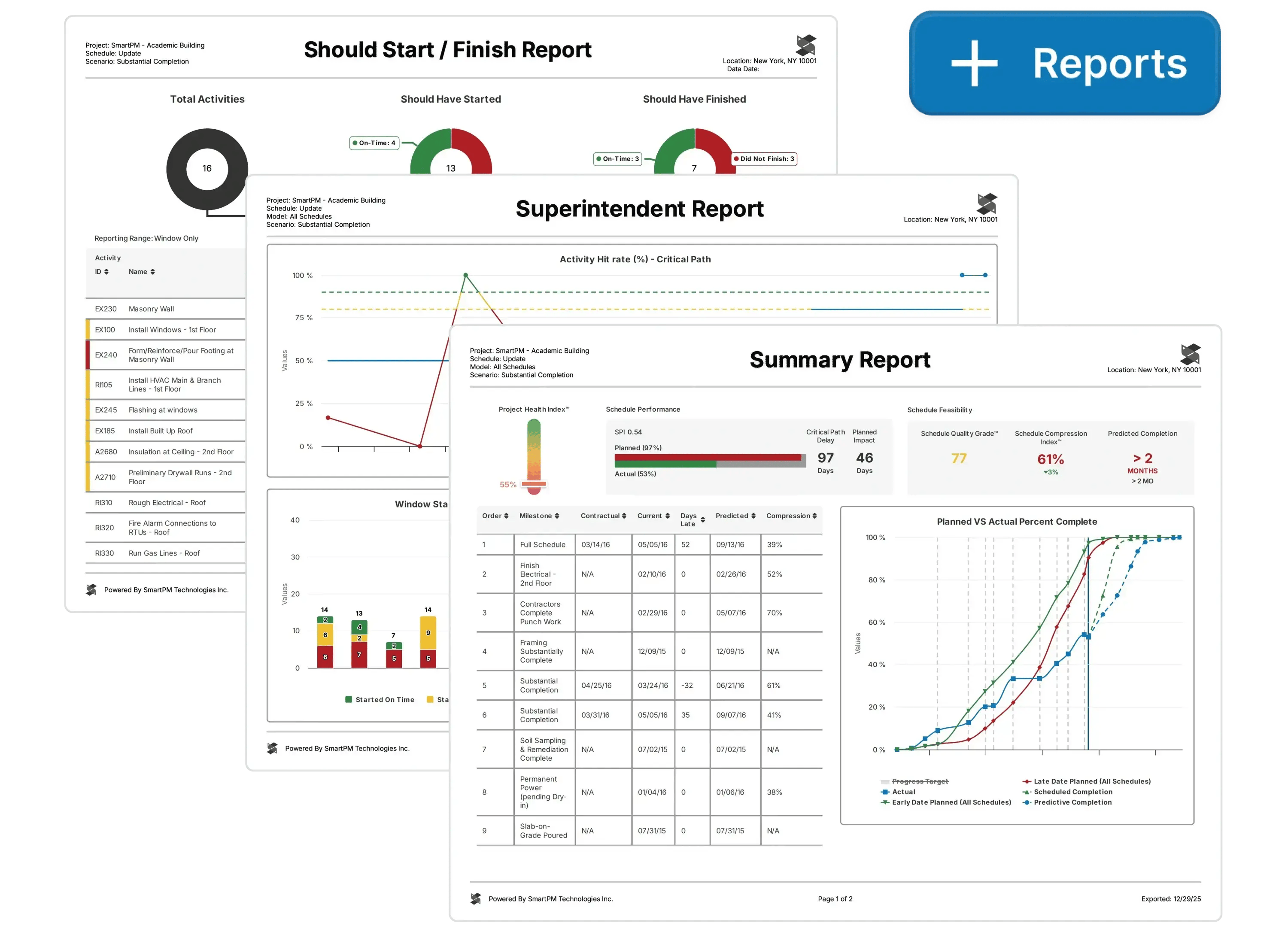
After the update review, key performance indicators are pulled automatically: planned vs. actual percent complete, float trends, delay accumulation, compression risk, and hit rate against the baseline. When metrics show variance, project managers don't wait for the next monthly report. They investigate the cause, quantify the impact, and model recovery options while the window for cost-effective action is still open.
Reading planned versus earned progress on the same cadence adds a budget-weighted view of that gap, which is easier to put in front of an owner than a float table.
Progress reports generated from the platform go to the owner on a consistent cadence, automatically, in a standard format. The owner sees the same metrics the project team sees. That transparency builds trust, reduces budget overruns caused by late discovery, and creates an audit trail that protects both parties if the project runs into trouble.
“The teams that actually use schedule data treat updates as a decision point, not a reporting exercise. They’re looking at trends every cycle — float, compression, performance — and adjusting while they still have options. The teams just checking the box upload a schedule, send a report, and don’t act until the end date moves. By then, most of the leverage is gone.” - Mike Pink, SmartPM CEO.
Choosing construction progress tracking tools is less about feature lists and more about understanding what kind of capability gap you're actually trying to close.
There are two fundamentally different categories of software that get grouped under "construction progress tracking." The first is visual progress verification, which uses imagery or reality capture to document physical conditions on site and document progress in the field. These tools confirm what's been built; they don't evaluate whether it was built on time or whether the critical path remains intact.
The second category is schedule analytics, which works from CPM schedule files to evaluate planned vs. actual performance, measure schedule quality, track construction activity against the baseline, and produce forecasts. This is the category that enables construction management software to function as a genuine control mechanism rather than a reporting system.
A meaningful distinction when evaluating tools: does the platform contain a true CPM engine or is it a visualization layer on top of scheduling software?
A visualization layer can make schedule data easier to read, but it can't evaluate logic, detect structural problems, or produce analysis defensible in a dispute. A proprietary CPM engine performs the underlying calculation work that makes the analysis reliable.
Other factors worth evaluating include integration with existing systems (Primavera P6, MS Project, Procore), schedule quality assessment against industry frameworks, real-time data availability across the portfolio, and automated reporting. The right tool fits the existing workflow rather than requiring teams to rebuild their entire process from scratch.
That fit starts with the construction scheduling software the team already runs, which the analytics layer should read from rather than replace.
SmartPM operates as an analytics layer on top of the scheduling tools project teams already use. It connects to existing systems, pulls the schedule files, and turns raw data into the actionable insights, metrics, and trend analysis that make tracking a genuine management function for the entire project lifecycle.
See SmartPM in action. Book a demo and see how over 70,000 project schedules are analyzed annually for leading GCs across the construction industry.