Choosing the wrong project controls software costs more than a subscription fee. It costs you months of adoption effort, unreliable data during the transition, and potentially a project controls program that never gets off the ground. We have watched this happen too many times to stay quiet about it.
At SmartPM, our CEO, Michael Pink, has spent more than 20 years in construction advisory, primarily in forensic delay analysis, working alongside the schedules that make or break construction projects.
That experience taught us something important: the gap between what software vendors claim and what actually holds up under real project pressure is enormous. Glossy demo environments and curated screenshots rarely tell you whether a tool can handle a 15,000-activity P6 schedule with logic issues baked in from day one.
We built this review methodology because construction professionals deserve an honest, technically grounded way to evaluate schedule analytics and project controls tools. Not marketing comparisons. Not pay-to-play rankings. A framework rooted in how these tools actually perform when the schedule hits the fan.
Why Trust Our Perspective
We are not a review aggregator or a software marketplace. We are a construction technology company that lives inside the same world our readers do – that matters because it shapes what we look for and what we refuse to overlook.
Deep construction roots. SmartPM was founded by a forensic delay analyst who spent two decades dissecting schedules for claims, litigation, and project recovery. Every evaluation criterion in this methodology traces back to problems we have actually encountered on real projects.
Trusted by the industry's best. More than half of the ENR Top 50 general contractors use SmartPM. When the most sophisticated project controls teams in North America choose to work with us, it validates that we understand what matters in this space.
We know what good looks like. Our proprietary CPM engine processes thousands of schedules. We see the patterns, the common failures, and the metrics that actually predict whether a project is heading for trouble. That volume of data informs how we evaluate other tools in the space.
We have skin in the game. Yes, we build schedule analytics software. We are transparent about that. But our credibility depends on the accuracy and honesty of everything we publish. If we recommended a tool that failed under real project conditions, our own reputation would take the hit. That keeps us honest.
What We Review (and What We Don't)
Our reviews focus specifically on schedule analytics, project controls, and construction scheduling software. This includes tools for schedule quality analysis, delay analysis and forensics, schedule performance monitoring, portfolio-level project visibility, and CPM schedule management.
We do not review general project management platforms (like Asana or Monday.com), field management tools, time tracking software, or accounting systems. These are different categories that serve different purposes.
How We Select Software for Review
We evaluate tools that construction project controls professionals are likely to encounter in the market. Our selection criteria includes:
- Market presence in construction. The tool must have meaningful adoption among general contractors, owners, or construction consultants. We are not interested in tools that claim construction capability but were originally designed for IT project management or manufacturing.
- Active development. The product must show evidence of recent updates and ongoing investment. Abandoned or stagnant tools do not get reviewed.
- Availability in North America. Our audience primarily operates in the United States and Canada, so reviewed tools need to be accessible in these markets.
- Relevance to CPM-based scheduling workflows. The tool must interact with or analyze CPM schedules in some meaningful way, whether that is through P6, MS Project, or other scheduling platforms.
What We Skip
We do not review tools that have no clear construction use case, products that exist only as vaporware or beta releases without real customers, or tools that are purely internal to a single enterprise (not commercially available).
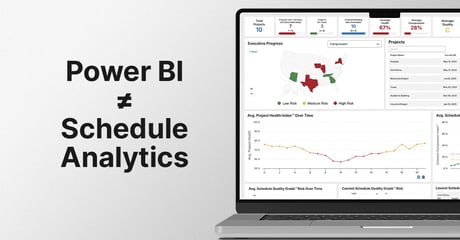
We also skip generic BI platforms like Power BI or Tableau on their own, since those are visualization layers rather than purpose-built schedule analytics tools.
Our 8-Factor Evaluation Framework
Every tool we review is scored across eight factors that reflect what actually matters when you are trying to manage schedules, identify delays, and protect project margins. These are not arbitrary categories. They come from two decades of watching what separates reliable project controls tools from the ones that create more problems than they solve.
Total Score: 100 Points Maximum
1. Schedule Quality Analysis Capabilities (20 points)
This is the foundation. If a tool cannot tell you whether your schedule is structurally sound, everything else it does is built on unreliable data. A schedule with open ends, excessive lags, negative float, and missing logic is not a planning tool. It is a liability.
What we evaluate:
- Number and depth of schedule quality metrics (the DCMA 14-point check is the baseline, not the ceiling)
- Ability to identify specific issues like open ends, missing logic, excessive lag, high-duration activities, and constraint overuse
- Schedule grading or scoring methodology
- Benchmarking capabilities (how does this schedule compare to industry norms?)
- Actionable reporting that tells you what to fix, not just that something is wrong
How we score:
|
Score Range
|
What It Means
|
|
18-20
|
Comprehensive metric library (30+), DCMA coverage and beyond, actionable remediation guidance, benchmarking
|
|
14-17
|
Solid coverage of standard quality checks, good reporting, some benchmarking capability
|
|
10-13
|
Basic quality analysis, covers DCMA checks but limited depth or actionability
|
|
6-9
|
Minimal quality checking, surface-level metrics without meaningful guidance
|
|
0-5
|
No real schedule quality analysis, or checks so basic they add little value
|
2. Analytical Engine and Data Integrity (15 points)
There is a critical difference between tools that visualize schedule data and tools that actually process it. A true analytical engine performs CPM calculations, identifies critical path changes, and detects patterns across schedule updates. A visualization layer just takes data from your scheduling tool and puts it in a prettier format.
This distinction matters because visualization alone cannot catch the subtle issues that cause projects to go sideways. You need mathematical rigor behind the analysis.
What we evaluate:
- Does the tool have its own CPM engine, or does it rely entirely on the source scheduling tool's calculations?
- How does it handle schedule updates and version comparison?
- Can it detect critical path shifts between updates?
- Does it perform its own calculations or simply reformat existing data?
- Data validation and error handling when schedule files have quality issues
How we score:
|
Score Range
|
What It Means
|
|
13-15
|
Proprietary CPM engine with independent calculations, robust version comparison, data validation
|
|
10-12
|
Significant analytical processing beyond visualization, good version handling
|
|
7-9
|
Some analytical capability but heavily dependent on source data, limited independent processing
|
|
4-6
|
Primarily a visualization or reporting layer with minimal independent analysis
|
|
0-3
|
Pure visualization with no analytical processing
|
3. Delay Analysis and Forensic Capabilities (15 points)
When a project runs late and there is a dispute about who caused the delay, you need defensible analysis. Not a summary slide. Not a narrative someone wrote after the fact. You need time-impact analysis, as-built vs. as-planned comparisons, and a methodology that would hold up in arbitration or litigation.
Even if you never end up in court, having forensic-grade delay analysis means you can identify exactly where time was lost, which activities drove the delay, and whether acceleration is needed. That is valuable on every single project.
What we evaluate:
- Supported delay analysis methodologies (time impact, windows analysis, as-planned vs. as-built, collapsed as-built)
- Ability to isolate concurrent delays
- Audit trail and documentation quality
- Court-readiness of outputs
- Ability to trace delay causation across schedule updates
How we score:
|
Score Range
|
What It Means
|
|
13-15
|
Multiple forensic methodologies, court-ready outputs, concurrent delay handling, full audit trail
|
|
10-12
|
Strong delay analysis with at least one rigorous methodology, good documentation
|
|
7-9
|
Basic delay identification, some comparison capability, limited forensic rigor
|
|
4-6
|
Delay flagging without forensic methodology, narrative-based rather than data-driven
|
|
0-3
|
No meaningful delay analysis capability
|
4. Portfolio Visibility and Reporting (10 points)
A tool that works well on one project but cannot scale across a portfolio is not much help to a VP of Operations managing 40 active projects. Portfolio-level visibility means the ability to see schedule health, quality trends, and risk indicators across every project in a single view. And the reporting that comes out of it needs to serve multiple audiences, from the scheduler in the field to the C-suite.
What we evaluate:
- Portfolio dashboards with real-time (or near-real-time) data
- Customizable reporting for different audiences (executive summary vs. detailed technical)
- Alerting and exception-based monitoring
- Trend analysis across projects and over time
- Export and sharing capabilities
How we score:
|
Score Range
|
What It Means
|
|
9-10
|
Comprehensive portfolio dashboards, multi-audience reporting, alerting, trend analysis
|
|
7-8
|
Good portfolio view with solid reporting, some customization limitations
|
|
5-6
|
Basic multi-project view, limited reporting flexibility
|
|
3-4
|
Can handle multiple projects but no real portfolio analytics
|
|
0-2
|
Single-project focus only
|
5. Integration Ecosystem (10 points)
Schedule analytics tools do not operate in a vacuum. They need to connect with the scheduling platforms your teams already use (P6, MS Project, Asta Powerproject), and ideally with the broader tech stack (Procore, CMiC, ERPs, Power BI). A tool that requires manual data entry or cumbersome file transfers creates friction that kills adoption.
Our position has always been simple: we play nice with everybody. We evaluate other tools by the same standard.
What we evaluate:
- Native integrations with major scheduling platforms (P6, MS Project, Phoenix, Power Project)
- Connections to construction management platforms (Procore, Autodesk, CMiC)
- API availability for custom integrations
- Data import/export flexibility
- Ease of data flow (automated sync vs. manual upload)
How we score:
|
Score Range
|
What It Means
|
|
9-10
|
Native integrations with 5+ major construction platforms, robust API, automated sync
|
|
7-8
|
Good coverage of common scheduling tools, decent API, some automation
|
|
5-6
|
Supports major platforms but limited automation, basic API or none
|
|
3-4
|
Manual file upload only with limited format support
|
|
0-2
|
Isolated system with no integration capability
|
6. Ease of Adoption and Time to Value (10 points)
The best analytics platform in the world is worthless if your team cannot get it running without a six-month implementation. Construction companies are not software companies. The people using these tools have projects to run. Adoption needs to be fast, intuitive, and supported.
We pay special attention to how quickly a team can go from signing a contract to actually getting useful data out of the tool. In construction, time to value is not a nice-to-have. It is the difference between a tool that gets used and one that collects dust.
What we evaluate:
- Implementation timeline (days vs. weeks vs. months)
- Onboarding and training requirements
- User interface intuitiveness for construction professionals (not just software-savvy users)
- Vendor support quality and responsiveness during rollout
- Learning curve for different user types (schedulers, PMs, executives)
How we score:
|
Score Range
|
What It Means
|
|
9-10
|
Fast implementation, minimal training needed, intuitive for construction users, excellent vendor support
|
|
7-8
|
Reasonable ramp-up time, good training resources, responsive support
|
|
5-6
|
Moderate learning curve, adequate support, some implementation complexity
|
|
3-4
|
Significant implementation effort, steep learning curve, limited support resources
|
|
0-2
|
Lengthy deployment, requires dedicated IT resources, poor or nonexistent support
|
7. Security, Compliance, and Data Governance (10 points)
Schedule data is sensitive. It contains information about project timelines, costs, resource allocation, and potential vulnerabilities. For government and federal contractors, security requirements are not optional. FedRAMP® authorization, SOC 2 compliance, and robust data governance are table stakes for working with agencies.
But even outside of federal work, data security matters. Construction firms increasingly operate under strict data handling requirements from owners, especially in sectors like healthcare, data centers, and critical infrastructure.
What we evaluate:
- Security certifications (FedRAMP, SOC 2, ISO 27001)
- Data encryption standards (at rest and in transit)
- Access controls and permission management
- Data residency and sovereignty options
- Audit logging and compliance reporting
How we score:
|
Score Range
|
What It Means
|
|
9-10
|
FedRAMP authorized or equivalent, comprehensive security certifications, granular access controls
|
|
7-8
|
Strong security posture with SOC 2 or similar, good access management
|
|
5-6
|
Basic security measures, standard encryption, limited compliance certifications
|
|
3-4
|
Minimal security documentation, unclear data handling practices
|
|
0-2
|
No meaningful security certifications or data governance
|
8. Value and Pricing Transparency (10 points)
Construction teams are used to dealing with opaque pricing in their own industry. They should not have to deal with it from their software vendors too. We look at whether a tool's pricing is clear, whether the total cost of ownership is predictable, and whether the value delivered justifies the investment.
What we evaluate:
- Pricing transparency (is it published, or do you have to sit through a demo to find out?)
- Total cost of ownership (licenses, implementation, training, support, add-ons)
- Pricing model alignment with construction workflows (per-project, per-user, flat rate)
- Contract flexibility and commitment requirements
- ROI evidence from existing customers
How we score:
|
Score Range
|
What It Means
|
|
9-10
|
Transparent pricing, predictable costs, flexible terms, strong ROI evidence
|
|
7-8
|
Clear pricing with minor add-on costs, reasonable contracts
|
|
5-6
|
Some pricing opacity, moderate commitment requirements
|
|
3-4
|
Hidden costs, rigid contracts, difficult to predict total spend
|
|
0-2
|
No pricing transparency, aggressive sales practices, locked-in contracts
|
Our Research Process
For each tool we review, we conduct research across multiple dimensions. Our goal is to evaluate the product as a construction professional would experience it, not as a vendor would present it.
1. Product Documentation and Feature Analysis
We start with what the vendor makes publicly available: feature pages, documentation, knowledge bases, API references, and technical specifications. We assess whether the claims are specific and verifiable or vague and marketing-heavy. A vendor that publishes detailed methodology documentation gets more credibility than one that hides behind "proprietary algorithms" with no explanation of approach.
2. Independent Review Analysis
We aggregate and analyze verified user reviews from platforms like G2, Capterra, and Software Advice, prioritizing reviews from construction professionals. We pay close attention to feedback about real-world schedule handling, issues around performance at scale, support quality during implementation, and long-term reliability.
We look for patterns, not outliers. A single negative review is not disqualifying, but recurring complaints about the same issue across multiple reviewers tells us something meaningful.
3. Technical Depth Assessment
This is where our construction expertise makes the biggest difference. We evaluate whether a tool's analytical approach is technically sound. Does its quality-checking methodology align with industry standards like the DCMA 14-point check and AACE recommended practices? Does its delay analysis approach follow recognized forensic methodologies? Or is it generating numbers without a defensible methodology behind them?
We also assess how the tool handles edge cases that are common in real construction schedules: negative float, out-of-sequence progress, fragmented critical paths, and overly constrained activities.
4. Integration and Ecosystem Review
We evaluate the breadth and depth of integrations, particularly with P6, MS Project, Procore, and major ERPs. We look at API documentation quality, data format support, and whether the integration is genuinely bidirectional or just a one-way data dump.
5. Market Positioning and Customer Context
We look at who the vendor says they serve and compare that with who actually uses the product. A tool marketed to "construction professionals" but primarily adopted by IT project managers tells a different story than the marketing suggests. We look at case studies, published customer lists, and industry presence (conference sponsorships, ENR rankings, association partnerships).
How We Calculate Overall Scores
Each factor is scored on its individual scale, then weighted according to its relative importance for project controls professionals.
|
Factor
|
Weight
|
Max Points
|
|
Schedule Quality Analysis Capabilities
|
20%
|
20
|
|
Analytical Engine and Data Integrity
|
15%
|
15
|
|
Delay Analysis and Forensic Capabilities
|
15%
|
15
|
|
Portfolio Visibility and Reporting
|
10%
|
10
|
|
Integration Ecosystem
|
10%
|
10
|
|
Ease of Adoption and Time to Value
|
10%
|
10
|
|
Security, Compliance, and Data Governance
|
10%
|
10
|
|
Value and Pricing Transparency
|
10%
|
10
|
|
Total
|
100%
|
100
|
Score Interpretation
- 85-100: Outstanding. Best in class for project controls professionals. Comprehensive capabilities with minimal gaps.
- 70-84: Very Good. Strong performer that delivers real value. Minor limitations that do not undermine core functionality.
- 55-69: Solid. Capable tool with notable gaps in certain areas. May be a good fit for specific use cases but not a complete solution.
- 40-54: Fair. Functional but has significant shortcomings that limit effectiveness for serious project controls work.
- Below 40: Not Recommended. Does not meet the baseline requirements for construction schedule analytics.
Our Commitment to Objectivity
What We Do
- Apply consistent evaluation criteria across every product, including our own competitive space
- Base assessments on publicly available information and verified user feedback
- Disclose our methodology transparently
- Highlight both strengths and weaknesses for every tool we review
- Update reviews as products evolve and as we learn new information
What We Don't Do
- Accept payment, commissions, or advertising revenue in exchange for reviews or rankings
- Cherry-pick positive feedback while ignoring critical reviews
- Evaluate tools based only on demo environments or best-case scenarios
- Position our reviews as a substitute for your own due diligence
Our Bias, Acknowledged
We build schedule analytics software. That is a bias we cannot eliminate, and we will not pretend otherwise. What we can do is be transparent about it, apply our criteria consistently, and let the methodology speak for itself. If a competitor outperforms in a given category, we will say so. Our credibility depends on it.
Limitations of Our Methodology
No evaluation framework is perfect, and we believe in being upfront about what ours can and cannot do.
What this methodology covers:
- Feature availability and depth based on vendor documentation and public information
- User experience patterns based on aggregated review data
- Technical soundness of analytical approaches based on industry standards
- Integration and ecosystem evaluation based on published capabilities
What this methodology does not cover:
- Hands-on performance testing with identical datasets across all products
- Long-term reliability beyond what user reviews and market presence indicate
- Custom pricing negotiations or enterprise-specific configurations
- Internal product roadmaps or features in development
Why we don't run controlled benchmarks:
Rigorous benchmarking of schedule analytics tools would require loading identical, complex P6 schedules across every platform, running forensic analyses, and comparing outputs down to the activity level. That is an enormous undertaking requiring licensing agreements, implementation, and weeks of testing per product. Instead, we rely on the technical depth of our team, the collective experience of verified users, and publicly available documentation. We acknowledge this limitation openly.
When We Update Reviews
We aim to update evaluations annually, or sooner when triggered by significant product changes, major pricing restructuring, company acquisitions or mergers, notable shifts in user review sentiment, or new integrations with major construction platforms.
When a product is discontinued, acquired, or materially changed, we note this in the review and adjust scoring accordingly.
Questions or Feedback?
We built this methodology to serve construction professionals, and we want to keep improving it. If you have suggestions for how we can make our reviews more useful, spot an error in one of our evaluations, or want to challenge a score with specific evidence, reach out to us. We take this seriously, and we will review our evaluation and share our reasoning.
The goal is straightforward: help project controls teams make better-informed software decisions based on what actually matters when schedules, margins, and project outcomes are on the line.