Spotlight on AACE RP 45R-08: How SmartPM Supports Best Practices
"When the Project Schedule is accurately maintained and documented, it is a vital element in successful project claims management."
Blog
Construction scheduling is the process of planning and organizing activities, resources, and timelines for a construction project.

Effective construction scheduling is what separates a project that delivers from one that drains margin and ends in dispute. It converts blueprints into sequenced, time-bound plans by defining what gets done, in what order, by whom, and when. Construction scheduling is essential for managing time, resources, and costs while keeping team members aligned, which helps prevent delays and budget overruns.
Yet even experienced teams run into serious trouble, not because they lack a schedule, but because the schedule they are managing is not actually reliable. According to McKinsey, 98% of megaprojects face cost overruns or project delays. That number holds across regions and project types. The root cause is almost always traceable to poor scheduling and poor schedule quality.
This guide covers the full construction scheduling process: the methods, the tools, how to build one in 12 steps, and what best-in-class teams do differently.
Construction scheduling is the process of planning and organizing all activities, resources, and project timelines needed to complete a construction project.
At its core, a project schedule answers three questions: what activities need to happen, when they need to happen, and who or what is needed to execute them.
The schedule is a living document. Before construction begins, it represents the plan. Once work is underway, it becomes the baseline against which actual progress is measured, updated, and defended. The construction process involves sequencing work, and scheduling methodologies must adapt to the unique challenges of construction workflows.
|
Term |
Definition |
|
Project Milestones |
Significant events marking key stages of the project (e.g., substantial completion, Building A handover) |
|
Duration |
Time required to complete an activity, measured in work days or calendar days |
|
Critical Path |
The longest sequence of dependent activities that determines the minimum project duration |
|
Task Dependencies |
Logical relationships between activities; one must start or finish before another can proceed |
|
The amount of time an activity can be delayed without pushing the project's end date |
|
|
Lead Time |
Time between the start of one activity and the start of a dependent activity |
|
Lag Time |
A deliberate delay between two activities, such as concrete curing time |
|
Resource Allocation |
Assignment of labor, equipment, and materials to specific project tasks |
|
The approved original schedule against which actual progress is tracked |
|
|
Master Schedule |
The high-level schedule governing all phases and milestones |
|
A hierarchical decomposition of the entire project scope into manageable work packages |
Construction scheduling is a collaborative process. The size and complexity of the project determines who takes the lead, but most commercial construction projects involve the following roles:
|
Role |
Responsibility |
|
Construction Scheduler |
Builds and maintains the schedule. A dedicated role on large commercial projects; often handled by the project manager on smaller ones. |
|
Project Manager |
Oversees the scheduling process, aligns the timeline with project goals, and ensures the schedule reflects operational reality throughout the project lifecycle. |
|
Site Supervisor |
Provides field-level input that keeps durations and sequences grounded in what can actually be executed. |
|
Architects and Engineers |
Supply design and technical constraints that affect sequencing. Design changes directly impact the schedule. |
|
Subcontractors |
Provide trade-specific durations, resource requirements, and sequencing constraints essential for a buildable schedule. |
|
Project Owner |
Reviews and approves the schedule before work begins. May also require regular updates and independent verification of reported progress. |
A well-run scheduling process keeps the entire project team aligned from groundbreaking to handover. Here are the 12 steps that make it work.
Establish what the construction project requires, what is excluded, and what a successful project looks like in terms of project goals, budget, and timeline. Clear scope definition is the only reliable defense against scope creep.
Decompose the full project into phases, deliverables, and individual tasks. Every activity on the schedule should trace back to a WBS element.
Determine the logical relationships between activities. The four dependency types: Finish-to-Start, Start-to-Start, Finish-to-Finish, and Start-to-Finish. Poorly defined task dependencies are one of the most common sources of schedule logic errors.
Assign time estimates to each activity using historical data, trade input, and realistic production rates. Optimistic estimates prevent construction project managers from building a realistic schedule.
Assign labor, equipment, and materials to activities. Identify resource constraints early and level the schedule before it becomes the baseline.
CPM for most commercial construction projects. LOB for repetitive work. The Last Planner System LPS for improving pull planning and weekly work planning discipline across the project team.
Build the logic network, calculate early and late dates, determine float, and identify the critical path.
Mark key project events: mobilization, phase completions, substantial completion, and owner handovers.
Which of those events belong in the milestone schedule is a separate decision, and keeping the set small is what stops the summary from becoming a second version of the network.
Check for open ends, negative float, logic errors, and unrealistic sequencing. Run schedule quality checks against DCMA standards before establishing the baseline. A schedule that does not pass quality review should not be baselined. This is the step where schedule development either produces a reliable plan or a document that looks finished but cannot be trusted.
Once the project team and project owner have reviewed the schedule and confirmed it is achievable, lock the baseline. All future updates measure against this version.
Update the schedule on a regular cadence. Record actual start and finish dates, revised durations, and documented reasons for any changes. Keep every update version for potential future use in claims or dispute resolution. Planned schedule vs. actual schedule comparisons only hold up if the data is clean and consistently maintained.
When the project closes, review what the schedule predicted versus what actually happened. Use that analysis to improve duration estimates, logic structures, and the scheduling process on the next project. A successful project leaves behind better data for the next one.
.png?width=3662&height=2463&name=Quality%20Grade%20Start%20to%20Finish%20and%20Start%20to%20Start%20(1).png)
Construction projects move through five phases, and scheduling plays a different role in each.
|
Phase |
Scheduling Role |
|
Initiation |
Assess feasibility; establish rough project timelines and budget alignment with multiple stakeholders |
|
Planning |
Build the detailed project schedule; sequence activities, assign resources, identify the critical path |
|
Execution |
Track project progress against the plan; manage resource deployment and material delivery |
|
Monitoring and Controlling |
Compare actual vs. planned progress; identify float erosion, delays, and risk signals |
|
Closure |
Coordinate final inspections, punch lists, and handover on time; meeting deadlines here protects payment and reputation |
Every phase depends on the integrity of the schedule that preceded it. A weak planning-phase schedule compounds in execution. Problems that could have been caught early become delays, disputes, and rework.

Most guides to construction scheduling stop at process: define scope, sequence tasks, allocate resources. That is necessary but not sufficient. A schedule can look complete on paper and still be functionally useless.
Activities with 28-day durations, excessive positive lag, missing logic ties: these are structural defects that make a schedule an unreliable planning tool. By the time those defects surface as project delays, the window to respond proactively has closed.
Industry standard for schedule quality assessment comes from the DCMA 14-point check, a structured evaluation used by the Defense Contract Management Agency to assess whether a CPM schedule is fit for use. SmartPM's proprietary CPM engine extends beyond the DCMA standard, evaluating 35+ metrics to grade every schedule on the platform.
Schedule quality is the prerequisite for reliable schedule analytics. An analytics layer built on a bad schedule produces bad analysis.
Choosing the right construction scheduling technique depends on project type, project complexity, and the team’s capacity to maintain the schedule over time. Project planners play a key role in selecting and implementing the appropriate construction scheduling technique to optimize resources, foster collaboration, and manage risks throughout the project's lifecycle. Most large commercial construction projects combine more than one method.
The critical path method (CPM) is the foundation of most commercial construction project schedules. Critical path method (CPM) identifies the longest chain of dependent activities through the project, establishing the minimum project duration.
Any delay to a critical task pushes the project’s end date by the same amount. The output is a mathematically defensible project schedule that supports resource allocation, progress tracking, contract compliance, and delay analysis. Critical path scheduling is required by most owners and government agencies on complex projects and is the foundation of forensic delay analysis when disputes arise.
PERT (Program Evaluation and Review Technique) handles uncertainty in duration estimates by using three time values per activity: optimistic, pessimistic, and most likely.
This evaluation and review technique uses the weighted formula (O + 4M + P) / 6 to produce an expected duration, making it a useful program evaluation and review tool in early project phases when historical data is limited or project scope is not fully defined.
Line of Balance (LOB) is designed for projects involving repetitive tasks, such as multifamily housing, road construction, or modular builds. LOB plots production rates to ensure crews move continuously through each unit without idle time, preventing resource conflicts that CPM alone can miss across multiple locations.
The Last Planner System (LPS) is a collaborative planner system rooted in lean construction principles. Pull planning is central to how it works: teams work backward from milestones through structured sessions covering master schedule review, phase planning, and weekly work planning.
Last Planner System LPS works especially well on commercial construction projects with multiple overlapping trades, where allowing project managers and trade partners to collaboratively own the schedule produces more reliable commitments than a top-down approach.
Q scheduling (quantitative scheduling) uses bar charts to schedule materials and equipment by location and time, integrating advanced data analysis into resource planning on projects with high equipment and material demands.
Resource-oriented scheduling prioritizes resource availability over pure activity sequence. When critical resources are the binding constraint on the overall project timeline, this scheduling method builds the schedule around availability rather than logic sequence. It is a practical approach for construction teams managing multiple projects simultaneously with shared labor or equipment pools.
Construction scheduling tools fall into two categories: tools that build and display schedules, and tools that analyze them. Both categories matter, and they are not interchangeable.
Weighing the available construction scheduling software against that analytical bar is what separates a platform that just draws the timeline from one that tells the team when the plan is slipping.
SmartPM operates as a schedule analytics platform, not a scheduling tool. It does not replace P6 or MS Project. Instead, it provides seamless integration on top of them, running a proprietary CPM engine against uploaded schedule data to produce schedule quality grades, health scores, delay analysis, and portfolio-level dashboards. The distinction matters: P6 builds the schedule, SmartPM tells you whether the schedule is reliable and what is happening to it across multiple projects over time.
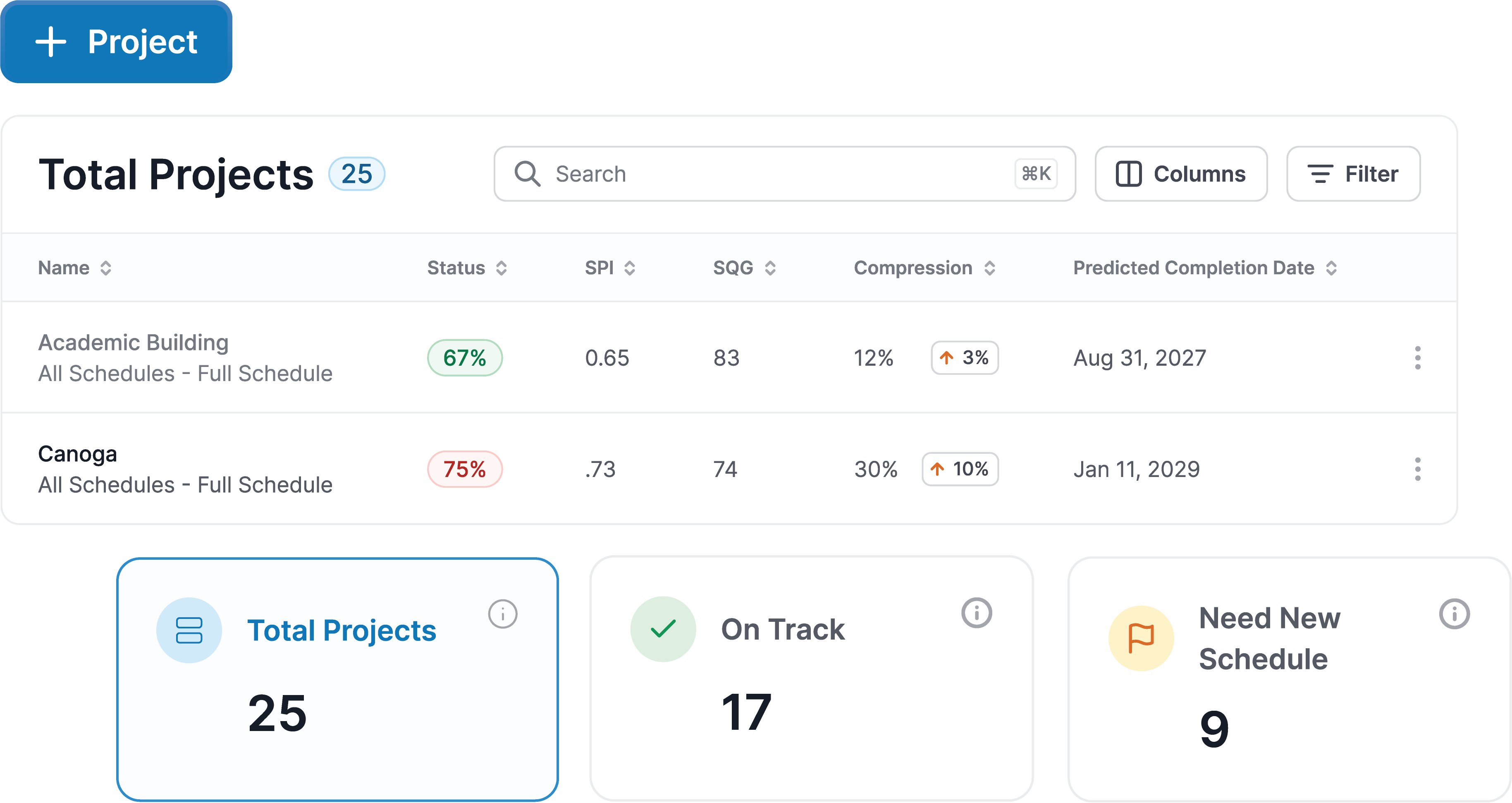
See what SmartPM’s schedule analytics look like on your projects. Book a demo.
The construction industry standard for large-scale scheduling. P6 handles complex activity relationships, calendar assignments, resource management, and critical path calculations. It is the tool of choice for ENR Top 100 contractors and government work requiring rigorous schedule documentation.
More accessible than P6 and widely used on mid-market commercial projects. Microsoft Project supports Gantt chart creation, task assignment, and basic critical path scheduling. Its integration with Microsoft Office makes schedule data straightforward to share across project teams.
Still in heavy use for look-ahead schedules, simple project tracking, and teams without scheduling software budgets. Its limitations become acute on complex projects where logic integrity, float calculations, and version control matter.
Work Breakdown Structure (WBS) divides the full project scope into a hierarchy of manageable components, from project phases down to individual project tasks. The three rules that make it work: the 100% rule (lower levels must fully account for everything above), mutually exclusive elements (no overlap between work packages), and measurable deliverables at the task level.
The critical path is the longest connected sequence of activities in the project network. It determines the minimum project duration and drives every scheduling decision that follows: contract compliance, resource allocation, and delay analysis all start here.
Proper resource allocation assigns labor, equipment, and materials to each activity based on availability and priority. Resource management extends that discipline across the project lifecycle, ensuring the project plan reflects what can actually be executed, not just what looks complete on paper.
Risk assessment involves identifying what could delay the project, estimating likelihood and impact, and building contingencies into the schedule. Weather, supply chain constraints, differing site conditions, labor availability: these are predictable risk categories that belong in the planning stage, not discovered mid-execution.
Progress tracking requires regular schedule updates comparing actual start and finish dates against the planned schedule. Planned progress and actual progress should align at a weekly or biweekly cadence. Monthly updates are common but often too infrequent: by the time a monthly analysis reveals a problem, a month of corrective opportunity has already passed.
|
Challenge |
Example |
|
Scope creep |
Additional project tasks added mid-build without adjusting the schedule |
|
Limited resource availability |
Key crews or materials unavailable when scheduled |
|
Poor time estimates |
Optimistic durations produce an unrealistic schedule from day one |
|
Task dependency conflicts |
Project delays cascade through dependent activities |
|
Change orders |
Scope modifications disrupt baseline logic and resource plans |
|
Weather conditions |
Outdoor work halted without float to absorb the delay |
|
Supplier delays |
Late material delivery idles crews on the critical path |
|
Decision paralysis |
Owner or design reviews stall activity starts and push project deadlines |
|
Equipment failures |
Critical machinery breakdown with no contingency plan |
|
Communication breakdown |
Field progress not captured in schedule updates, leaving the construction team working off stale data |
Look-ahead schedules (typically two to six weeks) give the project team time to resolve constraints before they become delays. Resource leveling eliminates overallocation without extending the overall project timeline. Reviewing schedule quality before issuing the baseline catches logic defects that would otherwise compound throughout the project lifecycle.
Schedule compression, through crashing (adding resources to critical path activities) or fast-tracking (overlapping sequential activities), can recover lost time. Both carry costs: crashing increases direct expense, fast-tracking raises rework risk. Forensic schedule analysis, grounded in AACE International's forensic schedule analysis standards, identifies the source and responsibility for delays, supporting claims resolution and documentation.
The teams that handle scheduling challenges best are the ones updating their schedules frequently enough to see problems forming, not just documenting them after the fact.
The gap between contractors who consistently deliver on time and those who do not comes down to schedule discipline, not schedule complexity.
Predefined templates ensure consistent logic structure, reporting cadence, and milestone definition across multiple projects. SmartPM provides a suite including the Contractor's Narrative Report, Executive Risk Report, 6-Week Look-Ahead, and OAC Report, each designed to keep project stakeholders informed without manual compilation.
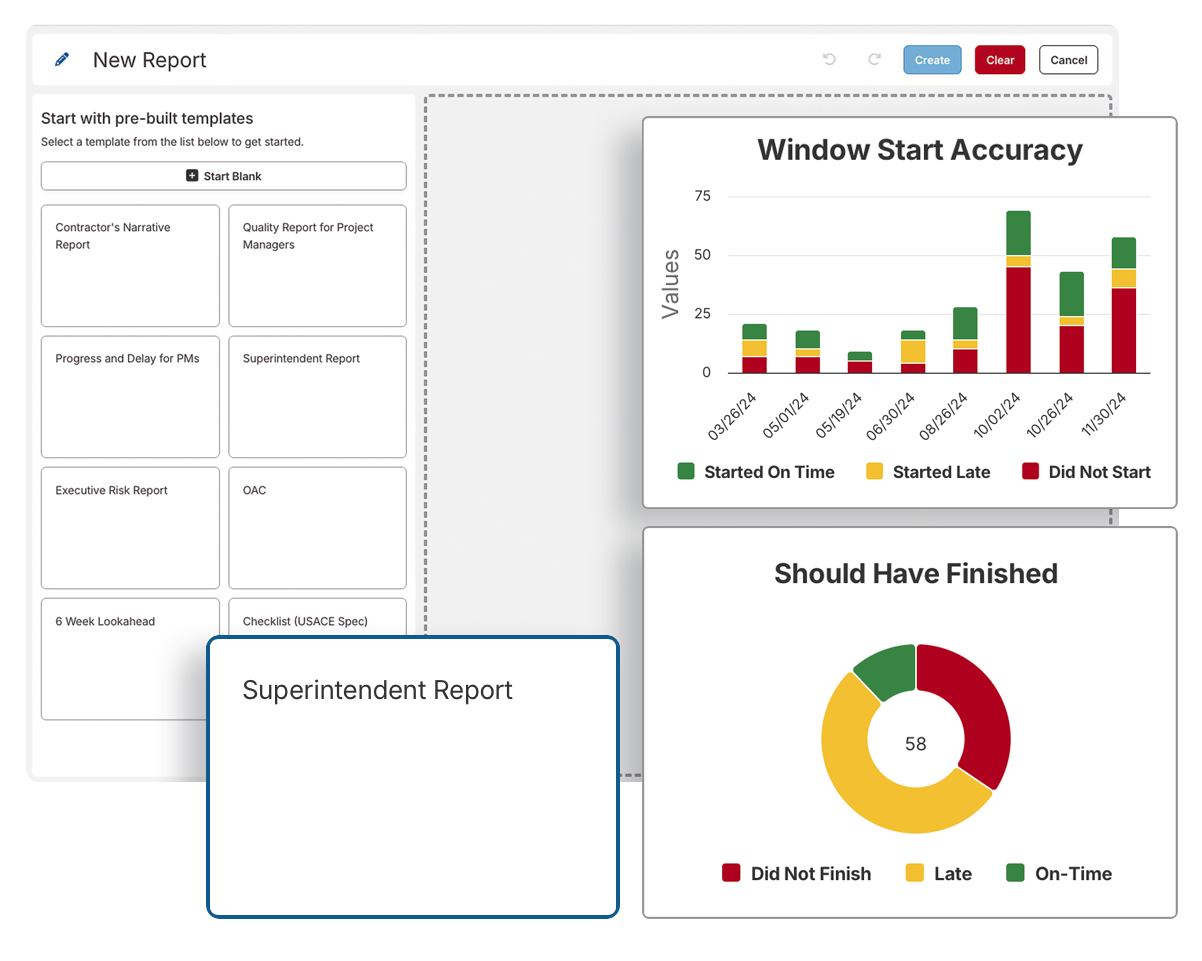
A project plan that lives only in a scheduler's software is not being used. Owners, trade partners, and project executives all need visibility into current project status and schedule trajectory. Transparency keeps everyone informed and reduces disputes.
Tom Carolan, Director of Scheduling at Barton Malow Builders, has noted that SmartPM provides leading indicators that give teams time to adjust early and with confidence. That early warning only exists when the schedule is updated frequently enough to surface it. Monthly updates report what already happened. Weekly updates give enough time to change the outcome.
Capturing actual progress in the schedule file is necessary but not sufficient. Understanding what that data means for the critical path, float trends, and project completion date requires analytical capability beyond what scheduling tools alone provide.
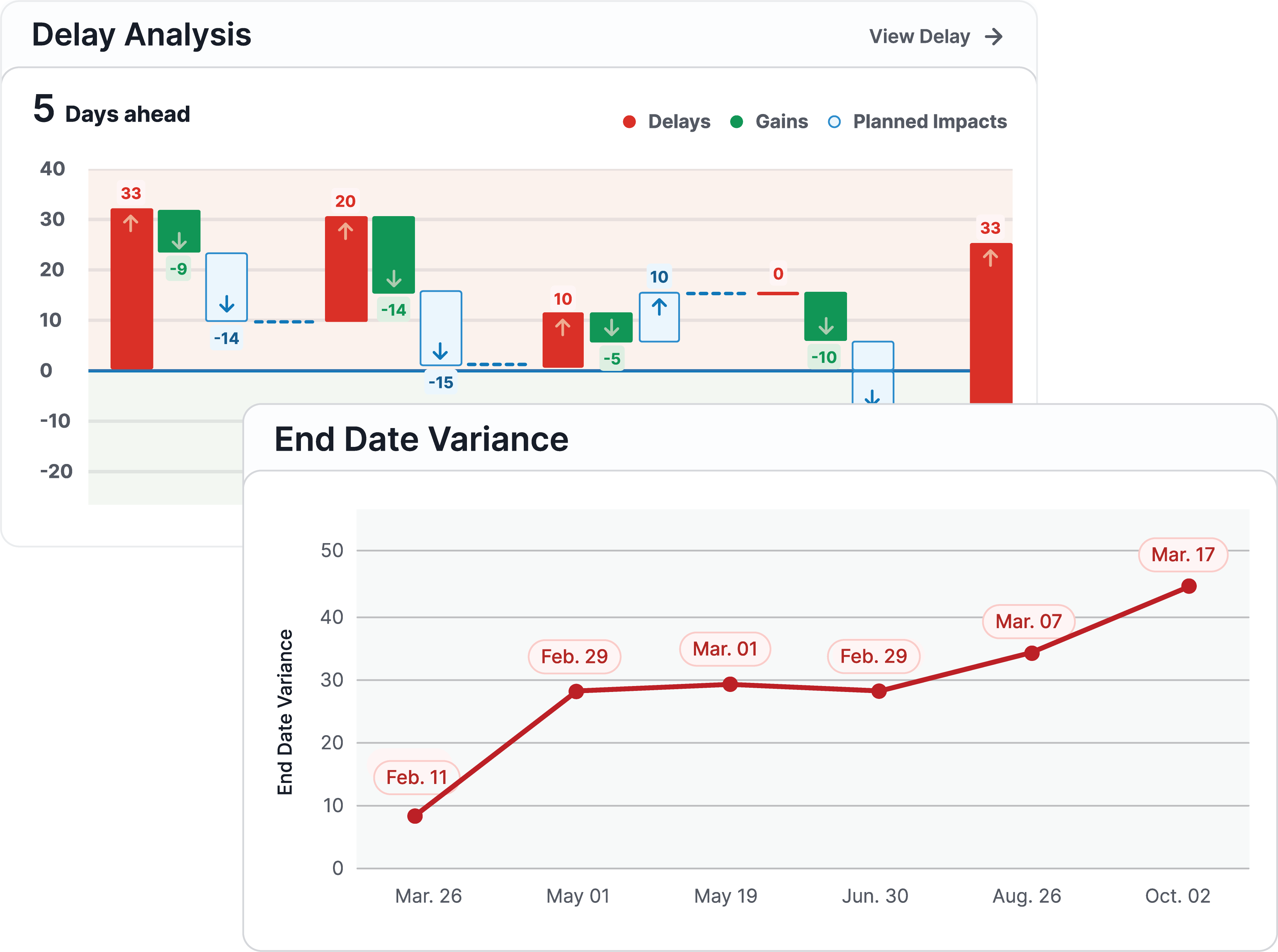
SmartPM does not build schedules. It analyzes them.
Construction teams upload schedule files from P6, MS Project, Procore, or Phoenix into SmartPM's platform, where the proprietary CPM engine runs mathematical operations against the data. The output: a schedule quality grade based on 35+ metrics, a schedule health score, delay attribution analysis, and portfolio-level dashboards showing the status of every active construction project in a single view.
The forensic delay analysis capability comes directly from CEO Mike Pink's 20+ years of experience as a delay analyst. More than half of the ENR Top 50 use SmartPM because that analysis is defensible: built on a real CPM engine, not a visualization layer. See how construction teams use SmartPM's construction schedule analytics.
SmartPM integrates with Primavera P6, Microsoft Project, Procore, Autodesk Construction Cloud, Phoenix, CMiC, Power Project, and PowerBI. It sits on top of existing tools and makes them more useful. No rip-and-replace required.
Ready to see what your schedule data is actually telling you? Book a SmartPM demo.


.jpg?width=460&name=Best%20Construction%20Scheduling%20Software%20(1).jpg)