
4 Reasons Why Construction is Litigious
The world has become gravely litigious, particularly in the commercial construction and real estate industries.

Blog
The majority of construction project claims result from impacts and delays over time, many of them being hidden for months after the fact.

Construction projects don’t fail all at once. They unravel gradually, often under the radar of even the most experienced teams. Missed deadlines, cost overruns, and disputes are typically symptoms of deeper issues, like unclear planning, mismanaged schedules, incomplete documentation, or delayed communication.
When left unaddressed, these challenges escalate into claims, draining time, money, and relationships.
The good news is that with proactive, well-documented analysis, construction claims avoidance becomes much more achievable. You can take practical steps to prevent construction project claims and subsequent disputes before they consume the project.
Construction delay analysis conducted at every update cycle builds exactly that kind of documentation, identifying which activities caused slippage and assigning responsibility before the data gets buried under months of additional changes.
It all comes down to a choice between objectivity and subjectivity.
Construction claims usually come from a gap between what the contract says should happen and what actually happens in the field. That gap may be caused by a single major event, but more often, claims develop through a series of smaller issues that compound over time.
Common causes of construction claims include:
The common thread is a lack of objective project data. Strong construction project controls, accurate CPM schedules, and consistent documentation give project teams a factual basis for identifying risk, assigning causation, and resolving issues before they become claims.
Whether you are an owner, general contractor, or subcontractor, understanding the categories of construction claims can help you avoid additional costs, additional time, and the strain of a protracted construction dispute.
Below is an overview of the most common claim types, giving project stakeholders the foresight to anticipate and address potential risks.
These types of claims occur when a project does not proceed as planned, causing an extension of time.
Delay claims often revolve around disagreements over the reasons for delays, such as excusable delays (for example, unforeseen weather events or acts of God) versus non-excusable delays caused by avoidable factors like mismanagement or resource shortages. [amended from: original wording included “e.g.” phrasing and had an incomplete parenthetical sentence.] Determining whether a delay is excusable is key to deciding responsibility for associated costs or schedule impacts.
Deciding responsibility is a separate question from quantifying the days, which is what a time impact analysis measures by inserting the delay event into the accepted schedule and comparing completion dates.
Prevention tip: Update the CPM schedule regularly, document delay events as they happen, and track causation before later updates obscure the facts.
Acceleration claims occur when a contractor is required or compelled to complete work faster than the agreed schedule. These claims can arise from direct orders to accelerate (directed acceleration) or situations where the contractor expedites work to mitigate delays without formal direction (constructive acceleration).
Prevention tip: Before accelerating, compare the recovery plan against the schedule of record and document whether acceleration is directed, agreed upon, or being performed to mitigate a specific delay.
Cost overrun claims arise when actual project costs exceed the agreed budget. Causes include inaccurate cost estimates, scope changes, productivity losses, or unforeseen conditions requiring additional resources. [amended from: original wording did not include “productivity losses.”]
Prevention tip: Track labor, equipment, materials, and productivity impacts at the activity level so cost growth can be tied to specific schedule events and decisions.
Design errors or omissions that lead to increased costs, additional work, or project delays are the basis for these claims. They often highlight incomplete plans or conflicts in design documents.
Prevention tip: Use RFIs, change logs, and schedule updates to document when design issues were identified, when responses were received, and how the critical path was affected.
These claims stem from disputes over whether additional work is outside the agreed project scope, often resulting from ambiguous construction contracts or evolving project requirements.
Prevention tip: Clearly define scope in the contract documents and document all change orders, directives, pricing assumptions, and schedule impacts before work proceeds where possible.
Claims for substandard work or materials arise when the final product fails to meet contractual quality standards, potentially requiring rework and compensation.
Prevention tip: Maintain inspection records, quality reports, deficiency logs, and rework documentation so quality issues are addressed early and supported by a factual record.
Payment disputes involve late payments, underpayments, or disagreements about the amount owed for completed work.
Prevention tip: Use consistent pay application processes, clear approval workflows, and documented backup to reduce ambiguity over completed work and amounts due.
These claims address defects discovered during the warranty period, holding contractors accountable for their obligations under the contract.
Prevention tip: Track warranty obligations, closeout documentation, and corrective work so responsibilities are clear after substantial completion.
Termination claims occur when one party prematurely ends a contract, leading to disputes over damages or compensation for incomplete work.
Prevention tip: Maintain accurate progress, cost, correspondence, and performance records throughout the project so the status of work is clear if termination becomes an issue.
Site conditions claims arise when actual site conditions differ from those described in the contract, such as hidden utilities, soil conditions, or hazardous materials.
Prevention tip: Document the condition immediately, preserve photos and field records, provide timely notice, and analyze the schedule impact before mitigation decisions are made.
Liquidated damages claims involve pre-agreed penalties for failing to meet contractual deadlines or performance targets.
Prevention tip: Maintain a reliable schedule history that distinguishes contractor-caused delay from owner-caused, excusable, or concurrent delay.
By recognizing these categories, project stakeholders can better anticipate, document, and resolve disputes before they escalate into costly claims.

Embracing an objective, fact-based approach reduces your risk during the dispute resolution process. It also clarifies the genuine impacts on your projects, including causation.
When paired with CPM scheduling, objective analysis paves the way for an iron-clad settlement strategy, offering the dual benefit of addressing internal project issues and minimizing construction claims. As these challenges are resolved, they lay the groundwork for smoother project execution.
Over the course of conducting similar analyses for numerous clients, I’ve gained valuable insights into the root causes of losses and claims. So, here is a list of things companies can do to minimize losses and mitigate claims effectively.
Developing a cost or resource-loaded CPM (critical path method) schedule is the first step any project should take. These schedules establish and document a workforce plan, timeline, and intended flow for the work. [amended from: original wording said “intended flow for their work.”]
This is beneficial for two reasons:
Thinking through workforce requirements, durations, and workflows at the outset greatly reduces the risk of a project becoming delayed and over budget.
If your team is evaluating different scheduling approaches, this guide to the types of construction schedules can help clarify where CPM scheduling fits.
The majority of construction claims result from impacts and delays over time. However, as a claims consultant, I noticed that the schedules analyzed on these projects consistently showed a static end date, indicating schedule compression.
While compressing a schedule might seem achievable, many of these projects used this tactic to the point that the schedule was unachievable. When that happens, the schedule is no longer a management tool. Rather, it becomes a means to indicate the project is progressing as planned.
Inevitably, the truth presents itself after over-compression leads to cost overruns.
CPM scheduling technology is highly useful, but only if you adopt a realistic approach. If your project experiences delays, take note of the delay within the schedule. Then, discuss it with the teams involved to develop and document a mitigation plan.
Do not remove logic and shorten durations unless you’ve discussed it as part of your mitigation strategy. Crashing your schedule consistently results in silent, unknown losses.
Avoid over-compression as much as possible so your schedule can be used to manage your project. Again, to avoid construction project claims, make your schedule as feasible as possible throughout the project lifecycle. [amended from: original wording said “you make your schedule as feasible as possible.”]
The right construction scheduling software can help teams maintain a more accurate schedule, but only when the schedule is treated as a management tool rather than a reporting exercise.
While the workforce required is tracked on most projects for accounting purposes, it is rarely captured as a way to understand productivity.
Productivity should be studied at the activity level as per the CPM schedule. At the least, it should be tracked for every trade in every area of the project, for example, on each floor. [amended from: original wording said “i.e., on each floor.”]
Productivity data, including productivity losses, should be captured daily for all work on the construction site. If X number of subcontractors worked on an activity, take note of the number of people and duration of time spent.
This information is paramount to controlling costs and project schedules. Schedule control software like SmartPM simplifies schedule data analysis, eliminating the need for extensive manual efforts.
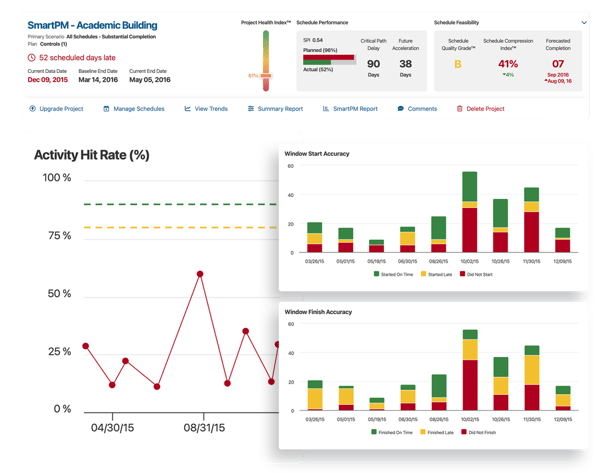
As a consultant dealing with construction project claims, the first thing I often did was create a detailed “as-built” schedule.
This is not your standard software’s “as-built” printout, as these tend to lack significant historical data. While start and finish dates and monthly percentage completes are useful, they are not enough to handle a claim, much less a dispute.
You need data that pinpoints and manages impacts as they are happening.
Detailed “as-built” schedules include this type of useful data, explaining why delays happen and offering clarity for claims or dispute resolution. It only takes 15 minutes daily to construct and is worth its weight in gold.
Before you can study impacts and causation, be sure you have done the following:
After following these steps, you can understand impacts and causation at any given point of the project lifecycle.
A main contributor to delays and overruns in construction is the lack of knowledge of critical impacts in real time. Many critical delays and impacts identified during the claims process begin as minor issues and then snowball into major problems from which projects cannot recover. The sooner you identify critical delays and impacts, the better the chance of overcoming them.
Identifying impacts at that pace requires real construction project controls, not just monthly reporting, since the lag between a problem occurring and a problem being detected is what determines whether it can still be addressed in real time.
For a broader breakdown of how controls support schedule, cost, risk, and performance visibility, see SmartPM’s guide to construction project controls.
While discussing project problems might seem like your worst nightmare, it offers an avenue for collaboration. CPM schedules are highly useful for this. They are an excellent information tool, as they hold the main points of discussion for collaborative project management.
When construction companies maintain honest, timely communication, projects run more smoothly. Greater transparency builds trust, leading to fewer disputes and stronger relationships overall.
Documenting the outcomes of all delay-related discussions is crucial for downstream protection. [amended from: original wording said “posterior protection.”] When millions of dollars are at stake, verbal conversations can be misinterpreted or forgotten.
So, ensure all discussions surrounding impacts, mitigation strategies, acceleration requests, and the like are documented. This ensures you have the necessary information during project closeout. Project correspondence like RFIs, change orders, and letters is great; emails work just as well.
Automating payment processes helps streamline the management of financial obligations on construction projects. With automation:
This proactive approach mitigates potential disputes, which are a common cause of claims in construction.
Efficiently managing project documentation, most notably CPM schedules, is critical for preventing claims. By ensuring that progress reports and related documents are detailed, accurate, and regularly updated:
When records and documents are meticulously managed, you reduce ambiguities that could lead to disputes.
The integrity of those records depends on the underlying construction software security model, where standards like SOC 2 Type II and ISO 27001 govern how schedule data and documents are stored, accessed, and audited over the life of the project.
The foundation for avoiding claims lies in a well-structured contract that sets clear, precise expectations for all parties. To achieve this:
By setting unambiguous expectations, you reduce the likelihood of misunderstandings or disagreements, creating a collaborative environment that focuses on project success.
These steps, when combined with the proactive use of CPM schedules and a collaborative approach to issue resolution, significantly reduce the likelihood of breach of contract or contract disputes.
Use this checklist to keep claims avoidance practical throughout the project lifecycle:
|
Claims Avoidance Action |
Why It Matters |
|
Create a cost-loaded or resource-loaded CPM schedule |
Establishes the baseline for measuring time, cost, and productivity impacts |
|
Update the schedule regularly |
Keeps the project team aligned on actual progress and emerging risk |
|
Track actual workforce daily |
Helps identify productivity losses before they become major cost issues |
|
Build a detailed as-built schedule |
Creates a factual record of what happened and when |
|
Document delay events immediately |
Preserves causation while the facts are fresh |
|
Review schedule compression carefully |
Prevents unrealistic recovery plans from hiding project risk |
|
Discuss problems when they arise |
Encourages early resolution before positions harden |
|
Document meeting outcomes and mitigation plans |
Reduces later disagreement over what was decided |
|
Maintain RFIs, change orders, letters, and emails |
Supports entitlement, causation, and impact analysis |
|
Define scope, payment terms, risk allocation, and delay clauses clearly |
Reduces ambiguity before the project begins |
|
Use centralized project controls software |
Improves visibility into schedule risk, documentation, and performance trends |
If you ever find yourself in a claims situation, know that effectively managing claims is all about being proactive, thorough, and collaborative throughout a construction project. By addressing issues as they arise, understanding your contractual obligations, and creating strategies to identify and manage risks, you can mitigate disputes before they escalate into formal claims.
Below are the four essential practices to help construction companies handle claims effectively.
Tackling problems as soon as they surface prevents small issues from snowballing into major disputes. Open lines of communication among stakeholders ensure that challenges are identified early, enabling timely resolution.
Proactively addressing delays, cost overruns, or quality concerns also builds trust and strengthens relationships between parties.
I cannot stress this enough: a clear understanding of your contract terms is crucial in managing claims. Contracts outline the roles, responsibilities, and risk allocations of all parties.
Familiarize yourself with key provisions, including clauses related to delays, changes, or unforeseen conditions. When disputes arise, an in-depth knowledge of these terms allows for stronger negotiations and claim defenses.
As mentioned above, many claims are symptoms of deeper project challenges, such as poor planning, misaligned expectations, or gaps in communication.
Analyzing the root causes of disputes helps address the underlying issues, minimizing recurrence and improving long-term project outcomes. This often involves reviewing schedules, resource allocations, and documentation to pinpoint the source of delays or disruptions.
No project is immune to risks, but having a well-prepared emergency plan ensures that issues can be managed efficiently.
Develop a plan that includes risk assessments, mitigation strategies, and a process for addressing unexpected challenges. A structured risk management approach reduces uncertainty and equips project teams with the tools to respond quickly and effectively when problems arise.
A comprehensive risk management plan only earns its keep if it is revisited at every schedule update, since the risks that generate claims rarely look the same at month six as they did at kickoff.
Once an issue becomes a potential claim, the project team needs more than a narrative. It needs a clear, supportable analysis of what happened, when it happened, who or what caused it, and how it affected the critical path.
That means tying cost impacts, schedule impacts, productivity losses, and mitigation decisions back to documented project records. Without that connection, claims become subjective and harder to resolve.
This is where construction analytics can help teams move beyond static reporting and identify the performance trends behind schedule and cost risk.
Claims have a ripple effect across financial performance, stakeholder relationships, project delivery, and the industry overall.
Financially, they drain resources and increase costs, sometimes leading to construction lawsuits or arbitration. Relationships between owners, contractors, and subcontractors strain under the weight of unresolved claims, sometimes damaging long-standing partnerships.
On the ground, claims slow project delivery, creating bottlenecks and jeopardizing timelines. Zooming out, the industry as a whole suffers from inefficiencies and distrust, as claims become a recurring theme in contracts and operations.
Addressing claims early and managing them effectively ensures smoother project outcomes and strengthens trust within the industry.
Construction claims avoidance is the process of preventing disputes before they become formal claims. It uses clear contracts, accurate CPM schedules, consistent documentation, progress tracking, and early communication to identify and resolve project risk while the team still has time to act.
The most common construction claims include delay claims, acceleration claims, cost overrun claims, design deficiency claims, scope change claims, payment disputes, unforeseen site condition claims, quality of work claims, warranty claims, termination claims, and liquidated damages claims.
CPM schedules help prevent construction claims by creating a clear baseline for planned work, sequencing, duration, and critical path impacts. When updated regularly, they help project teams identify slippage, analyze causation, document impacts, and evaluate mitigation options before issues escalate into disputes.
Helpful documents include baseline schedules, schedule updates, daily reports, workforce records, RFIs, change orders, meeting minutes, photos, pay applications, correspondence, deficiency logs, and documented mitigation plans. The key is not only collecting these documents, but keeping them accurate, organized, and tied to project events.
To prevent delay claims, maintain an accurate CPM schedule, update it consistently, document delay events immediately, track responsibility and causation, communicate impacts early, and record agreed mitigation steps. Delay issues are much easier to resolve when they are addressed during the project instead of months later.
Claims avoidance focuses on preventing claims before they happen. Claims management focuses on handling claims after an issue has already developed. The best project teams do both, but avoidance is usually less costly because it addresses risk before positions harden and formal dispute processes begin.
Contractors can reduce dispute risk by clarifying scope, using reliable CPM schedules, tracking progress daily, documenting project impacts, communicating issues early, understanding contract terms, and using objective project data to support decisions. Strong project controls make this process more consistent.
Overcoming construction claims demands objectivity, detailed planning, open communication, and meticulous documentation. A structured protocol integrating these principles into construction management significantly reduces risks and helps ensure timely, dispute-free project delivery.
The teams that avoid claims most effectively are usually not the teams with the least project risk. They are the teams that identify risk early, document it clearly, and use objective schedule data to make better decisions before disputes take over the project.
Take control of your projects. Equip your team with tools like SmartPM to streamline planning, improve visibility, and proactively manage risks. Learn more and safeguard your projects today.