
What is an RFI? Guide to Request for Information
An RFI is a formal request submitted during a construction project to clarify details, resolve uncertainties, or fill information gaps.

Blog

Change orders are an inevitable part of managing construction projects. For most general contractors, owners, and project teams, the challenge is not understanding what a change order is. The challenge is understanding what each change is doing to project performance.
A construction change order may adjust scope, contract value, schedule duration, or all three. But on active projects, the real risk is often broader than the signed document. Pending changes, disputed changes, late approvals, and poorly connected schedule updates can distort forecasts, hide critical path movement, and make executive reporting less reliable.
That is why change order management is not just an administrative process. It is a project controls discipline. When changes are documented late, priced inconsistently, or disconnected from the CPM schedule, teams lose visibility into cost exposure, schedule risk, margin movement, and the true path to completion.
This guide still covers the fundamentals for search intent, including what change orders are, common types, process steps, and what to include in a change order. But the focus is on what SmartPM’s audience needs most: better visibility into how change orders affect cost, schedule, forecast accuracy, risk, and overall project performance.
Change order management matters because every change can affect the cost forecast, CPM schedule, critical path, margin outlook, and risk profile of a project. For project controls teams, executives, and PM teams, the issue is not simply whether a change order exists. It is whether the organization can see how pending and approved changes are influencing project performance.
When change orders are tracked only as paperwork, teams can miss the cumulative impact. A handful of small scope changes may consume float, delay procurement, shift the critical path, or create cost exposure that does not appear clearly in the forecast until it is too late.
Strong change order management connects each change back to the schedule, budget, contract, forecast, and executive reporting process. That gives leaders a clearer view of what has been approved, what is still pending, where risk is building, and how the project’s expected completion date or financial outcome may be changing.
A change order is a formal amendment to the original construction contract that documents a change to the scope of work, contract price, project timeline, or some combination of the three. These changes may stem from owner requests, design clarifications, unforeseen conditions, RFIs, regulatory requirements, or coordination issues.
A typical change order includes a change order number, description of the change, reason for the change, revised scope, cost impact, schedule impact, supporting documentation, and required approvals.
For experienced project teams, the definition is straightforward. The bigger issue is control: making sure the change is validated, priced, approved, reflected in the CPM schedule, and visible in the project forecast.
There are several types of change orders used in the construction industry, each serving a specific purpose based on the nature of the change.
These occur when new work is added to the original scope. This type typically results in additional costs and extended project timelines. Common examples include client-requested upgrades, scope expansions, or regulatory compliance requirements that were not initially accounted for.
These reduce the scope of work, often leading to cost savings and a shortened project schedule. They may be initiated when project budgets are re-evaluated, or certain components of the project are deemed unnecessary.
These involve changes to the project that do not affect the overall cost. They are often used for clarification of design elements, minor scope adjustments, or sequencing changes that impact the workflow but not the budget or duration.
Issued by the project owner or architect, CCDs allow work to proceed immediately without a signed agreement on the revised price or time. This type of change order is particularly useful when time-sensitive decisions must be made, but it requires subsequent negotiation and documentation.
These change orders adjust the project timeline without altering the cost or scope. They are typically used in response to external delays, such as adverse weather or supply chain disruptions.
Justifying the days on a time-only change order usually means running a time impact analysis, which models the event in the accepted schedule and measures how far the completion date moves.
In some cases, the project scope remains unchanged, but a price adjustment is needed, perhaps due to material cost fluctuations or updated labor rates. These are categorized as price-only change orders.
Understanding the type of change order being issued is essential for accurate project tracking, financial forecasting, schedule analysis, and stakeholder communication. It also helps teams separate true scope growth from timing adjustments, substitutions, and administrative clarifications.
Change orders are typically triggered by a variety of factors that can occur throughout the project lifecycle. Understanding these triggers can help project teams anticipate, document, and respond to changes more effectively.
These include subsurface issues, contamination, or structural anomalies not identified in the original assessment. Discovering buried utilities, unstable soil, or unexpected rock formations often necessitates scope modifications.
Mistakes or gaps in the drawings, specifications, or scope descriptions can lead to confusion during execution. These discrepancies often prompt change orders to clarify the intended design or correct oversights.
Owners may alter aesthetic preferences, upgrade materials, or change functional requirements during construction. While these changes can improve project outcomes, they typically result in additional work and costs.
New or revised building codes, environmental regulations, or safety requirements can emerge mid-project. Compliance with these mandates may require design alterations, new materials, or changes in construction methods.
Market fluctuations, supply chain disruptions, or vendor issues can delay the availability of specified products. In such cases, substitutions or changes to procurement schedules may be necessary.
Requests for Information (RFIs) submitted by subcontractors or field teams often highlight ambiguities in the plans. When responses necessitate changes to the original scope, formal change orders are required.
Misalignment between subcontractors’ scopes or sequencing can uncover logistical challenges. Change orders help adjust timelines or tasks to ensure smooth coordination.
Sometimes, project owners request upgrades or enhancements that go beyond the original contract. These may include higher-end finishes, expanded amenities, or technology upgrades.
Anticipating these triggers and planning for change order contingencies from the outset can minimize disruptions and maintain project momentum.
The earlier these triggers are identified, the easier they are to evaluate against the contract documents, budget, and schedule. This is where strong construction project controls help teams connect field changes to project performance instead of reacting after delays or cost overruns have already accumulated.
A well-structured change order process gives project teams a controlled way to validate scope changes, quantify cost exposure, evaluate schedule impact, and prevent approval delays from becoming performance problems. Here’s how a typical process works.
The process begins when a project stakeholder identifies a potential deviation from the approved scope, budget, or schedule. This may originate from the field team, subcontractors, the project owner, the architect, or a coordination issue uncovered during execution.
The first control point is determining whether the item is truly a contract change or an issue that already falls within the original scope. That requires a review against the contract documents, drawings, specifications, approved baseline, and current project schedule.
Once the potential change is identified, the responsible party submits a change order request. The request should clearly describe the proposed modification, the reason it is needed, and the supporting evidence behind it.
At this stage, the quality of the submission matters. Field notes, photos, RFIs, sketches, revised drawings, subcontractor pricing, and schedule references help reduce back-and-forth and prevent the request from stalling in review.
The project management team evaluates whether the change is valid, necessary, and aligned with the contract. This is where teams should move beyond a simple yes-or-no review and assess the effect on scope, budget, forecast, procurement, sequencing, float, and milestone commitments.
For project controls teams, this step is critical. A change may look minor in cost but still create meaningful schedule exposure if it affects work on or near the critical path.
Detailed estimates are prepared, including labor, materials, equipment, overhead, and markup. At the same time, the team should evaluate schedule impact using the current CPM schedule, not a disconnected narrative estimate.
When the change affects time, the impact should be reviewed against critical path movement, available float, logic ties, procurement activities, and downstream trade sequencing. This is especially important on projects managed with construction scheduling software, where schedule data should support the change order decision.
The change is formalized in a change order form with a change order number, clear description, cost impact, schedule impact, and required supporting documentation.
Strong documentation is not just about contract compliance. It creates an auditable record that supports forecast updates, executive reporting, dispute resolution, and future analysis of project performance.
The documented change order enters the approval workflow. This may include the general contractor, owner, architect, subcontractors, finance, legal, or executive leadership, depending on the contract and approval thresholds.
Approval bottlenecks are one of the biggest risks in change order management. Pending changes can leave teams performing work without full commercial clarity, carrying unapproved cost exposure, or reporting a forecast that does not reflect the project’s true risk position.
Once approved, the change order is signed by all required parties and communicated to the project team. The communication should make clear what changed, who owns the work, what budget or contract value changed, and whether the schedule has been affected.
No one on the project should be unclear about the approved scope, responsible parties, cost impact, or schedule implications.
The approved change is executed on the jobsite. Project management systems should be updated to reflect the revised scope, timeline, budget, procurement needs, and reporting status.
Ongoing monitoring helps ensure the change is completed as approved and that additional unapproved scope does not accumulate around the original change.
After authorization, project records should be updated to reflect the approved change. This may include the contract value, budget, forecast, project schedule, procurement logs, meeting minutes, executive dashboards, and risk reports.
This is where many teams lose visibility. If approved and pending changes are not reflected in the same data used for forecasting and schedule reporting, leadership may not see the true impact until cost or delay has already materialized.
After execution, a follow-up review assesses whether the change was completed as approved, whether the cost and schedule impact matched expectations, and whether any lessons should be captured for future projects.
A disciplined and transparent change order process minimizes disputes, reduces rework, improves forecast accuracy, and gives stakeholders a clearer view of project risk.
A construction change order process flowchart helps teams understand who needs to act, when documentation is required, and where approvals can slow the project down.
Use the following flow as a simple model: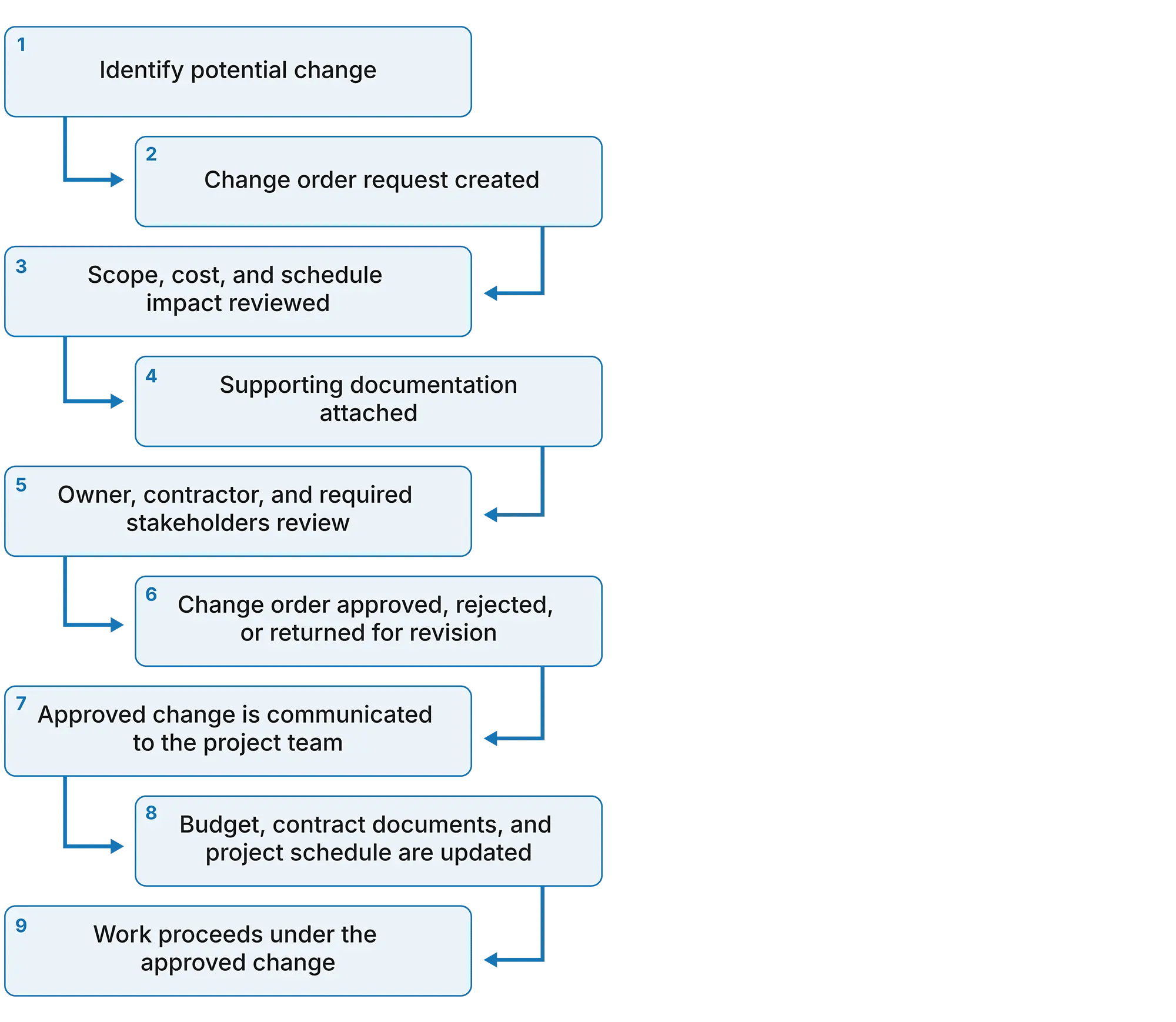
This flow should be adapted to match the contract, project delivery method, and approval authority on each project. On complex projects, teams should also connect change orders to the project schedule, cost forecast, and reporting dashboards so leadership can see the cumulative impact of changes over time.
Effective change order management requires a proactive and coordinated approach across the entire project team. For SmartPM’s buyer ICP, the goal is not only to move change orders through a workflow. The goal is to understand how change is affecting project performance.
Key strategies include:
Establish open lines of communication between all project stakeholders. Ensure that everyone, from field supervisors to project executives, understands the procedures and protocols for submitting, evaluating, approving, and reporting on change orders.
Communication should also clarify whether a change is pending, approved, disputed, forecasted, or already reflected in the schedule. These distinctions matter for leadership reporting and risk visibility.
Standardize documentation practices by using a consistent change order form or template. This should include clear descriptions, justification for the change, detailed cost breakdowns, schedule impacts, and supporting evidence.
Maintaining a centralized document repository helps avoid confusion, supports compliance, and gives project controls teams the backup needed to validate cost and time impacts.
Utilize project management software to automate and track change order workflows. This includes automatic alerts for pending approvals, digital signatures, and real-time updates to scope, schedule, and budget tracking.
Integrated workflows reduce manual errors and help teams identify where approval bottlenecks are creating commercial or schedule exposure.
Closely monitor additional costs related to change orders. Apply agreed-upon markup rates for labor and materials, and validate cost estimates with historical data or benchmarking.
For executives, the bigger question is how approved and pending changes affect the current forecast. If change order exposure is tracked separately from forecast updates, teams may understate risk and overstate expected margin.
Immediately evaluate approved and pending changes against the CPM schedule. Perform impact analyses to identify critical path shifts, float consumption, milestone movement, procurement constraints, and downstream trade effects.
Use schedule simulations to forecast the cumulative impact of multiple change orders, especially when changes occur in parallel or affect the same sequence of work.
Track the cumulative effect of approved, pending, and disputed change orders. A single change may appear manageable in isolation, but multiple small changes can compress float, shift the critical path, and alter the reliability of the reported completion date.
For teams that rely on CPM schedules, this should be reviewed alongside the appropriate types of construction schedules used on the project.
Change order reporting should give leadership a clear view of exposure across projects, not just a list of open items. Useful reporting includes pending change value, approved change value, average approval cycle time, schedule days at risk, critical path impacts, and trends by project, owner, trade, or change driver.
At the portfolio level, these trends help executives identify recurring sources of change, projects with growing risk, and teams that may need additional support.
Provide ongoing training for project managers and field staff on how to manage and process change orders efficiently. Assign clear ownership of each change order to ensure accountability and follow-through.
Accountability should include both workflow ownership and performance visibility: who owns the approval, who owns the schedule update, who owns the forecast update, and who is responsible for communicating risk.
Periodically review the status of open and closed change orders. Conduct audits to verify that all approvals, cost allocations, timeline changes, and forecast updates have been properly documented and executed.
Regular reviews help teams catch disconnects between the change log, budget, schedule, and executive report before they become disputes or missed forecasts.
To streamline change order management, construction teams should embrace both technology solutions and procedural best practices. The strongest tools do more than store forms. They connect change order activity to the project data leaders use to make decisions.
Digital templates help standardize how change orders are created, reviewed, and stored. They reduce paperwork and ensure consistency in documentation.
Templates should capture both commercial and schedule impact so teams can evaluate the full performance effect of each change.
Project management software can automate notification, routing, and approval processes. Automating workflows minimizes bottlenecks, reduces errors, and ensures timely processing.
Teams should also track approval cycle time, overdue reviews, and the value of pending changes so executives can see where delayed decisions are creating exposure.
Ensure that every change order is linked to its respective project name, contract number, original scope of work, budget, forecast, and CPM schedule activity where applicable.
This connection helps teams understand whether a change affects only contract value or whether it also affects procurement, sequencing, milestones, float, or the critical path.
Use cloud-based tools that allow stakeholders to view, comment on, and approve change orders in real time. This enhances communication and speeds up decision-making.
Real-time collaboration is especially valuable when unresolved changes are affecting active work, executive reporting, or near-term schedule commitments.
Implement systems that provide historical insights into change orders, helping identify patterns, causes of delays, or budget overruns.
Lifecycle tracking helps teams separate isolated project issues from recurring portfolio trends, such as repeated design clarifications, trade coordination conflicts, late owner decisions, or procurement-driven changes.
Storing all change order forms, approvals, and supporting documents in one location improves accessibility and audit readiness.
A centralized record also helps project controls teams validate whether cost, schedule, and forecast updates are supported by the approved change documentation.
Configure dashboards and reports to highlight pending approvals, cost variances, schedule impacts, forecast movement, and risk trends. Proactive reporting enables quicker mitigation.
Executive dashboards should make it easy to distinguish between approved value, pending exposure, disputed amounts, and changes already reflected in the current forecast.
Schedule visuals, including a construction Gantt chart, can help teams show how approved changes affect activity sequencing, milestones, and completion dates.
For more advanced schedule control, teams should review changes against CPM logic, critical path movement, and float consumption, not just static milestone dates.
Over time, construction analytics can reveal repeat change order drivers, approval delays, trade coordination issues, and project types with higher change exposure.
Analytics can also help leadership compare projects across a portfolio, identify teams with recurring approval bottlenecks, and understand where change orders are creating the greatest schedule or forecast risk.
By combining these tools and best practices, construction companies can better manage change orders, reduce risk, improve forecast accuracy, and protect project performance.
To be legally enforceable and practically useful, every change order should contain the following essential components:
To streamline compliance and standardization, many construction professionals use industry-recognized forms such as the AIA G701 Change Order and ConsensusDocs 202/795. These forms provide a structured framework that captures the required fields and approvals, ensuring legal sufficiency and alignment with best practices.
Including these elements ensures clarity, reduces risk of disputes, and facilitates smoother execution and tracking of project changes.
This checklist can also be used as a quality-control review before a change order is submitted for approval. If any of these items are missing, the change may be more difficult to price, approve, defend, or reconcile later.
Submitting a change order involves a clear and standardized approach to ensure that project changes are well-documented, approved, and implemented without confusion or delays. Here’s a step-by-step guide to help construction professionals navigate the submission process effectively.
Determine whether the proposed modification deviates from the original scope of work, contract value, or project timeline. This may result from field conditions, design clarifications, or owner-driven requests.
Use a standardized change order template or form. Include the required change order details listed in the checklist above, along with any RFIs, sketches, specifications, photos, or other supporting documentation.
Typically, subcontractors submit change order requests to the general contractor, who then consolidates and forwards them to the project owner or architect for review.
Each party should have designated contacts for managing change requests.
Before sending the request forward, the general contractor or construction manager should internally evaluate the cost estimates, timeline impact, and justification for the change.
Once submitted, the change order enters the formal approval process. Monitor the request through project management software to ensure timely responses and prevent bottlenecks.
After review and negotiation, the change order must be signed by all required parties to become binding. Only upon full approval should the change be implemented, unless the contract provides another authorized path such as a construction change directive.
Reflect the approved change in all relevant project schedules, budgets, and contract records. Notify all affected teams of the modification.
A well-organized submission process ensures clarity, accountability, and timely execution, key elements for maintaining project momentum and minimizing risk.
Poorly managed change orders can derail even the most well-planned construction projects. By proactively addressing scope changes and aligning all parties through transparent processes, teams can reduce disputes, protect margins, and maintain better control over the project schedule.
Change order management matters because every approved change has the potential to affect cost, scope, time, risk, and stakeholder confidence. When change orders are tracked in isolation, project teams may miss the cumulative impact. When they are connected to project controls, schedule analysis, and reporting, teams can make faster, more informed decisions.
The goal is not to eliminate every change order. Changes are a normal part of construction. The goal is to make sure each change is properly documented, priced, approved, communicated, and reflected in the project plan.
Change orders are unavoidable, and it is still useful for this article to answer the core search questions around definitions, process, documentation, and best practices. But for experienced contractors, owners, project controls teams, and executives, the real value is not another explanation of paperwork.
The value is visibility.
SmartPM’s audience needs to understand what change orders are doing to project performance: how they affect the CPM schedule, whether they are moving the critical path, how they change the forecast, where approval bottlenecks are creating exposure, and what trends are emerging across a portfolio.
With a clear process, consistent documentation, and connected project data, teams can manage change orders as a project controls function, not just a contract administration task. That is how construction organizations protect cost, schedule, margin, and stakeholder confidence when change inevitably happens.