
What Float in CPM Schedules Means for Your Construction Project
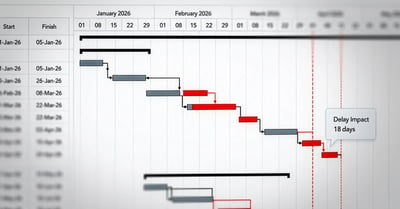
In essence, float can offer a buffer against unexpected changes, allowing activities to be postponed without impacting the overall end date.
Blog

Construction planning is the difference between a project that finishes on time and one that quietly loses margin every week until someone finally pays attention.
It sounds simple in theory: define the scope, build the schedule, allocate resources, manage the risks. In practice, construction project planning is one of the most complex, high-stakes disciplines in business, and most teams underinvest in it until something goes wrong.
This guide covers the full picture of the project planning process, from the phases every project moves through to the specific components that determine whether a plan holds up under real-world pressure. It also addresses something most planning guides skip entirely: what happens after the plan is built.
Construction planning is the process of defining how a construction project will be executed, what work needs to happen, in what order, by whom, with what resources, and within what constraints. It is an ongoing discipline that spans the entire construction project lifecycle, from preconstruction through closeout.
A construction plan typically encompasses scope definition, cost estimation and budget development, CPM scheduling, resource allocation, procurement strategy, risk management, and a communication framework for project stakeholders.
Done well, it gives every member of the construction team a shared understanding of the project's goals and a realistic path to achieving them.
Done poorly, it becomes a document that nobody trusts because nobody checked whether it reflected reality.
Most construction planning failures trace back to the same root cause: planning is treated as a front-end activity rather than a continuous management discipline.
The numbers behind poor planning are well-documented. According to McKinsey's construction productivity research, 98 percent of megaprojects face cost overruns or delays, with large projects typically finishing 20 percent late and running 80 percent over budget.
The root causes show up often:
The construction industry has accepted these outcomes as normal, but proper planning can change them.
Proper construction planning, backed by rigorous schedule monitoring throughout execution, changes the trajectory. The teams that consistently deliver on time have better data, and they act on it earlier.
SmartPM addresses this directly by treating the construction project schedule as a continuous data source. Every update runs through a proprietary CPM engine that measures 35+ quality metrics, surfacing structural problems in the plan itself before they show up as delays in the field. Teams know their schedule health score every week.
That cadence is what turns construction planning from a front-end activity into an active management discipline.
Understanding how construction project planning maps to the project timeline is essential for knowing when to act, and why sequencing matters.
The construction planning process begins before a shovel touches the ground. Pre-construction is where project objectives get defined, feasibility is assessed, and the foundational decisions are made that will either support or undermine every phase that follows.
This planning phase includes a thorough site assessment to understand existing conditions, access constraints, and environmental considerations. It also covers early-stage cost modeling, preliminary scheduling, identification of the key stakeholders whose input will shape the project's direction, and a review of applicable safety protocols for the construction site. Mistakes made here, particularly in scope definition and site assessment, compound throughout the entire project, undermining the entire construction effort.
As design progresses, the project scope sharpens. The work breakdown structure (WBS) begins to take shape, breaking the project into manageable, definable work tasks that can be scheduled, resourced, and tracked. This is the planning phase where defining work tasks with sufficient specificity pays dividends later. Vague scope is the most consistent precursor to change orders.
Project managers and construction managers should be deeply involved during design development, and project managers in particular should pressure-test schedule feasibility early, not just reviewing drawings but actively pressure-testing whether the scope can be built within the budget and schedule framework that has been established.
Procurement planning is often treated as an administrative function. In reality, it is a schedule risk variable. Long-lead items, specifically structural steel, mechanical equipment, and specialty systems, must be identified early and reflected as predecessor activities in the project schedule. When procurement is not logic-linked to the CPM schedule, a missed delivery date cannot be traced to its schedule impact until the delay has already happened.
Contracting decisions made in this phase, including how risk is allocated between the general contractor and trade partners, directly shape the risk management posture for the entire construction project.
Breaking ground without a detailed execution plan is how projects get into trouble quickly. This phase involves finalizing the CPM schedule, confirming resource availability, establishing the update cadence for schedule monitoring, and setting the communication protocols that will keep the project team aligned throughout construction, and confirming that all team members and the broader project team understand the baseline and update process.
The baseline schedule, the original CPM plan before actual construction starts, is the most important document the project team will produce. Every future performance measurement, every delay claim, and every recovery plan will be measured against it. Teams that fail to maintain a quality baseline lose their ability to complete the project with the data needed for defensible construction project performance claims.
Every construction project plan starts with a clear, complete definition of what is being built. The work breakdown structure is the primary tool for translating scope into manageable project tasks. A well-constructed WBS decomposes the project into specific tasks at a level of detail that allows for meaningful scheduling, resource planning, and cost control.
Scope gaps are the primary driver of change orders, and change orders are one of the primary drivers of cost overruns and schedule delays. They also reduce the team's ability to complete the project within the original budget and schedule. Proper planning at the scope level, before breaking ground, is among the highest-return activities in the entire construction process.
Budget development should be grounded in realistic assumptions. A realistic budget accounts for labor productivity rates based on actual historical performance, material escalation risk, contingency for identified risks, and management reserve for scope that is not yet fully defined.
Cost control through execution depends on how well the budget was built in the first place. Teams that establish a detailed budget with traceable line items have a meaningful baseline for tracking cost performance. Teams that build top-down budgets without that granularity often discover variance only after it has become unrecoverable.
The Critical Path Method (CPM) is the industry standard for construction scheduling. The CPM planning process also draws on Program Evaluation and Review Technique (PERT), a program evaluation method that helps teams estimate activity durations across best-case, expected, and worst-case scenarios. The Critical Path Method produces a schedule that maps every activity in the project, defines the logic relationships between them, assigns durations based on resource assumptions, and identifies the critical path: the sequence of activities that determines the project's earliest possible completion date.
The Critical Path Method scheduling process requires two things working together:
A note on weather delays: Seasonal weather risk is one of the most consistently underestimated components of CPM scheduling. Projects with exterior work in northern climates need realistic non-work periods built into the schedule. In some project types, weather alone accounts for three to six weeks of float consumption over a 12-month project.
Resource management is where many construction plans collide with reality. It is straightforward to build a schedule that looks achievable. It is harder to verify that the required resources, labor, equipment, and materials are actually available at the productivity rates the schedule assumes.
Effective resource management requires checking whether the same crews are double-booked across project tasks, whether subcontractor commitments are realistic given their existing workloads, and whether material lead times have been accurately modeled. As the project progresses, resource availability changes. Project managers, construction managers, and scheduling leads need to continuously monitor actual resource consumption against plan, adjusting project timelines and crew assignments before gaps widen into delays that are expensive to recover.
Risk management in construction project planning means more than filling out a risk register. It means identifying the events most likely to affect the project schedule and budget, quantifying their potential impact, and defining specific responses before those events occur.
A written risk management plan is what holds those pieces together, naming who identifies risks, how they are scored, and what triggers a response.
Safety protocols belong in this section as well. A thorough risk assessment addresses not only schedule and cost exposure but also site safety conditions that could interrupt construction work or trigger regulatory review. Safety events and schedule risk are more directly connected than most project plans acknowledge.
AACE International's recommended practices for risk analysis provide a rigorous framework for integrated cost and schedule risk assessment. For most GC project teams, a practical risk assessment process does not require Monte Carlo modeling. It does require honest identification of which activities carry the most schedule exposure and what the contingency plan is if those activities slip.
Project stakeholders, including owners, developers, executives, and trade partners, all need visibility into project performance. The challenge is that they need different levels of detail and different formats.
A structured communication plan defines who gets what information, at what frequency, and in what format. It also defines the escalation path when performance falls below thresholds. Keeping key stakeholders on the same page throughout execution, not just at milestone reviews, is what prevents small deviations from becoming adversarial disputes.
Construction management software and schedule analytics platforms have made it significantly easier to produce stakeholder-ready reporting without consuming days of manual effort. The goal is a communication framework that keeps project timelines visible to the people responsible for protecting them.

Good construction planning produces a technically complete plan at the start. Great construction planning keeps it accurate throughout execution.
This is the distinction most construction planning guides miss. The plan is a living management tool, and its value is entirely dependent on how rigorously it is monitored and updated as the project progresses.
Schedule quality is the lever that determines whether a CPM schedule is a reliable decision-making tool or a document that looks authoritative but cannot be trusted. A schedule with open ends, missing logic, excessive duration activities, and hard constraints is a liability masquerading as a plan.
The construction teams that operate at the highest level share three habits:
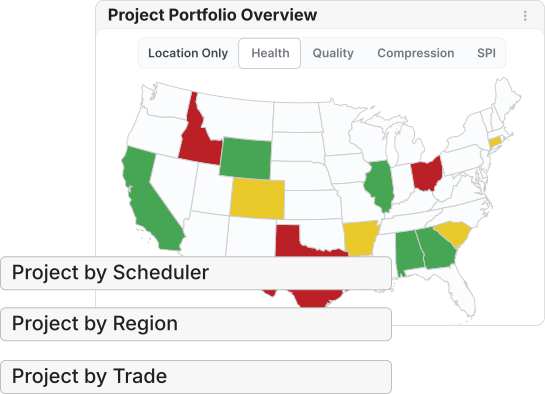
This is exactly where construction schedule analytics changes the game for project controls teams. The difference between identifying a developing delay at week four versus week twelve is a matter of whether the right data is in front of the right people at the right frequency.
Consider Barton Malow Builders, whose Director of Scheduling Tom Carolan noted the shift from lagging to leading indicators after adopting SmartPM:
"Some metrics we looked at in the past were lagging indicators. SmartPM provides leading indicators that give us time to adjust early and with more confidence."
Barton Malow's experience began when their insurance carrier's auditor used SmartPM to analyze their schedule practices and identified areas for improvement. The outcome was a multi-year contract extension and a company-wide rollout.
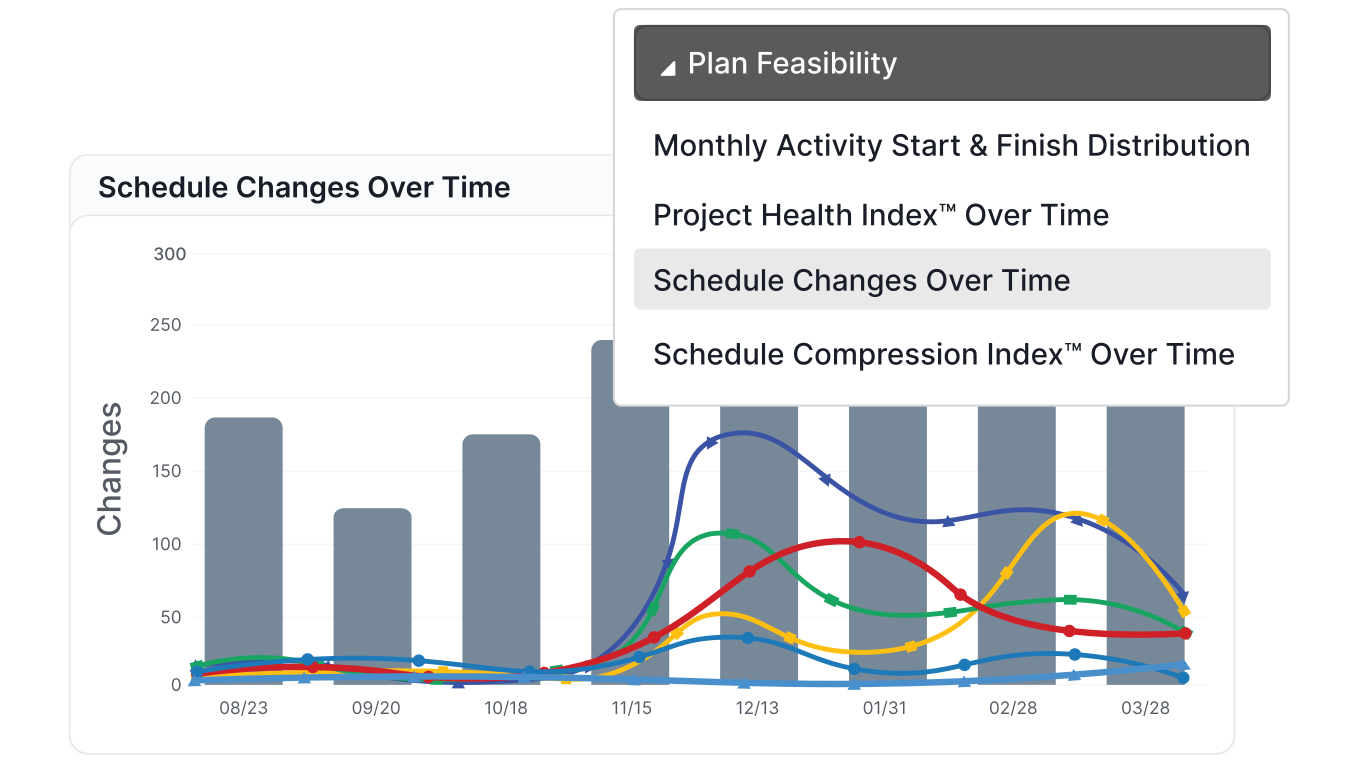
For MCP Group, a mid-market GC, the shift to data-driven project planning produced results that measured in months. According to their CEO:
"Instead of being 2 months behind schedule, now we're 2 months ahead of schedule."
Ready to see what your schedule data is telling you? Book a demo with SmartPM.
Construction delays cluster around a predictable set of causes. Understanding them in advance is the first step to building plans that are resistant to them.
|
Delay Cause |
Why It Happens |
How to Prevent It |
|
Incomplete scope at contract execution |
Scope gaps that surface mid-project generate change orders, each carrying direct cost and schedule impact. Cumulative changes compress the remaining schedule into an unachievable window. |
Invest in a thorough WBS before breaking ground. Define work tasks at a level of detail that can be scheduled, resourced, and tracked. Pressure-test scope completeness during design development. |
|
Poor schedule logic |
When activities are not properly linked, the CPM schedule cannot accurately predict how a single delay cascades to project completion. Poor logic density turns a schedule into a Gantt chart with no real analytical value. |
Require logic review as part of baseline schedule acceptance. Every activity should have at least one predecessor and one successor. Open ends are a red flag. |
|
Late procurement |
Long-lead items ordered late compress the construction sequence. A structural steel delivery that lands four weeks behind plan can eliminate float that looked adequate at baseline. |
Map all long-lead items as predecessor activities in the CPM schedule at pre-construction. Procurement milestones belong in the project schedule. |
|
Optimistic productivity assumptions |
Schedules built on peak crew productivity do not survive contact with the field. Learning curves, site congestion, and weather all reduce actual output below theoretical rates. |
Base duration estimates on historical production data. Build weather contingency directly into the schedule for exterior work and climate-sensitive activities. |
|
Inadequate update frequency |
Monthly schedule updates, the industry norm when analysis is done manually, are too infrequent to catch developing problems in time to act. By the time a monthly update reveals a two-week slip, the project is often three weeks behind. |
Shift to biweekly or weekly updates. When schedule analytics tools automate the analytical work, weekly cadence becomes operationally feasible and moves the team from reporting on what happened to managing what is happening. |
One of the most preventable sources of construction disputes is the gap between what an owner believes is happening on a project and what the general contractor's schedule actually reflects. That gap usually starts as different interpretations of the same data, and it widens every month that the two parties are not looking at the same numbers.
Owners and GCs who agree on schedule quality standards, reporting formats, and update cadence at contract execution eliminate most of the friction that develops later.
|
Alignment Checkpoint |
What to Agree On |
Why It Matters |
|
Baseline schedule acceptance criteria |
Define what constitutes an acceptable baseline: logic density thresholds, maximum activity duration, open end limits, and DCMA compliance requirements. |
A baseline that does not meet quality standards is not a reliable planning tool. Agreeing on criteria upfront prevents disputes over whether the schedule was ever valid. |
|
Schedule update frequency and format |
Establish whether updates will be weekly, biweekly, or monthly, and what data each update must include. |
Inconsistent update cadence is one of the most common sources of owner-GC friction. A shared expectation set at contract execution removes the ambiguity. |
|
Delay documentation and communication |
Define how delays will be identified, documented, and communicated, including the timeline for notification and the format for reporting. |
Undocumented delays become disputed delays. A clear process protects both parties and creates the paper trail needed if a claim surfaces later. |
|
Time Impact Analysis thresholds |
Agree on the threshold at which a formal Time Impact Analysis is required, and what methodology will govern it. |
Without a defined threshold, every change order becomes a negotiation about whether an analysis is even needed. Setting this expectation early keeps the process objective. |
Columbia Ventures experienced this firsthand during a contractor claim. Using SmartPM, their team consolidated a 30-page schedule into half a page of relevant data for negotiation. As their project executive noted, SmartPM "was instrumental in removing emotion in order to let the facts and data dictate negotiation." Owners who specify schedule analytics requirements in their contracts start from a fundamentally stronger position.
The short answer: project planning and execution lose contact with each other.
The longer answer involves the compounding effect of small construction project problems that were visible early but not acted on. A two-day slip in concrete pours compounds: the electricians who were supposed to start rough-in cannot access their work area, the schedule compresses, crews accelerate to recover, and acceleration produces rework.
As detailed in SmartPM's analysis of construction cost overruns, the construction industry's persistent struggle with budget and schedule performance traces back to a failure to use schedule data as a continuous management tool rather than a periodic reporting obligation.
The teams that break this pattern share a common discipline: they know their schedule health score every week. They catch compression before it requires expensive recovery. They have the data to support or refute change order claims objectively. That discipline starts in construction planning and only pays off during execution.
See how SmartPM gives your construction team the visibility to drive better construction planning and execute with confidence. Request a demo today.