

Make Worker Safety Part of the Equation in Schedule Compression
Let’s start off this blog with a sobering truth: While worker safety is always a concern in the construction industry, it may get–shall we say–downplayed on occasion.

Blog
Compression quantifies extra workload, helping gauge whether end dates are feasible without excessive strain on your workforce.

L
et’s face it: delays are inevitable. There are simply too many moving parts involved during any multi-million dollar venture. As a result, frequent schedule changes are the norm.
How you alter your schedule is up to you. Yet, one of the most common delay mitigation strategies is construction schedule compression.
Compressing CPM schedules to mitigate historic impacts can be an effective tactic for keeping projects within their prospective scope. The risk is not compression itself. The risk is untested, excessive, or poorly understood compression that makes the remaining work appear achievable on paper while pushing crews, cost, quality, and safety past realistic limits.
A schedule risk analysis process that runs at every update quantifies exactly how much additional risk each round of compression introduces, giving the team an objective basis for deciding when recovery has pushed the plan past what is achievable.
Schedule compression in construction is the process of shortening a project’s remaining duration without changing the project scope. In CPM schedules, that usually means accelerating critical or near-critical work through crashing, fast tracking, acceleration, or resequencing logic.
The compressed timeline meaning is simple: the same work must be completed in less time. That can help teams recover from delays, but it also increases pressure on resources, coordination, quality, safety, and claims exposure if the plan is not tested.
Schedule compression matters because CPM schedules are used to forecast completion, manage dependencies, evaluate delay, and support project controls. When compression is modeled and measured at each update, teams can distinguish a realistic recovery plan from one that simply shifts risk downstream.
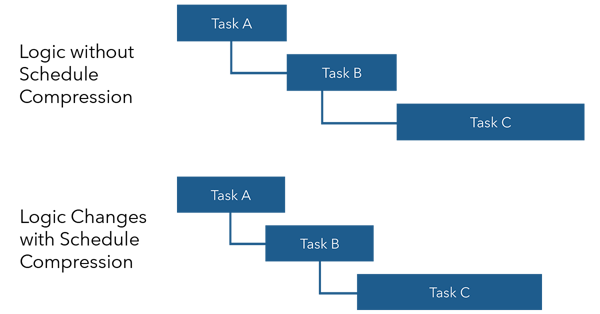
Compression (trade stacking, crashing, acceleration, etc.) occurs when decisions are made to shorten a project’s duration without changing its scope. This means the remaining amount of work needs to be completed in less time than initially planned.
The available schedule compression techniques range from crashing and fast tracking to resequencing logic, and each one redistributes that remaining workload differently across the time that is left. Crashing typically adds resources, overtime, shifts, or crews to shorten critical or near-critical work. Fast tracking overlaps activities that were originally planned in sequence. Resequencing logic changes the planned order or dependency structure of activities to regain time.
Compression is indicative of schedule changes as it typically results from:
While this may seem like an ideal recovery method for common scheduling pitfalls, it is widely misunderstood. Consequently, it should only be used when the level of compression is achievable.
Teams test that by modeling the accelerated sequence in the schedule and comparing the recalculated finish against the current plan before crews get reassigned. That is where schedule compression analysis becomes critical: it quantifies the extra workload baked into the current plan so teams can judge whether the remaining timeline is realistic or already stretched past what crews can deliver.
For more context on how CPM schedules fit into broader planning practices, see SmartPM’s guide to the types of construction schedules.
|
Schedule compression technique |
What it means |
Primary risk introduced |
|
Crashing |
Adding resources, overtime, shifts, or crews to shorten critical or near-critical work. |
Higher labor cost, productivity loss, congestion, and coordination risk. |
|
Fast tracking |
Overlapping activities that were originally planned in sequence. |
Rework, quality issues, safety exposure, and trade stacking. |
|
Resequencing logic |
Changing planned activity order or dependencies to regain time. |
Logic integrity issues, missed constraints, downstream delay, and claims exposure. |
Each technique can shorten duration in a CPM schedule, but each also introduces different risk to cost, quality, safety, and dispute potential. The key is not simply whether the finish date moves earlier. The key is whether the revised plan is buildable.
By analyzing over 45,000 CPM schedules, SmartPM found some interesting data.
With fewer than 12% of schedules meeting their intended progress goals, it makes sense that, on average, more than half of the projects (60%) require schedule crashing to reach their intended goals. However, doing so often leads to an unachievable plan.
Compression quantifies extra workload, helping gauge whether end dates are feasible without excessive strain on your workforce. In that sense, compression is more than a recovery tactic. It is a signal of feasibility.
When compression is at its highest, problems arise. Every delay, be it material delivery or workforce-related, begins to stack up. The schedule tightens, and suddenly, there’s a realization that the project won’t finish on time.
This phase is where most claims originate. Stakeholders start pointing fingers at each other about what went wrong during this period, questioning critical activities, and examining the Time Impact Analyses (TIA) that may have pushed the end date.
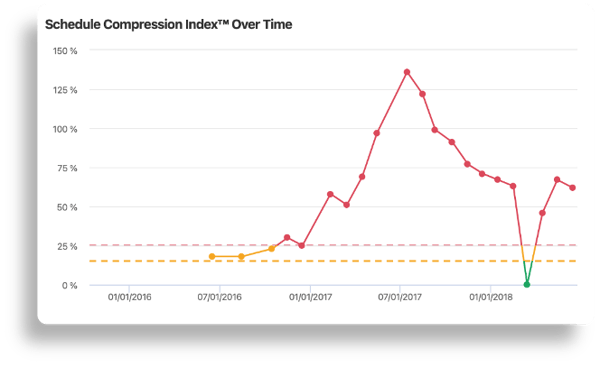
The Schedule Compression Index™ Over Time graphic above displays a fluctuation in compression indexes throughout the project lifecycle. A sharp peak happens around mid-2017, followed by a significant drop and stabilization.
The dramatic rise and subsequent drop in the compression index suggests that extensive changes were made to the schedule, possibly in response to unforeseen challenges or setbacks. Furthermore, a compression index of 125% implies an impractical workload towards the end of the project. With such a high compression rate, the resources and adjustments necessary to stay on track are impractical.
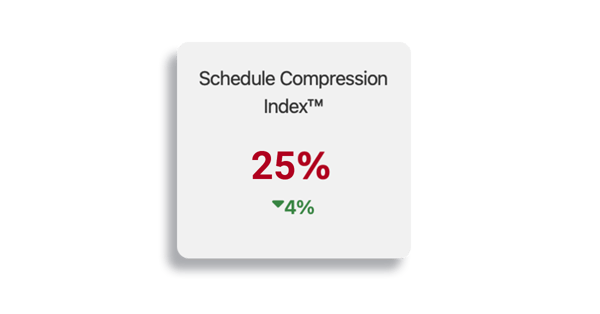
Any compression over 25% is problematic. It denotes an attempt to achieve 25% more work in the remaining project duration. In practical workforce terms, that means the plan is asking the project team to produce materially more work in the same remaining window, often through added hours, added crews, stacked trades, or compressed handoffs.
If this remains unaddressed, the project team might find themselves working extra hours or even weekends to meet the target completion date.
With this in mind, it is crucial for project teams to monitor schedule changes throughout the project to manage time and budgets more effectively. Before executing any changes, evaluate their effects regarding schedule compression and feasibility.
A schedule scenario analysis does exactly that, testing a compressed calendar or a resequenced path against the finish date so the team sees the real cost of acceleration before any crews are committed to it. This step leads to more informed decisions, ensuring the changes won’t negatively impact the project’s timeline, resources, or deliverables.
A schedule compression analysis helps teams determine whether a proposed recovery plan is realistic before it is approved. Use the latest schedule data and evaluate the impact before crews are reassigned or commitments are made.
This type of review should be part of a broader construction project controls process, where schedule, cost, risk, and progress data are evaluated together.
Over-compressing a schedule leads to unrealistic timelines and increases the likelihood of missing critical milestones, potentially compromising project viability. In CPM schedules, excessive compression can also mask logic issues, create misleading float, and make the forecasted finish date appear more achievable than it really is.
High-intensity work periods can lead to burnout, decreasing overall team productivity rather than improving it. Adding crews, shifts, or overtime may seem like a direct path to recovery, but production often suffers when teams are crowded, fatigued, or poorly sequenced.
Accelerating work to meet condensed timelines often results in neglected safety standards and reduced work quality, raising the likelihood of accidents and errors. Trade stacking, rushed handoffs, and overlapping activities can increase exposure when the site is not ready for the added pace.
Trying to accomplish additional work in less time can inadvertently lead to additional delays and costs due to unrealistic expectations and additional resource requirements. If the compressed plan does not reflect actual crew availability, site constraints, or procurement realities, the project may fall further behind.
Heightened schedule compression often leads to unmet deadlines, creating a hotbed for conflicts as stakeholders assign blame for delays. This scenario escalates the likelihood of legal disputes and liability concerns.
Testing schedule adjustments on a copy of the data first reveals whether proposed compression actually shortens the timeline or just redistributes the risk to downstream activities. This is especially important when teams are evaluating delay responsibility, recovery plans, or broader construction risk assessment findings.
Avoiding the wrong compression decisions is just as important as choosing the right technique. Common mistakes include:
These mistakes can make a recovery plan look successful in the schedule while making the actual work harder to execute in the field.
While some project teams are okay with making a massive volume of changes to logic and durations to achieve completion dates, it requires deliberate monitoring so as not to drive projects “off the rails.”
At the end of the day, the higher the compression, the greater the risk. Frankly, it is unrealistic to assume things will happen faster in the future without the same issues from the past arising on a much shorter timeline.
The goal is not to avoid every form of compression. The goal is to measure it, test it, and decide whether the recovery plan is achievable before the project commits to it. Proactive schedule analytics help teams see when recovery is realistic, when it is risky, and when the plan needs to be revised.
Check out our guide to construction risk management to discover effective strategies for identifying, evaluating, and mitigating risks, ensuring safer and more successful building projects.