Project Control Metrics for Construction Executives
Construction projects are a multifaceted endeavor, requiring checks and balances for successful completion.

Blog
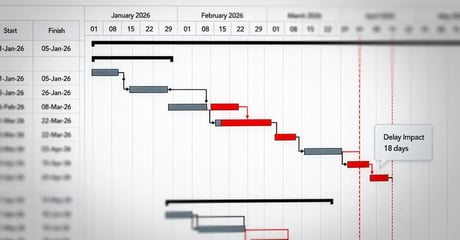
Forensic delay analysis is commonly used in construction to investigate the causes and impacts of delays during the project lifecycle.

Forensic delay analysis is the process of investigating the causes and impacts of schedule delays, using a project's CPM schedule data alongside the record of events and circumstances that contributed to the delay. It determines the root cause of each delay and assigns responsibility for it, usually to resolve a claim or dispute and to prevent similar ones later.
The method works, but it carries a heavy cost. Traditional forensic analysis runs after the fact, which means it tends to arrive with lawyers, consultants, interest, and added management and operational expense attached, the exact figure depending on which technique is used. By the time the analysis is finished, so is the project, and the money is already spent.
Watching for patterns that signal risk before they reach the critical path is the version of the same analysis that still has somewhere to go.
That timing is the core problem. It is also what makes the case that relying on manual, after-the-fact forensic analysis as the primary way to understand delay is an outdated approach. Automated delay analysis closes the gap by running the same root-cause assessment at every schedule update, so teams can see which activities moved the end date while the project is still in progress and there is still time to respond.
A single project can put hundreds, sometimes thousands, of people in motion at once, alongside the materials and equipment they depend on. Architects, engineers, subcontractors, owners, and superintendents all need decisions about where people and resources should go, on top of every other call that fills a normal day. The more decisions that stack up, the more the later ones lean on gut instinct alone, and gut instinct under fatigue tends to produce worse outcomes.
Real-time project insights take some of that load off, narrowing the number of judgment calls a team has to make from memory.
Intuition has its place. Intuitive decisions often run on heuristics, the mental shortcuts that screen out large volumes of information so the brain has less to process. That is reasonable for low-stakes choices. On a multi-million or billion-dollar project, intuition needs to be paired with something more reliable. That something is data.
As the Business Insights blog from Harvard Business School Online notes, intuition can anticipate a sequence of events, but data is what verifies, quantifies, and explains it. The raw material is not the shortage. An estimated 328 million terabytes of data are created every day, yet construction puts little of its own to work.
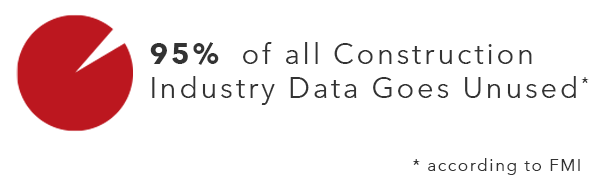
According to FMI, 95% of all construction industry data goes unused. On top of that, roughly 13% of a construction team's time goes to hunting for the right data to keep a project moving, which is a steep price given that the most useful data is real-time data. Teams should not have to sift through piles of numbers, photos, spreadsheets, and emails months or even years after a project closes, and they should not be held responsible for data processes that were never built to serve them.
Role-specific report layouts are a partial fix, at least ensuring the data someone receives is shaped for the decision they own.
Before founding SmartPM, CEO Mike Pink spent his days doing exactly that: poring over schedule files to find data after the project had already finished, late and over budget, in the middle of the resulting claim and dispute process.
Several forensic delay analysis techniques are in common use across the industry. Each one claims to find the root cause of delay, but different methods produce different results, and every method carries its own limitations.
|
Method |
How it works |
Stated limitations |
|
Impacted As-Planned |
Inserts delay events into the original baseline to model their theoretical effect on completion |
Theoretical assumptions make its usefulness questionable; cannot account for changes in activity logic or duration; results rest on hypothetical scenarios; cannot identify actual concurrent delay |
|
Collapsed As-Built (CAB) |
Removes delay events from the as-built schedule to estimate the outcome without them |
Time-consuming; as-built logic is subjective; does not reflect the contractor's contemporaneous intentions; cannot distinguish pacing activities from critical delays; identifies compensable delay periods but not critical paths; requires many subjective assumptions |
|
As-Planned vs. As-Built (APAB) |
Compares the original plan against what actually happened to identify variance |
The as-built sequence must relate to the as-planned sequence for the activity-level variance method; cannot deduce the as-built critical path without monthly progress updates; building a proper as-built program is expensive and resource-intensive |
|
Time Impact Analysis (TIA) |
Inserts a delay fragnet into a contemporaneous schedule update to measure its prospective impact |
Results rest on hypothetical scenarios; cannot identify actual concurrent delay; labor-intensive and technically complex; requires frequently prepared and correctly updated progress schedules; activity start, finish, and float constraints can create gaps in the critical path; logical errors in early updates that were corrected later produce inaccurate results; requires planning expertise |
|
Windows Analysis |
Breaks the project into sequential time windows and analyzes critical-path movement within each |
Not separately detailed in the source material (see note) |
A note on the source: the original material listed Time Impact Analysis limitations under two separate headings and gave no limitations for Windows Analysis. The second TIA block may have been intended for Windows Analysis. The two TIA lists are combined above, and the Windows Analysis row is left open rather than filled with content that cannot be confirmed.
As shown above, any forensic delay analysis technique requires a thorough understanding of project schedule files and the data held within them. More importantly, it requires access to accurate, valid data – meaning, if the schedule files lack well-grounded, rational logic, then the analysis risks being unreliable and not credible.
Stripped of the courtroom framing, the exercise is really root cause analysis run on schedule data, and teams that perform it continuously can act on the finding while the delay is still recoverable.
In Pacific Construction Co. Ltd vs. Greater Vancouver Regional Hospital District1, the British Columbian Supreme Court held that forensic delay analysis requires a valid and reasonable baseline schedule. They found that the contractor’s baseline schedule was inadequate and failed to represent the project’s scope. Therefore, the court used the owner’s design changes to determine the cause of the delay.
Forensic delay analysis is not solving the problem if the industry uses less than 95% of its data and most projects are delayed, rendering it outdated and inefficient because it focuses on investigating the past. And, if parties disagree and do not have the data to perform an objective analysis, the process is dubious, at best.
The most important thing you can do to utilize your data more effectively is to implement a proactive approach to project management, focusing on preventing delays and overruns at the outset.
Luckily, most projects require a CPM schedule to be created and maintained per the contract. CPM schedule files are the only data set in construction that lists all the activities needed to complete a project, from start to finish, while also explaining the interdependencies among those activities.
However, as noted above, the industry struggles with creating and maintaining high-quality schedules. This is an issue as low-quality schedule data is useless. Beginning with a high-quality baseline schedule requires a high level of detail, as a comprehensive plan helps identify potential problems and risks before the project starts.
Those risks are easier to size when you can run what-if scenarios against the baseline, testing what a late permit or a compressed pour sequence would actually cost.
Pairing that baseline with construction project controls is what turns the plan into a live measurement instrument, rather than an artifact that only gets revisited when a dispute forces a forensic look back.
Identifying those risks is only the opening move; risk management in construction also means assigning each one a response and an owner before the schedule is ever updated.
From there, choose a project management software. Many construction companies already leveraging software to assist with schedule management. I recommend choosing one that allows for real-time updates and analysis of project progress so that you receive a comprehensive view of your project’s status, identify potential issues early on, and take the necessary steps to avoid them from happening.
Leveraging a cloud-based project management software has several advantages, such as:
Most importantly, the effective use of schedule data fosters open communication with all project parties. Everyone from the C-suite to the site teams must accurately understand the project. This includes understanding the risks and what the data says for the best results.
An easy way to do this is to present data in formats that are easy to understand. In other words, utilize data visualization.
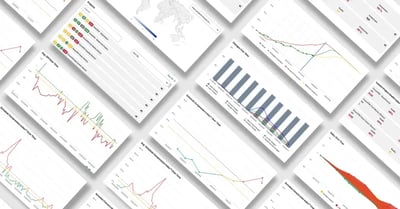
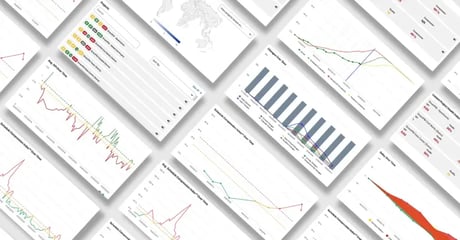
That clarity gets even sharper at a company dashboard view, where executives can compare schedule health, compression, and risk indicators across every active job rather than evaluating one project at a time.
Data visualization is data representation through graphics, such as charts, plots, infographics, and animations. Using visual displays of information assists with communicating complex data relationships. Additionally, you can visualize data-driven insights in a way that is easy to understand.
Data visualization has several benefits, including:
While the benefits of utilizing data are vast, some key risk factors make users wary about leveraging cloud-based software. For one, security issues are top-of-mind for many construction companies. If project data falls into the wrong hands, the consequences might be more substantial than the delays and overruns companies usually experience.
Choosing a vendor whose construction software security posture covers SOC 2 Type II and ISO 27001 reduces those risks materially, since the standards require ongoing audit of how customer data is stored, accessed, and protected.
Another concern is the insights given by utilizing data. The age-old adage, “garbage-in, garbage-out,” attests to this issue. Essentially, the quality of insights is only as good as the quality of data they came from. A prerequisite for generating accurate, valuable data is regularly updating and reviewing the schedule with all involved parties.
Schedule updates are a point of adhesion for many projects. However, leverage software that pinpoints and uses checks and balances to ensure your updates are feasible and trustworthy. Your updates provide instrumental data for risk mitigation, better communication, and harmonious project outcomes.
As noted by Sir Michael Latham in Constructing the Team, risk can be managed, minimized, shared, transferred, or accepted but cannot be ignored. However, utilizing your schedule data identifies and mitigates potential project risks. Using schedule data in this way minimizes the need for forensic delay analysis.
Deciding which of those responses applies to each risk, before the project starts, is the core of proactive risk management, and it is far cheaper than sorting it out in hindsight.
The pattern is hard to ignore. Most of the industry's data goes unused, most projects finish late and over budget, and decision fatigue pushes teams toward gut calls under pressure. A process that can only explain a delay after it has already happened does nothing to change any of that.
Traditional forensic delay analysis has served its purpose. The techniques can identify a cause of delay, but they are subjective, expensive, and applied after the outcome is already set. Running the same root-cause logic continuously, on high-quality schedule data, moves that insight to the point where it can actually change the result.
By using real-time data and clear visualization, construction teams can get ahead of problems instead of litigating them later. The payoff is tighter alignment with the contract and objective decisions that serve every party on the project.
See how SmartPM runs delay analysis at every schedule update, while the project is still in motion: book a demo.